You're staring at your warehouse costs, wondering if plastic pallets1 could save money or just drain your budget. The decision feels overwhelming with countless options and conflicting advice.
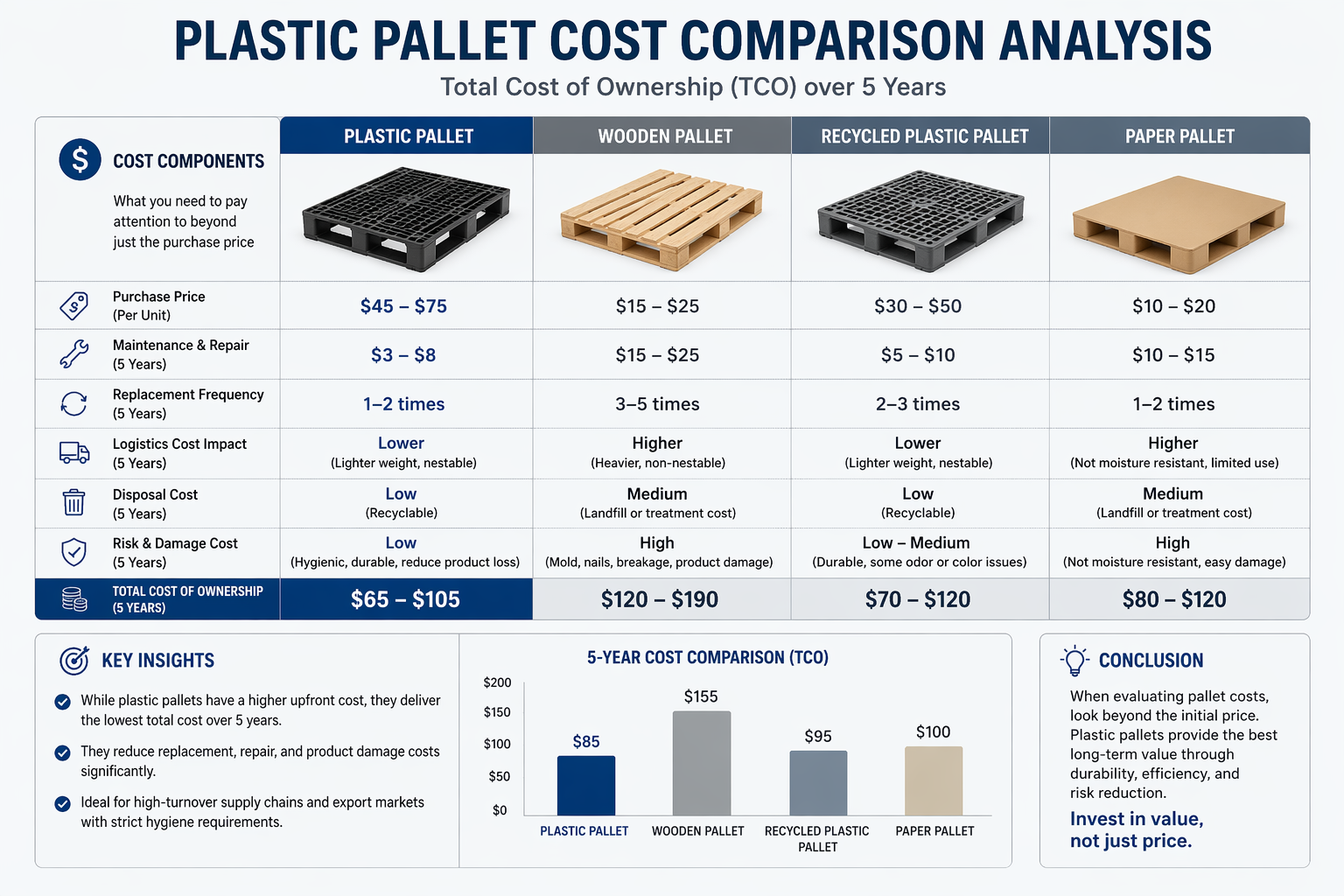
Plastic pallets typically cost 2-3x more upfront than wooden alternatives, but deliver 5-10x longer lifespan in closed-loop operations. For food, pharmaceutical, or export applications, they often provide lower total cost per successful cycle.
I've spent years analyzing procurement decisions across different industries. What I've learned might surprise you - the answer isn't about plastic versus wood. Instead, it's about matching the right pallet type to your specific workflow.
What Makes Plastic Pallets Different from Traditional Options?
Most buyers ask the wrong question first. They want to know HDPE versus PP before defining their actual needs. Unfortunately, this backwards approach costs money.
Plastic pallets excel in four key areas: hygiene control2, dimensional consistency3, export compliance4, and multi-cycle durability5. The material choice matters less than structural design for your specific application.
Four Essential Application Categories
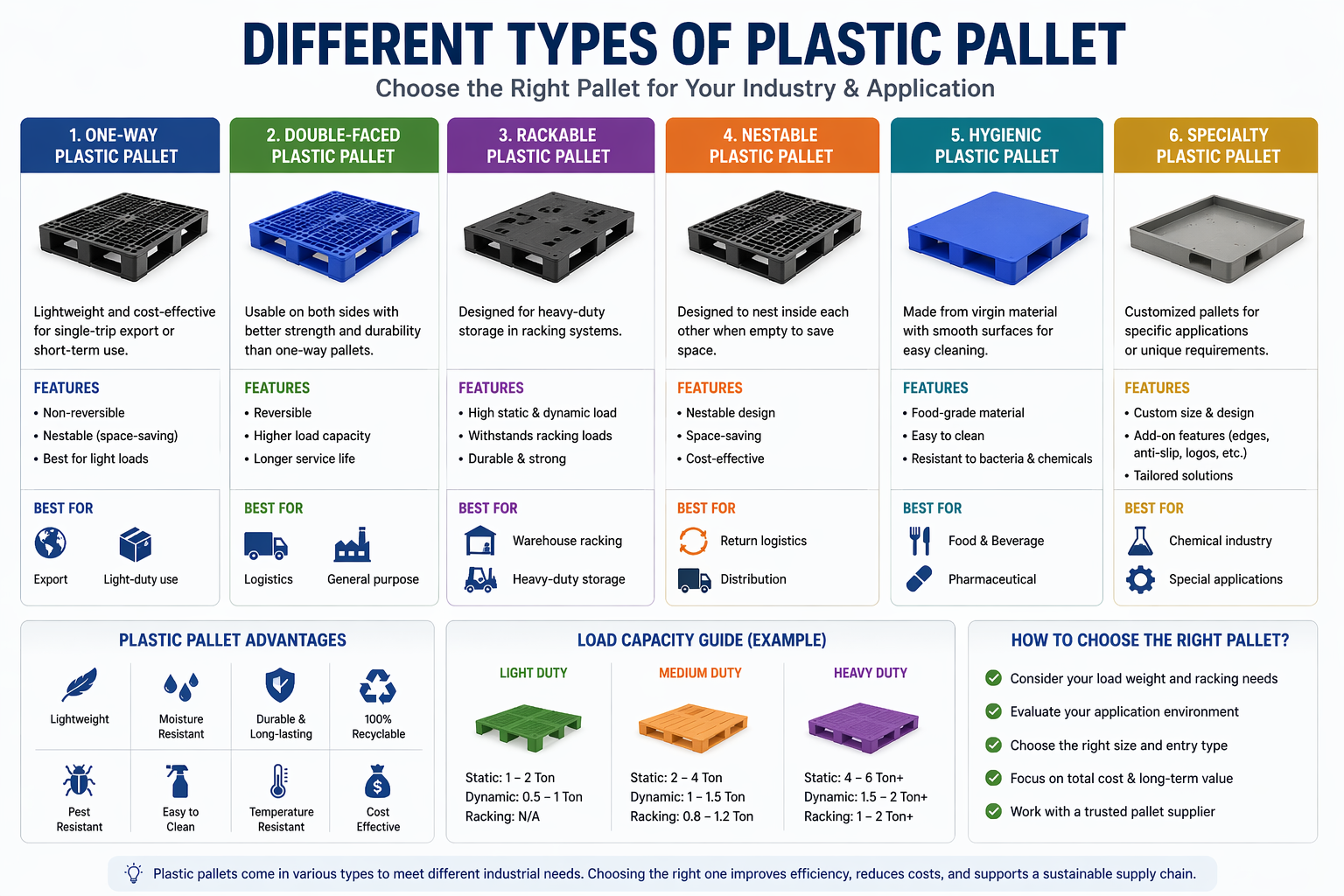
I categorize every project into four buckets: export/one-way shipping, general warehouse stacking, high-rack automation, and food/pharmaceutical clean environments. Each requires different solutions.
For export and retail distribution, I prioritize lightweight nestable designs. These stack efficiently for empty return shipping.
Meanwhile, for high-rack and automated systems, I focus on block-style designs with proven rack load ratings. These offer dimensional stability that automated equipment demands.
In contrast, for direct food contact applications, I specify closed-deck designs with smooth surfaces. These include material compliance documentation essential for regulatory approval.
Understanding Price Differences
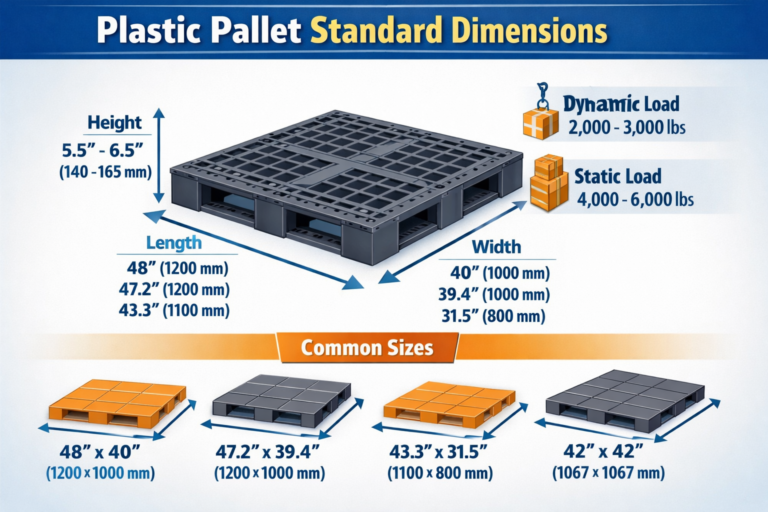
The price difference tells the real story. In public catalogs, economy export plastic pallets1 run about $31 USD for 48×40 size.
However, heavy-duty versions cost around $75 USD. Furthermore, rackable food-grade models reach $135-155 USD. You're not paying extra for the word "plastic" - you're buying structural integrity, hygiene features, testing validation, and consistency.
| Pallet Type | Material | Typical Load Rating | Weight | Expected Cycles | Price Range |
|---|---|---|---|---|---|
| Lightweight Nestable | PP/Recycled | 2-5 tons static | 4-15 kg | 10-60 cycles | $10-35 USD |
| Standard Stackable | PP/HDPE | 3-8 tons static | 8-20 kg | 30-150 cycles | $25-80 USD |
| Heavy-Duty Block | HDPE | 5-15 tons static | 17-25 kg | 50-200+ cycles | $50-105 USD |
| Hygienic Food-Grade | Virgin HDPE | 3-7 tons static | 14-25 kg | 50-200+ cycles | $55-105 USD |
How Do You Calculate True Pallet Costs Beyond Purchase Price?
Everyone focuses on sticker price. Unfortunately, that's the wrong metric entirely. Instead, I use a different formula that reveals the real economics.
True pallet cost equals (purchase price minus salvage value) divided by successful cycles, plus cleaning, inspection, damage, return shipping, and compliance costs per cycle.
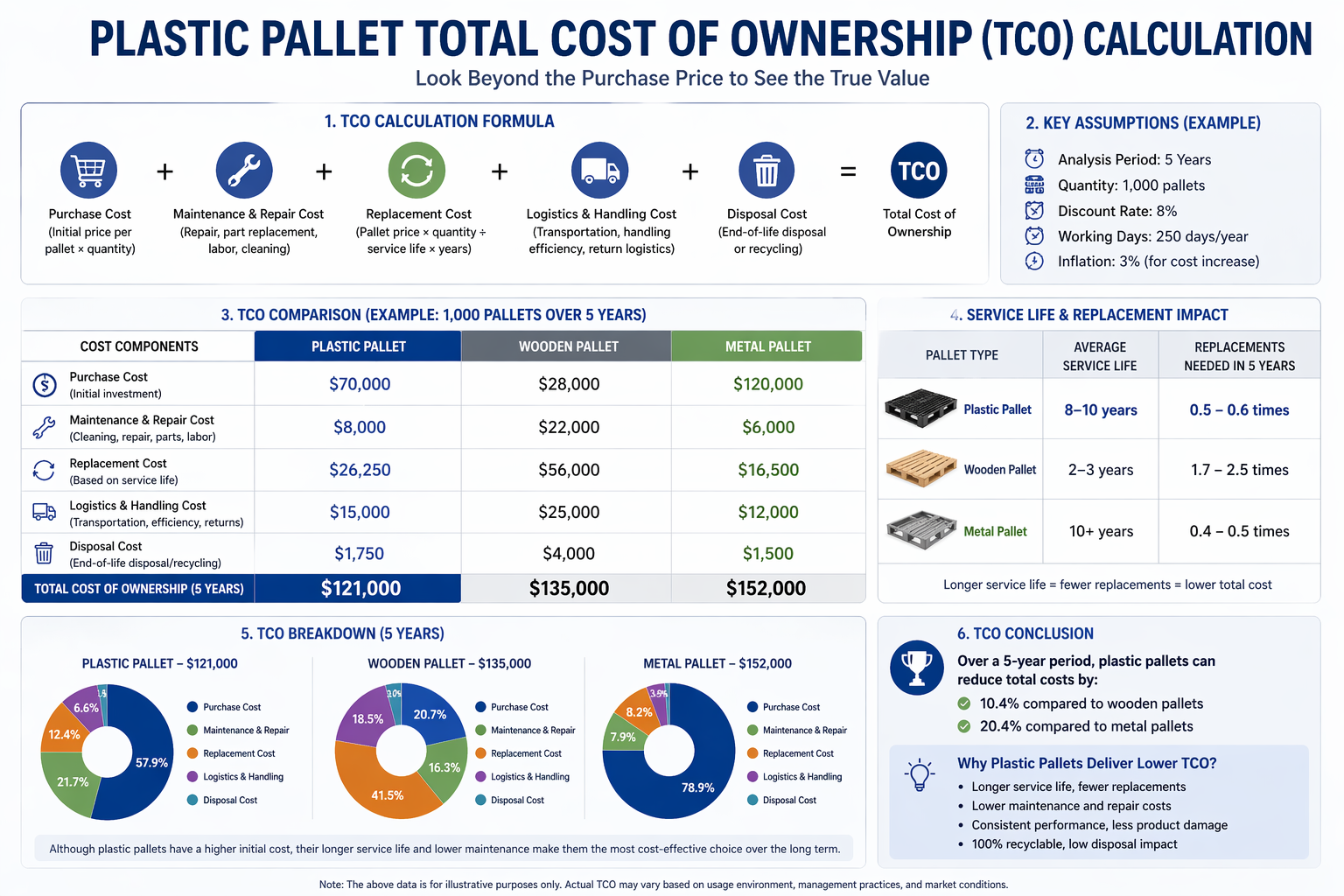
Real-World Cost Comparison Example
Let me show you a real example. Take a closed-loop warehouse operation with ambient temperature, packaged goods, occasional racking. I'll use USD pricing to match public catalog rates.
A mid-range PP pallet costs $45 upfront with $4 salvage value and delivers 50 successful cycles. Additionally, add $0.32 per cycle for cleaning, inspection, and damage. Your cost per cycle: $1.14.
In comparison, consider a heavy-duty HDPE pallet at $75 upfront with $8 salvage value but 150 successful cycles. Moreover, add $0.21 per cycle for maintenance costs. Your cost per cycle: $0.66.
Breakeven Analysis Results
The heavy-duty option costs nearly double upfront but delivers 40% lower operating costs. The breakeven point sits around 72 successful cycles.
Below that threshold, the economy option wins. Above it, the premium option dominates.
This analysis changes everything about procurement strategy. Variables that matter most: actual cycle count, return shipping density, cleaning requirements, and end-of-life value.
Variables that matter least: material brand names and marketing terminology.
Which Industries Benefit Most from Plastic Pallet Investment?
I've tracked adoption patterns across sectors. Four industries show clear advantages, while others should proceed more carefully.
Food/pharmaceutical, automated warehousing, export operations, and cold storage applications typically achieve fastest ROI with plastic pallets due to hygiene requirements, dimensional precision, and regulatory compliance.
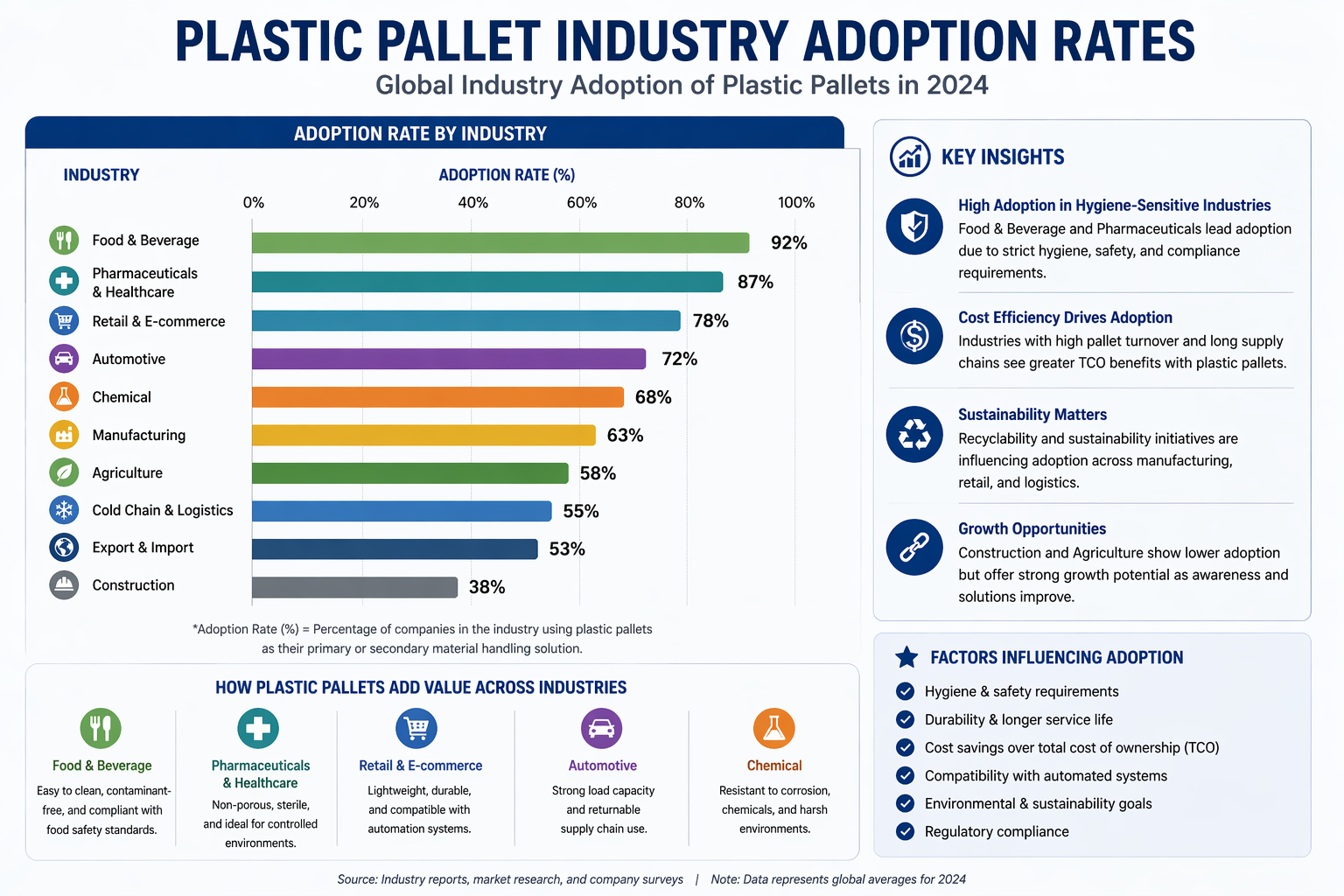
Food and Pharmaceutical Operations
Food and pharmaceutical operations need documentation trails, cleanable surfaces, and contamination control. Wooden pallets harbor bacteria in grain structure and splinter over time.
In contrast, plastic pallets offer closed surfaces, chemical resistance, and material traceability. FDA compliance6 requires specific resin formulations and additive systems.
Similarly, EU regulations demand Declaration of Compliance documents and Good Manufacturing Practice adherence.
Automated Warehouse Systems
Automated warehouses depend on dimensional consistency3. Conveyor systems, AS/RS equipment, and robotic handling need pallets that maintain size tolerances cycle after cycle.
Wood pallets warp, split, and lose nails. Conversely, plastic pallets hold dimensional stability through hundreds of cycles. This prevents equipment jams, reduces maintenance downtime, and protects stored products.
Export and International Trade
Export operations benefit from ISPM15 exemption7. International Plant Protection Convention standards require heat treatment or fumigation for wooden packaging materials.
Fortunately, plastic pallets bypass these requirements entirely, simplifying customs clearance and reducing shipping delays.
Cold Storage Applications
Cold storage applications expose material limitations quickly. Wood pallets absorb moisture, develop ice formation, and deteriorate in freeze-thaw cycles.
On the other hand, plastic pallets resist moisture absorption and thermal cycling damage. This extends service life significantly in refrigerated environments.
Industries Where Wood May Still Win
Construction, raw materials, and single-use applications often favor wood pallets for cost reasons. Unless hygiene, precision, or compliance drives the decision, wood pallets may deliver better value in these sectors.
What Compliance Requirements Apply to Plastic Pallet Selection?
Regulations vary dramatically by application. I break compliance into four layers: dimensional standards8, performance testing9, food contact rules10, and export requirements.
ISO 8611 and GB/T standards govern testing methods and load ratings. FDA 21 CFR covers food contact materials. EU Regulation 10/2011 specifies plastic compliance. ISMP15 exempts plastic pallets1 from wood treatment requirements.
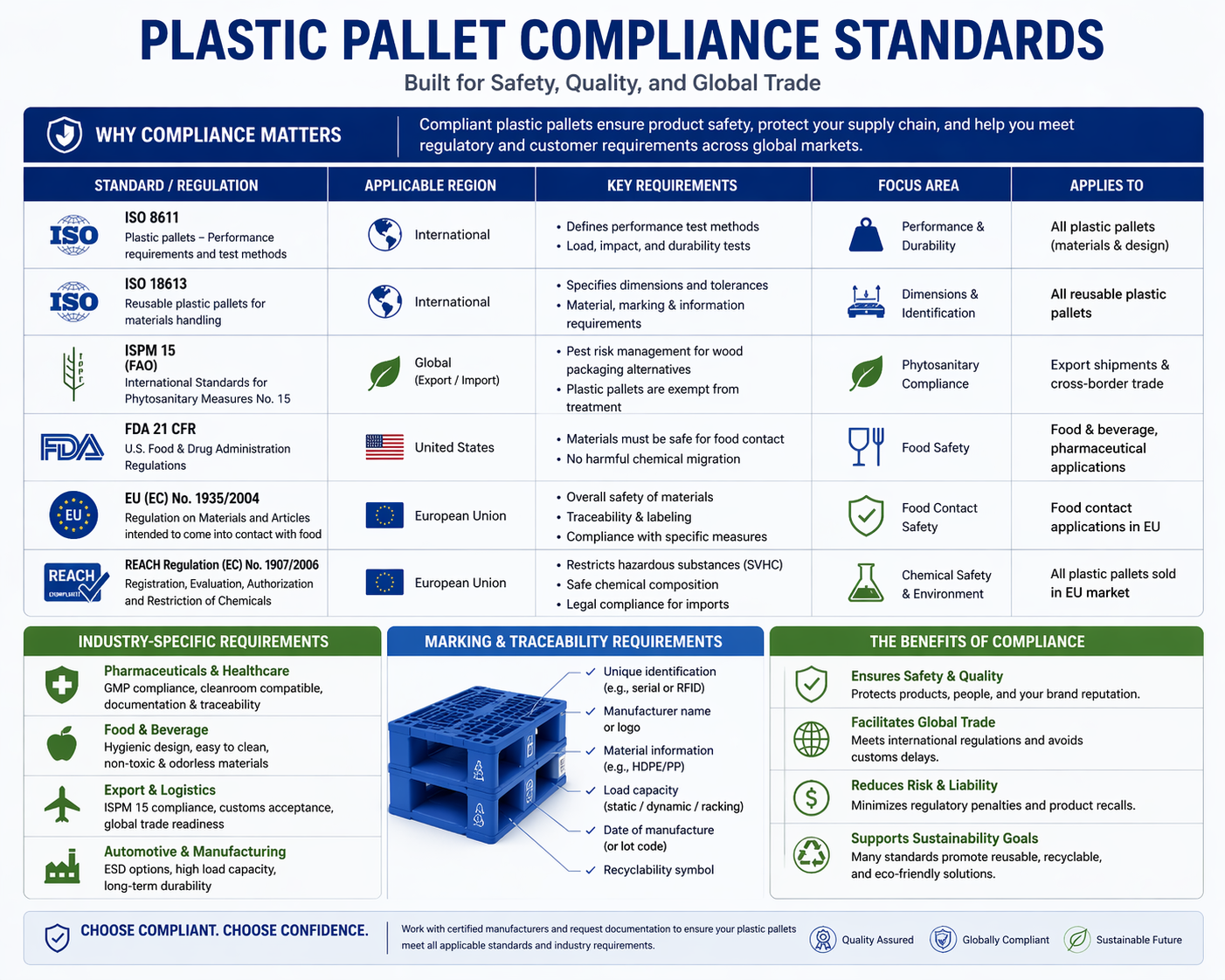
International Dimensional Standards
Dimensional and performance standards provide the foundation. ISO 6780 establishes size tolerances.
Additionally, ISO 8611-1:2025 defines testing protocols. ISO 8611-2:2025 specifies load rating procedures.
Furthermore, China's new GB/T 15234-2025 standard aligns with international practices while addressing local market needs.
Food Contact Regulations
Food contact regulations get complex quickly. For indirect contact (packaging between pallet and food), requirements stay relatively simple.
However, for direct contact applications, you need specific resin approvals, additive limitations, and migration testing. FDA 21 CFR 177.1520 covers polyolefin applications.
Similarly, EU Regulation 10/2011 requires Declaration of Compliance documents and supporting migration data.
European Packaging Requirements
European packaging regulations add another layer. PPWR 2025/40 took effect February 2025 with general application starting August 2026.
This doesn't require immediate pallet replacement but does demand recycled content documentation11, reusability design evidence, and end-of-life planning.
Export Compliance Simplification
Export compliance stays straightforward for plastic pallets1. ISPM15 wood treatment requirements don't apply to plastic materials.
However, mixed packaging with wood components still triggers treatment obligations. Smart buyers specify "plastic pallet with ISPM15 exemption7" in shipping documents while checking for wooden accessories separately.
Essential Compliance Document Checklist
The compliance document checklist I use includes:
- Specification sheets with test conditions and load ratings
- Material composition statements with resin and additive details
- Declaration of Compliance for food contact applications
- Good Manufacturing Practice certifications for pharmaceutical use
- Batch traceability systems for quality control12
- End-of-life recycling documentation for sustainability reportin13
How Do You Choose Between HDPE and PP Materials?
Material selection comes after you define structure requirements. Unfortunately, too many buyers reverse this order and pay the price later.
HDPE offers superior chemical resistance, temperature stability, and food-grade options. PP provides better impact resistance, lower weight, and cost efficiency for moderate-duty applications.
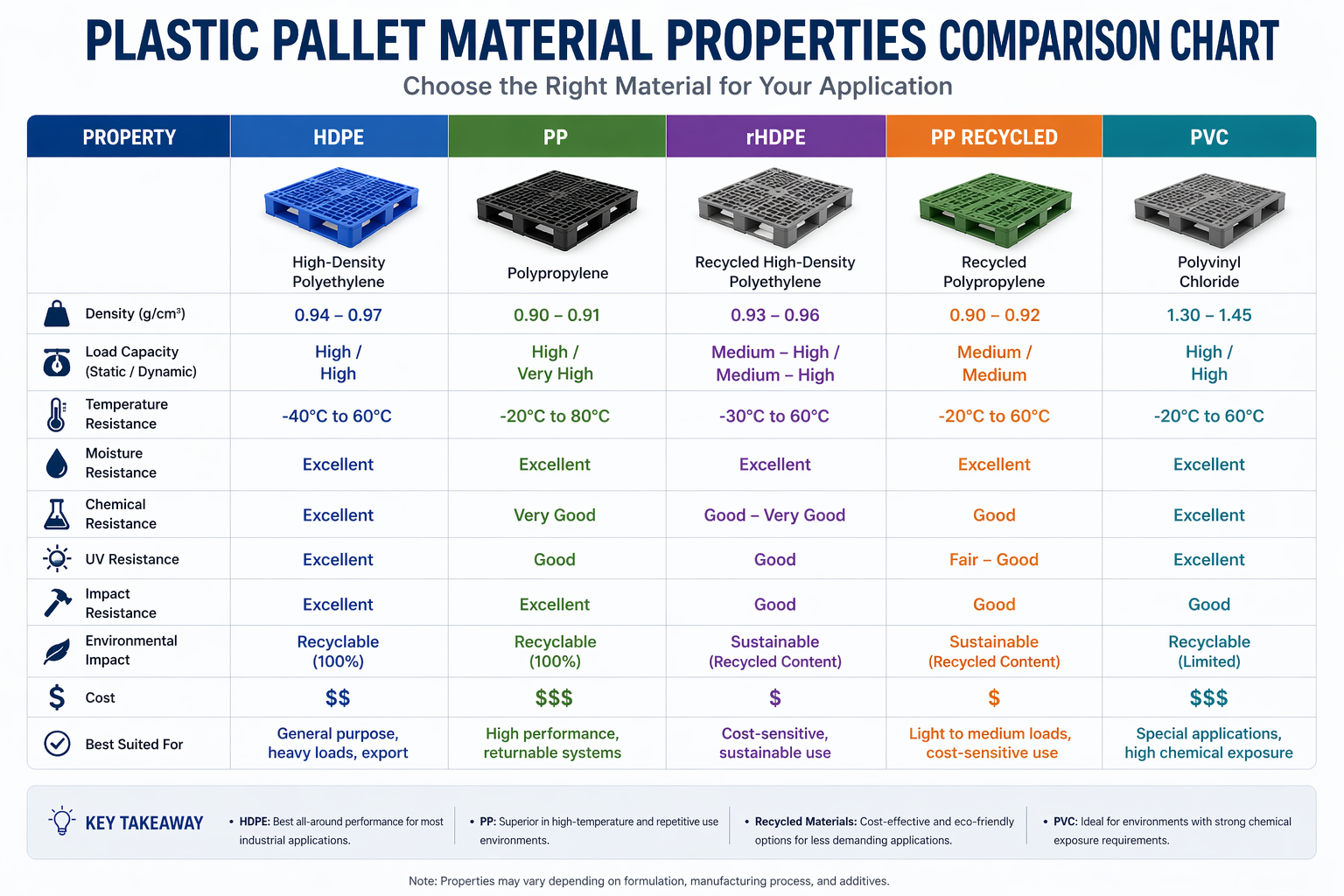
HDPE Advantages for Harsh Environments
HDPE pallets dominate in harsh environments. Chemical resistance matters in pharmaceutical, food processing, and cleaning operations.
Additionally, temperature stability helps in cold storage and heated warehouse applications. Most food-grade formulations use HDPE base resins with controlled additive packages.
However, the trade-off includes higher weight and material costs.
PP Benefits for Impact Resistance
PP pallets excel in impact resistance and weight optimization. Copolymer PP formulations handle repeated drops and impacts better than HDPE.
Furthermore, lower density reduces shipping costs and manual handling effort. Injection molding efficiency often favors PP for complex designs.
Nevertheless, the limitation includes more temperature sensitivity and fewer food-grade options.
Recycled Content Considerations
Recycled content pallets deserve separate consideration. Both recycled PE and PP materials can deliver excellent performance when properly processed and tested.
The key questions include: source material quality, contamination control, and performance validation. Don't assume recycled means inferior - many recycled plastic pallets1 outperform virgin wood alternatives.
Decision-Making Process
I recommend this decision sequence:
First, define your load requirements14, environmental conditions15, and compliance needs.
Second, evaluate suppliers' actual test data rather than material marketing claims.
Third, request samples for real-world validation in your specific application.
Finally, negotiate recycled content and end-of-life terms based on actual project requirements.
The material choice impacts long-term performance more than initial cost. HDPE typically delivers longer service life in demanding applications.
In contrast, PP often provides better value in moderate-duty, cost-sensitive applications. Recycled materials offer sustainability benefits when properly specified and validated.
Conclusion
Plastic pallets deliver value when properly matched to application requirements, not when purchased based on material preferences or lowest initial price.
My Role
I help businesses navigate complex procurement decisions by analyzing total cost impact rather than focusing on upfront prices. My approach emphasizes matching products to actual workflow requirements while building sustainable supplier relationships16.
About Euro Plastic Pallet
Euro Plastic Pallet is a plastic pallet manufacturer with over 20 years of production experience, headquartered in China. We provide high-quality, customized plastic pallet solutions for brand owners, wholesalers, and distributors.
With 60+ injection/rotational molding machines, each staffed with quality control12 personnel having 5+ years of experience, we ensure consistent product quality.
Services
- Products: Complete plastic pallet solutions
- Customization: Custom colors, logos, and molds
- International Certifications: ISO 9001, CE, REACH, ROHS, SGS, FDA, GRS
Quality Assurance
- Raw Material Testing: Complies with RoHS, REACH standards, meeting international strength and performance requirements
- Precision Manufacturing: Automated injection molding, precision assembly, accuracy ±0.1mm
- Comprehensive Inspection: 100% factory testing, ISO 9001 sampling protocols ensuring high standards
- Certifications: ISO 9001, CE, REACH, ROHS, SGS, FDA standards compliance
Production Capacity
- High-Quality Manufacturing: 60+ injection/rotational molding machines following ISO 9001
- Premium Customization: Customized solutions for global brands
- Flexible Solutions: Customer-specific customization17 enhancing market competitiveness
Global Impact
Serving global customers with reliable plastic pallets1 and customized logistics packaging solutions18, supporting business growth and customer trust.
Explore the advantages of plastic pallets for cost savings and efficiency in various industries. ↩
Learn about the importance of hygiene control in pallet selection, especially for food and pharmaceutical industries. ↩
Understand how dimensional consistency affects warehouse operations and equipment efficiency. ↩
Discover the compliance requirements for exporting goods and how plastic pallets simplify the process. ↩
Find out how multi-cycle durability can lead to cost savings and improved logistics. ↩
Explore the FDA regulations that affect the use of plastic pallets in food and pharmaceutical applications. ↩
Find out how the ISPM15 exemption benefits businesses using plastic pallets for export. ↩
Learn about the standards that govern pallet dimensions and their importance in logistics. ↩
Understand the significance of performance testing in ensuring pallet reliability and safety. ↩
Discover the regulations surrounding food contact materials and how they apply to pallets. ↩
Learn about the importance of recycled content documentation in sustainability reporting. ↩
Understand the quality control measures that ensure high standards in pallet production. ↩
Learn about the role of sustainability reporting in promoting eco-friendly practices in pallet production. ↩
Get guidance on assessing load requirements to choose the right pallet for your needs. ↩
Explore how different environmental conditions influence the choice of pallet materials. ↩
Discover strategies for developing strong supplier relationships for better procurement outcomes. ↩
Learn about the various customization options for plastic pallets to meet specific business needs. ↩
Discover how customized logistics packaging can enhance efficiency and reduce costs. ↩