I have seen buyers order the right pallet size for the wrong warehouse, truck, or market. The result can be wasted space, handling problems, or a costly pallet change.
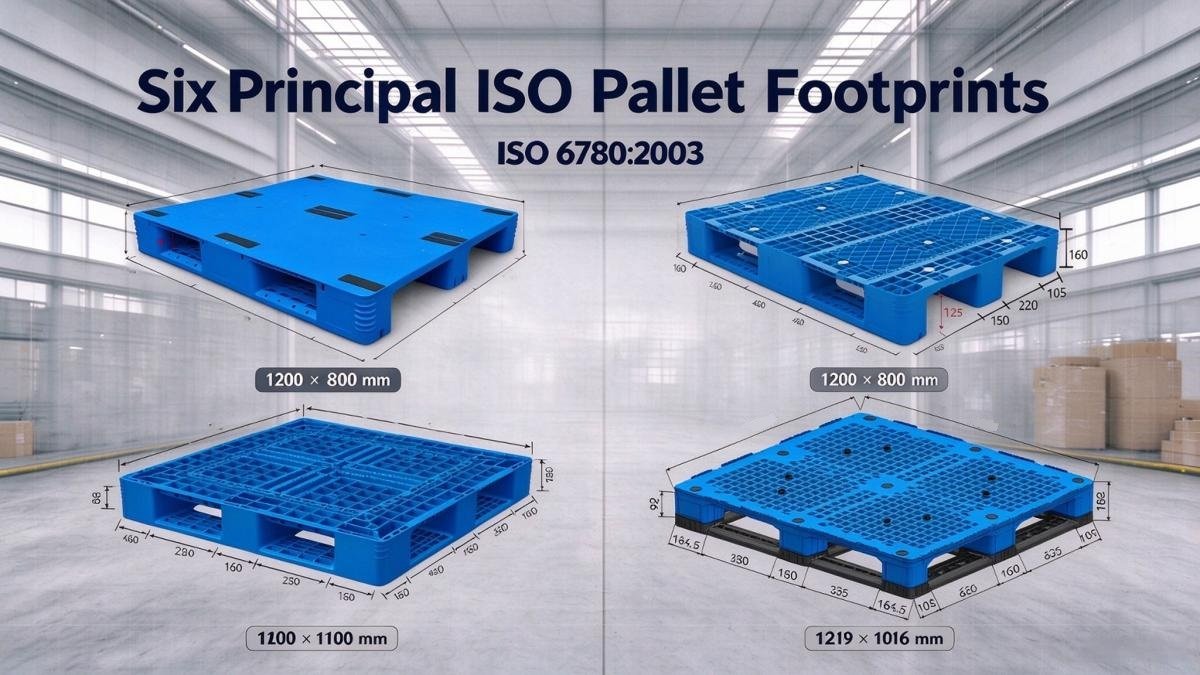
ISO pallet dimensions refer to six main flat pallet sizes recognized by ISO 6780: 1200 × 800, 1200 × 1000, 1219 × 1016, 1067 × 1067, 1100 × 1100, and 1140 × 1140 mm. The standard also covers dimensional tolerances and related handling clearances.
If I were choosing a pallet for an international supply chain, I would not start with the word “ISO” alone. I would first look at the pallet size, then the load, handling equipment, warehouse system, and transport route. That is where the real selection starts.
What Are ISO Pallet Dimensions and What Does ISO 6780 Cover?
I often see buyers treat “ISO pallet” as one fixed pallet size. That can cause confusion because ISO recognizes several main pallet dimensions rather than one universal size.
ISO 6780 covers principal dimensions and tolerances for flat pallets used in intercontinental materials handling. It covers more than length and width. It also addresses related clearances and dimensional features that affect pallet handling.
What does ISO 6780 actually cover?
When I explain ISO 6780 to a buyer, I describe it as a common dimensional framework for pallets. It is not simply a list of six numbers.
The standard covers flat pallets made from different materials, including plastic and wood. It considers different pallet constructions and handling arrangements. The areas include plan dimensions, dimensional tolerances, vertical entry clearances, horizontal clearances, bottom-deck features, bearing surfaces, diagonal distortion, and flatness.
This matters because a pallet has to work as part of a handling system. A pallet can have the correct length and width and still create problems if the openings do not work with a pallet truck or forklift. Buyers can therefore compare different plastic pallet solutions based on their handling and warehouse requirements. I have seen this issue in real purchasing discussions. A buyer may focus on a 1200 × 1000 mm footprint, but the warehouse team may care more about how the forks enter the pallet.
I also separate ISO 6780 from ISO 8611. ISO 6780 mainly deals with dimensions and related requirements. ISO 8611 deals with pallet testing methods. I would not use ISO 6780 alone to claim that a pallet has a specific load capacity.
Does an ISO size mean ISO certification?
No. I think this distinction is important for anyone buying plastic pallets.
When a supplier says that a pallet is an “ISO size,” the statement may only describe its footprint. A 1200 × 800 mm plastic pallet can have an ISO-recognized footprint, but that does not automatically make it an EPAL pallet or mean that the pallet has some general “ISO certification.”
I always ask buyers to separate three questions:
| Question | What I check |
|---|---|
| What is the pallet size? | Length and width |
| What standard applies? | ISO, regional, customer, or industry requirement |
| What performance is required? | Load, racking, handling, temperature, and application |
This simple distinction prevents many misunderstandings.
Why do standard pallet dimensions matter?
Standard dimensions help different parts of a supply chain work together. Trucks, containers, forklifts, pallet trucks, racks, conveyors, and storage areas all have physical limits.
If I change the pallet footprint, I may also change how much cargo fits in a truck or container. I may change how a conveyor handles the pallet. I may even need a different rack configuration.
That is why I see pallet dimensions as a logistics decision, not just a product specification.
What Are the Six ISO Standard Pallet Dimensions?
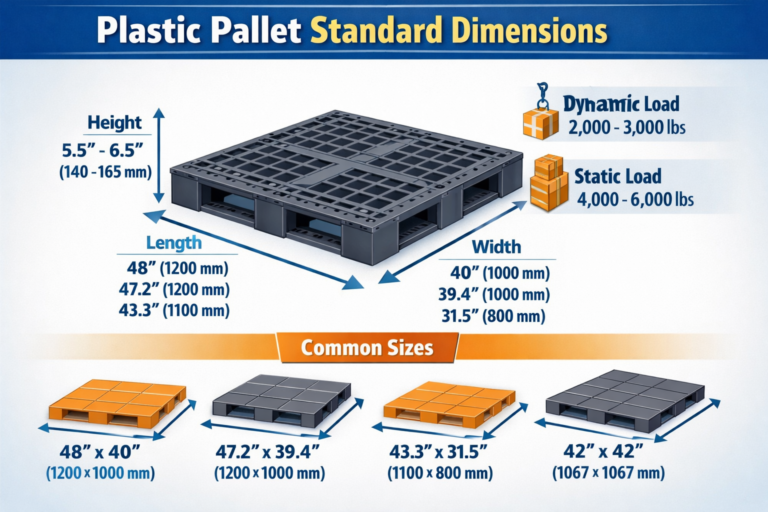
The easiest way for me to understand the ISO pallet system is to put the six main sizes in one table. I can then compare the metric and inch dimensions before looking at regional use.
The six main ISO pallet dimensions are 1200 × 800 mm, 1200 × 1000 mm, 1219 × 1016 mm, 1067 × 1067 mm, 1100 × 1100 mm, and 1140 × 1140 mm.
| ISO pallet size | Approx. size in inches | Shape | Common market association |
|---|---|---|---|
| 1200 × 800 mm | 47.2 × 31.5 in | Rectangular | Europe |
| 1200 × 1000 mm | 47.2 × 39.4 in | Rectangular | Europe, Asia, industrial logistics |
| 1219 × 1016 mm | 48 × 40 in | Rectangular | North America |
| 1067 × 1067 mm | 42 × 42 in | Square | Multiple markets |
| 1100 × 1100 mm | 43.3 × 43.3 in | Square | Asia-Pacific |
| 1140 × 1140 mm | 44.9 × 44.9 in | Square | Multiple markets |
I would use the regional information as a guide, not as a strict rule. ISO dimensions do not mean that one region can only use one size. A company can use a different pallet footprint when its products, equipment, customers, or transport system require it.
I also would not add every regional pallet size to this table and call it an ISO size. For example, 1165 × 1165 mm is used in Australia, but it should not be presented as one of the six main ISO 6780 dimensions.
How Do the Six ISO Pallet Sizes Differ?
The six dimensions look simple on paper, but I would not treat them as interchangeable. Each footprint creates a different relationship between the cargo, handling equipment, and transport space.
The 1200 × 800 mm size is strongly associated with European logistics, 1200 × 1000 mm is common in industrial applications, 1219 × 1016 mm is the 48 × 40 in North American footprint, and the three square sizes serve different regional and logistics needs.
1200 × 800 mm: Why is this size common in Europe?
When I hear 1200 × 800 mm, I usually think of the European pallet market first. This footprint is widely associated with the Euro pallet format.
There is an important difference, though. A 1200 × 800 mm footprint does not automatically make a pallet an EPAL Euro pallet.
EPAL manages its own pallet system with specific requirements for dimensions, construction, markings, and other features. A plastic pallet can use the same 1200 × 800 mm footprint pallet without being an EPAL pallet.
For buyers, I would therefore ask whether the customer needs only the footprint or needs a specific Euro pallet system.
1200 × 1000 mm: When does this size make sense?
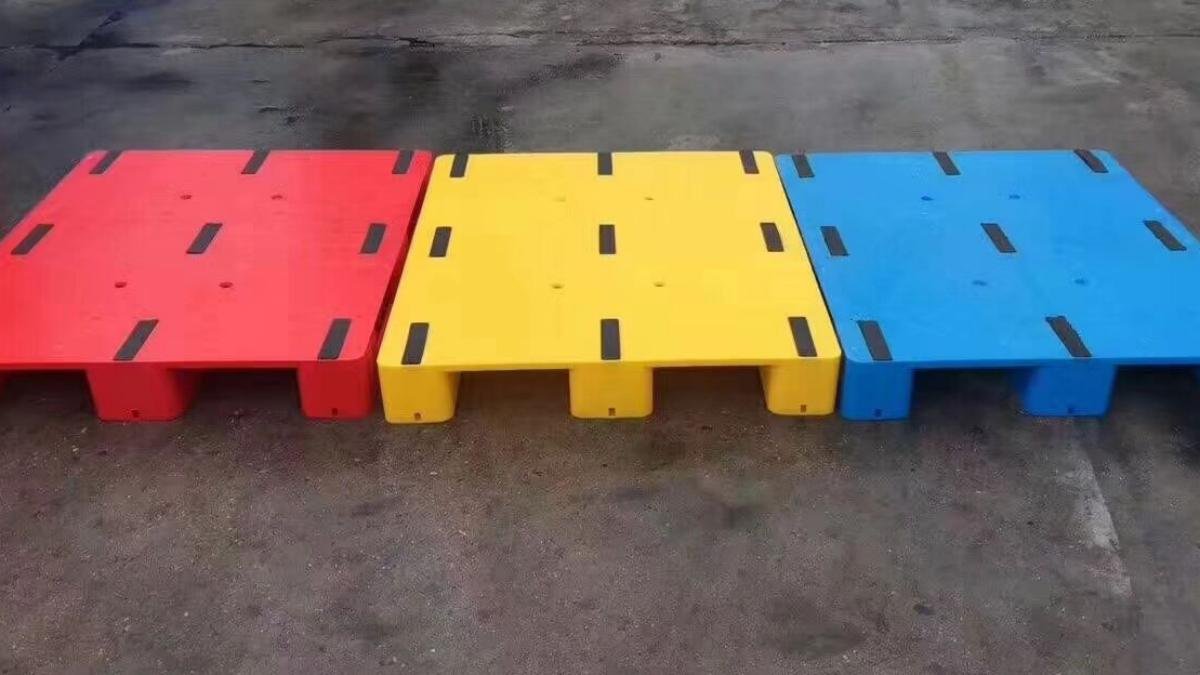
I often see 1200 × 1000 mm plastic pallets used for industrial and international logistics. It gives more deck area than 1200 × 800 mm, which can be useful for larger cartons, bags, drums, and industrial loads.
I would not call it a “European-only” pallet. Its use can extend across different markets.
Buyers comparing standard plastic pallet sizes should first match the pallet footprint with their product dimensions and warehouse layout. The important point is to check the product footprint before choosing it. A larger pallet does not automatically mean better space use. If the cartons are small and the warehouse is designed around another footprint, the extra deck area may not provide a practical benefit.
1219 × 1016 mm: Why is 48 × 40 in important?
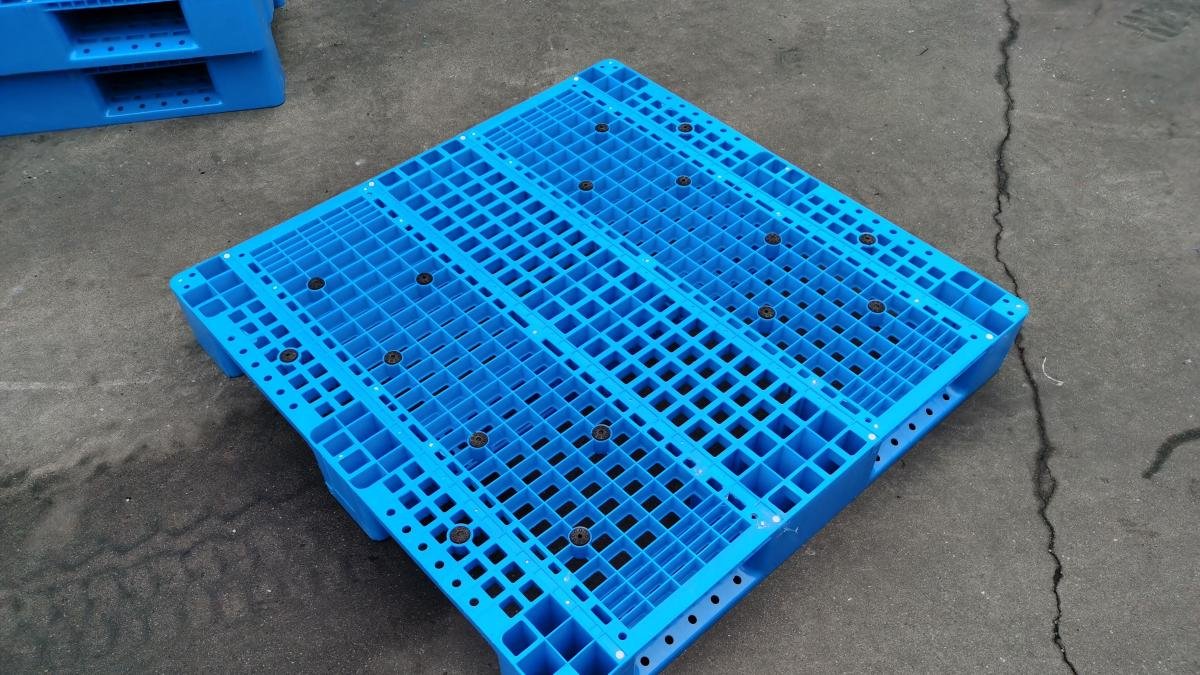
This is the metric equivalent of the familiar 48 × 40 in pallet.
For North American buyers, I would normally use both expressions because purchasing teams may search by either measurement. The 48 × 40 in format is much more natural in many US logistics conversations, while 1219 × 1016 mm gives the exact metric dimensions.
I would not describe this as the only American pallet size. It is one important standardized footprint within a much larger pallet market.
What about the three square ISO pallet sizes?
The square dimensions are:
- 1067 × 1067 mm
- 1100 × 1100 mm
- 1140 × 1140 mm
I would look at these sizes based on the product and distribution system rather than assuming that all square pallets serve the same purpose.
The 1100 × 1100 mm size is especially relevant when I am discussing Asia-Pacific logistics. The 1067 × 1067 mm and 1140 × 1140 mm sizes can also make sense in systems designed around those footprints.
The key point is simple: I would always check the customer's existing pallet system before treating an ISO size as the default choice.
Are ISO Pallet Dimensions Only About Length and Width?
If I only compare length and width, I can miss some of the most important pallet requirements. A pallet is a three-dimensional handling tool, and its bottom structure can be just as important as its footprint.
ISO pallet requirements also address dimensional tolerances and handling clearances. For a plastic pallet, I would check the footprint, entry openings, bottom structure, flatness, and compatibility with the actual handling equipment.
Plastic pallet forklift and pallet jack entry clearance
What dimensional tolerance should I consider?
ISO 6780 gives a plan dimension tolerance of +3 / -6 mm for the principal pallet dimensions. I would not expect every pallet to measure exactly 1200.000 × 800.000 mm in actual production.
The standard also specifies conditions for measurement. For plastic pallets, temperature can matter because plastic can expand or contract with changes in temperature. ISO 6780 specifies measurement at 23 ± 2°C.
For a normal warehouse, a small dimensional difference may not create a problem. For an automated system, I would take the tolerance more seriously because equipment can have tighter operating limits.
Why do forklift and pallet truck clearances matter?
I have learned that the bottom of the pallet deserves as much attention as the top.
Pallet trucks need enough vertical and horizontal space to enter the pallet. Forklifts also need suitable entry openings. If the pallet has a different bottom structure from what the equipment expects, the correct footprint will not solve the handling problem.
ISO 6780 includes different vertical entry clearance requirements for pallet truck profiles. The values include 100 mm for high-profile pallets, 95 mm for standard-profile pallets, and 89 mm for low-profile pallets. Forklift entry requirements also need to be checked against the actual equipment and operating environment.
Why does automation need more than an ISO footprint?
I pay even more attention to the bottom deck when the customer uses automation.
An AS/RS, conveyor, shuttle, or automated pallet handling system may care about:
- Overall length and width
- Dimensional tolerance
- Flatness
- Bottom-deck design
- Entry openings
- Pallet weight
- Load capacity
- Racking conditions
- Conveyor support points
A 1200 × 1000 mm pallet is not automatically compatible with every 1200 × 1000 mm warehouse.
That is why I always recommend that buyers provide the equipment requirements to the pallet manufacturer before placing a large order.
How Should I Choose the Right ISO Pallet Size?
I would never choose an ISO pallet based only on the country where the pallet will be used. I would look at the whole logistics chain from the product to the final handling system.
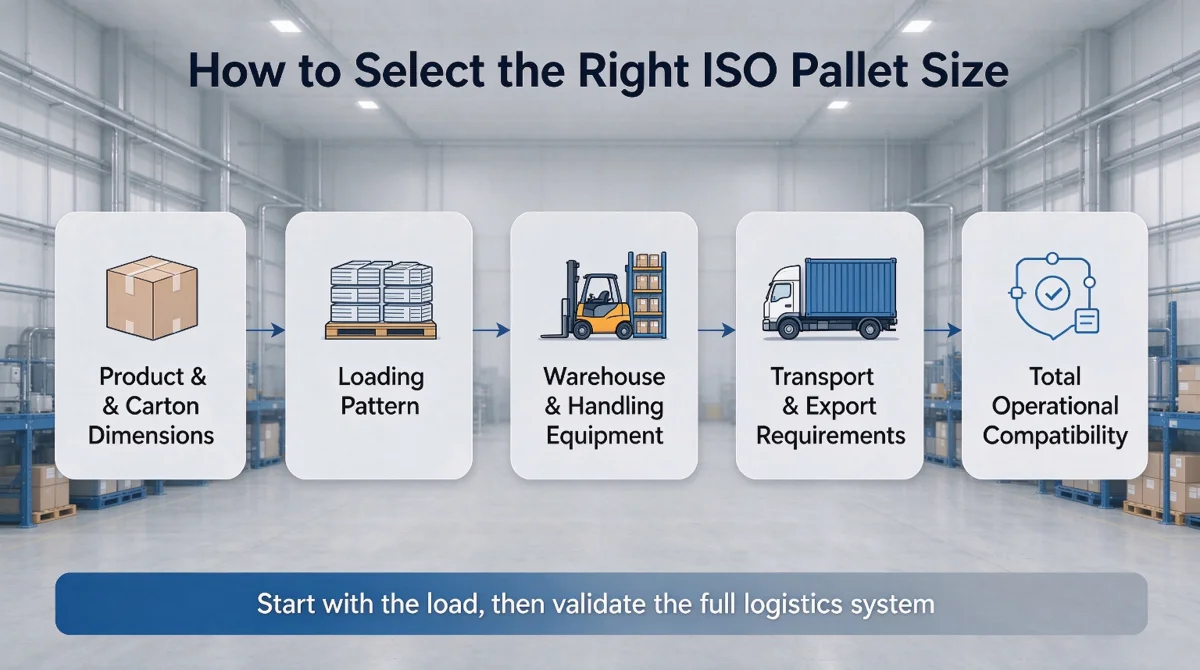
I choose an ISO pallet size by checking the destination market, product dimensions, transport space, warehouse equipment, racking, conveyors, and automation before selecting the pallet construction.
1. Where will the pallet be used?
I start with the destination market because local supply chains often have established pallet footprints.
For Europe, I may first compare 1200 × 800 and 1200 × 1000 mm. For North America, I would normally check the 48 × 40 in footprint. For Asia-Pacific applications, I would also consider 1100 × 1100 mm.
If the pallets will move between several regions, I would check whether the same footprint can work across the full route.
2. What is the product footprint?
I then measure the actual load.
I look at:
- Carton dimensions
- Bag dimensions
- Drum dimensions
- IBC dimensions
- Case configuration
- Product overhang limits
I want the cartons to use the pallet deck efficiently. A pallet that is technically standard may still create poor space use if the product dimensions do not match it.
3. How will the pallet be transported?
I also check the truck and container arrangement.
A pallet footprint affects how many pallets can fit into a container or vehicle and how much floor space remains around the load. The best arrangement depends on the pallet size, cargo size, loading pattern, and transport equipment.
I would not choose a pallet based on a generic claim about container utilization. I would calculate the actual loading pattern for the customer's cargo.
4. What equipment will handle the pallet?
I check forklifts, pallet trucks, conveyors, racks, and automated equipment.
I also ask for the equipment manufacturer's pallet requirements when automation is involved. This step can prevent a buyer from ordering thousands of pallets that later need modification.
5. What warehouse system will support the pallet?
Racking changes the selection again.
A pallet designed for floor stacking may not be suitable for a particular rack system. I would check the required racking load, support arrangement, pallet deflection, and working conditions before selecting the final pallet.
My basic selection order is:
Market → Load → Equipment → Transport → Pallet Size → Pallet Structure
I find this approach much safer than simply asking, “Which ISO pallet size is best?”
Does an ISO Pallet Size Determine Its Load Capacity?
I would never use pallet dimensions alone to decide whether a pallet can carry a particular load. Two pallets with the same footprint can have very different structures, weights, materials, and performance.
ISO pallet dimensions do not by themselves define a pallet's load capacity. I would check the pallet's tested performance, load type, support conditions, racking application, and working environment separately.
ISO pallet dimensions and plastic pallet load capacity
Why does the same size have different load capacities?
A 1200 × 1000 mm pallet can be designed in many ways.
I can have a lightweight nestable pallet, a stackable pallet, a reinforced industrial pallet, or a pallet designed for a specific racking system. The footprint stays the same, but the structure can change.
Material also matters. HDPE and PP can have different performance characteristics. Recycled and virgin materials can also be used in different product designs. The final performance depends on the material formulation, pallet weight, structural design, reinforcement, production process, and test conditions.
This is why I do not recommend using pallet weight as a simple replacement for load testing. A heavier pallet is not automatically the right pallet.
What is the difference between ISO 6780 and ISO 8611?
I keep these two standards separate when I explain pallet specifications.
| Standard | Main purpose |
|---|---|
| ISO 6780 | Principal pallet dimensions, tolerances, and related dimensional requirements |
| ISO 8611 | Pallet test methods and performance evaluation |
ISO 6780 helps answer:
What dimensions and dimensional features should the pallet have?
ISO 8611 helps answer:
How should the pallet be tested and evaluated under specified conditions?
This difference matters when a buyer asks for an “ISO pallet.” I would ask what part of the standard the buyer actually needs.
What should I ask a pallet manufacturer?
Before I buy, I would provide at least:
- Required pallet dimensions
- Product weight
- Load distribution
- Static or dynamic loading
- Racking requirements
- Forklift or pallet truck type
- Conveyor requirements
- Operating temperature
- Export or domestic use
- Required material
- Required certifications or test reports
This gives the manufacturer enough information to recommend a pallet based on the actual application instead of only the footprint.
What Should I Look for in an ISO-Size Plastic Pallet?
Once I have confirmed the required footprint, I move to the pallet structure. This is where plastic pallet selection becomes more specific.
For an ISO-size plastic pallet, I would compare nestable and stackable designs, deck construction, load requirements, material, temperature conditions, and any customization needed for the warehouse.
ISO-size plastic pallets for warehouse and export applications
Should I choose a nestable or stackable pallet?
I usually connect this choice to the logistics model.
A nestable pallet can save space when empty pallets need to be returned or stored. The feet nest into the pallet below, which reduces the empty stack height.
A stackable pallet can be useful when loaded pallets need stable stacking. The bottom structure and top deck are designed to support the pallet above.
Neither design is automatically right for every application. I would first ask how the empty and loaded pallets move through the supply chain.
Should I use an open deck or closed deck?
I look at the product and cleaning requirements.
An open or ventilated deck can provide airflow and reduce pallet weight in some designs. This can be useful for certain agricultural, food, and cold-chain applications.
A closed deck gives a more continuous surface. It can be useful when the load needs more deck support or when cleaning and hygiene are important.
The choice depends on the product, cleaning process, handling system, and load distribution.
When do I need a heavy-duty plastic pallet?
I would consider a reinforced or heavy-duty design when the pallet will carry higher loads, work in demanding industrial environments, or enter a racking system.
I would not select a heavy-duty pallet only because it “looks stronger.” I would compare the required working load and support conditions with the pallet's tested performance.
What material and temperature requirements should I check?
I would check the operating temperature before choosing the plastic material.
Cold storage, outdoor storage, food handling, chemical applications, and general warehouse use can create different material requirements.
I would also confirm whether the buyer needs virgin material, recycled material, food-contact suitability, chemical resistance, or other specific requirements.
What if none of the standard sizes fit my application?
Standard ISO dimensions are useful because they can simplify logistics, but they do not solve every product-loading problem.
If the customer's product, equipment, or warehouse requires another footprint, I would first confirm whether a standard size can be adapted through pallet configuration. If not, custom plastic pallets may be more practical.
A custom size can involve changes to the mold, deck structure, runner layout, material, color, logo, or reinforcement. I would still check the full logistics system before moving to a custom design.
Conclusion
ISO pallet dimensions give me a useful starting point, but I always select the final pallet by looking at the load, equipment, transport, warehouse, and actual working conditions.
My Role
Having served clients in logistics, wholesale, and retail throughout Asia for many years, I know how critical the right pallet size is for smooth operations. In this guide, I bring together complete ISO pallet specifications to help you quickly identify the most suitable pallet footprint for Asia-bound logistics.
About Euro Plastic Pallet
Euro Plastic Pallet is a China-based plastic pallet manufacturer with more than 20 years of manufacturing experience. We serve B2B buyers, distributors, wholesalers, brands, logistics companies, and industrial users.
We provide standard and customized plastic pallet solutions. Our manufacturing capabilities include more than 60 injection molding and rotational molding machines.
Our customization services may include:
- Custom pallet sizes
- Custom colors
- Custom logos
- Custom molds
- Material selection
- Structural customization
- Load capacity customization
Services
- Products: One-stop plastic pallet solutions
- Customized solutions: Custom colors, logos, and molds
- International standards and certifications: ISO 9001, CE, REACH, RoHS, SGS, FDA, and GRS
Quality Assurance
- Raw material inspection: Materials can be selected to meet relevant RoHS and REACH requirements.
- Precision production: Automated injection molding and precision assembly are used for controlled production.
- Inspection: Products can be subject to outgoing inspection and ISO 9001-based sampling procedures.
- Certification: Relevant products and materials can be supplied according to applicable certification and compliance requirements.
Production Capability
- Manufacturing: More than 60 injection molding and rotational molding machines
- Customization: Custom pallet and logistics packaging solutions for different applications
- Flexible solutions: Product size, structure, material, color, logo, mold, and load requirements can be discussed according to the project
Global Service
Euro Plastic Pallet provides plastic pallets and customized logistics packaging solutions for customers in different markets. We work with buyers to match pallet design with their products, handling systems, transport requirements, and supply chain needs.