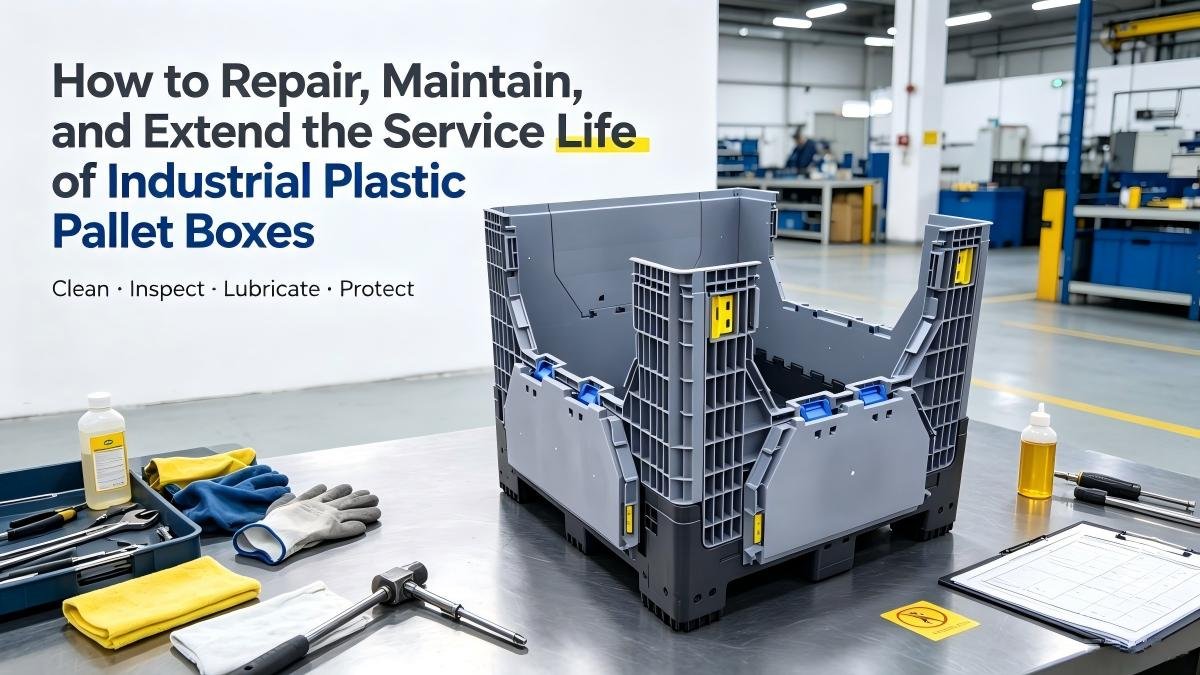
A damaged plastic pallet box can disrupt handling, damage loads, or create replacement costs if you repair the wrong problem or keep unsafe units in service.
A plastic pallet box should be managed through three decisions: maintain minor issues, repair technically recoverable damage, and retire boxes when structural integrity or safe operation cannot be restored.
The key is not simply making a damaged box look usable again. The real goal is to restore reliable function while preventing the same damage from happening again.
How Do You Know If a Plastic Pallet Box Can Be Repaired?
A damaged plastic pallet box is not automatically a repair candidate. The location, severity, and function of the damaged area should be assessed first.
In general, cosmetic damage may need only monitoring, while damage to the base, runners, corners, stacking points, or other load‑bearing areas requires a much more careful decision.
I normally start with three questions:
- Where is the damage?
- How extensive is it?
- What load, movement, or handling force does that area experience?
| Damage condition | Typical consideration |
|---|---|
| Superficial scratch | May only require inspection and monitoring |
| Minor non‑load‑bearing damage | May be repairable or remain in service after assessment |
| Broken hinge or latch | Check whether the component can be replaced |
| Cracked side wall | Assess crack location, size, and effect on structure |
| Broken runner or damaged base | Requires careful structural assessment |
| Damaged stacking interface | Check whether safe stacking and alignment remain possible |
| Repeated damage around a previous repair | Investigate the underlying failure before repairing again |
| Severe deformation or widespread deterioration | Replacement may be more appropriate |
This distinction matters because damage size alone does not determine risk. A large abrasion on a non‑structural surface may be less important than a small crack near a load‑bearing corner.
I would also inspect whether the box still sits flat, stacks correctly, and maintains its intended geometry. Signs such as whitening around an impact, stress marks, warping, brittle areas, loose components, or cracks extending from holes and corners deserve attention.
For a reusable fleet, it is useful to establish clear criteria for maintain, repair, or retire rather than allowing each operator to make a different judgment.
What Are the Main Ways to Repair a Plastic Pallet Box?
The appropriate repair method depends on the plastic material, damage type, location, and required function. Plastic welding and component replacement are two important approaches.
For thermoplastic boxes such as HDPE or PP, compatible welding methods can repair suitable localized damage. Damaged modular parts may also be replaced when the design allows it.
Plastic Welding for HDPE and PP Boxes
Plastic welding can be suitable for certain cracks and localized structural damage. Common professional techniques include hot‑air hand welding, hot‑air speed welding, and extrusion welding.
The repair material must be compatible with the base plastic. I would not select a welding rod, filler, or adhesive simply because it is labeled for general plastic repair.
For example, an HDPE box requires an appropriate HDPE repair process and compatible material. A PP box requires a compatible PP process and material. The repair method should also reflect the size and thickness of the damaged area.
Smaller or difficult‑to‑reach repairs may use different welding techniques from larger or thicker repair areas. The important point is to match the process to the material and damage rather than treating every crack in the same way.
Replacing Hinges, Latches, Runners, and Other Components
Not every damaged box needs body welding. Some failures involve replaceable components.
Hinges, latches, runners, feet, lids, or other modular parts may be candidates for replacement if the box was designed for serviceable components. Before purchasing a pallet box fleet, I would ask which parts can be replaced and whether spare parts are available.
This can have a major lifecycle benefit. If a commonly damaged component can be replaced without discarding the entire box, maintenance becomes more practical.
When a Simple Patch or Adhesive Is Not Enough
A quick patch can hide a problem without restoring the required function. Ordinary adhesives should not be treated as a universal solution, especially for structural repairs involving HDPE or PP.
When damage affects a load‑bearing wall, base, runner, corner, stacking interface, or critical hinge, the repair should be assessed against the original operating requirement. The objective is not appearance. It is reliable function.
If the surrounding plastic has already become brittle, heavily deformed, or repeatedly damaged, repairing one visible crack may not solve the underlying problem.
How Should You Inspect a Plastic Pallet Box Before and After Repair?
Inspection should focus on the parts that carry, transfer, or control loads rather than simply checking whether the outside looks acceptable.
Before repair, identify the damage and its cause. After repair, confirm that the box has regained the function required for its intended application.
What to Check Before Repair
I would inspect:
- Bottom panel
- Pallet base
- Runners and feet
- Corners
- Side‑wall joints
- Folding joints
- Hinges
- Latches and locking points
- Handles
- Stacking interfaces
- Areas around previous repairs
Look for cracks, punctures, deep scratches, impact marks, deformation, warping, brittle areas, and loose components. Previous repair areas deserve special attention because reopened cracks or separation around welds can indicate an unresolved problem.
The cause should also be investigated. A crack caused by repeated forklift impact requires a different response from damage caused by excessive loading or a folding mechanism that is being forced.
What to Check After Repair
A repaired pallet box should be checked against its intended use.
Ask:
- Does it sit flat?
- Does it stack correctly?
- Do hinges and latches operate properly?
- Are replacement components secure?
- Does the repair interfere with folding?
- Has the intended load path been restored?
- Does the box still fit the handling equipment?
- Can it safely perform its intended storage or stacking function?
For automated operations, dimensional consistency is particularly important. A repair that is mechanically strong may still be unsuitable if it changes the geometry required by conveyors, automated storage systems, or robotic handling.
A repaired box should therefore remain part of the inspection system rather than returning to service without further monitoring.
How Can You Maintain Plastic Pallet Boxes to Prevent Damage?
Preventive maintenance starts with loading and handling practices. Many failures begin with impacts, uneven loading, dropping, dragging, or incorrect equipment operation rather than simple aging.
Load and Stack the Box Correctly
Total weight is only part of the loading equation. Load distribution also affects stress on the box.
I would check:
- Total load weight
- Load distribution
- Center of gravity
- Contact between cargo and side walls
- Stacking arrangement
- Bottom support
- Floor or rack suitability
A concentrated load can create greater local stress than a uniformly distributed load with the same total weight. Static, dynamic, stacking, and racking conditions should also be treated separately. The manufacturer's rated capacity should control the application.
Cargo should be loaded in a controlled way. Throwing heavy products into a box can create concentrated impact that would not occur during normal placement.
Use Forklifts and Pallet Trucks Correctly
Forklift and pallet‑truck handling is another major source of damage.
Operators should avoid:
- Driving forks into side walls
- Lifting before forks are properly positioned
- Dropping loaded containers
- Hitting corners
- Dragging boxes unnecessarily
The exact fork engagement, operating speed, and load limits should come from the manufacturer's instructions for the specific pallet‑box design. These values should not be generalized across different models.
Handle Collapsible Boxes Carefully
Collapsible boxes have additional moving and folding components. Hinges, latches, locking tabs, and folding joints should be operated correctly rather than forced.
Repeated stress around these areas can eventually create cracks or component failures. During inspection, I would pay particular attention to folding joints, connection points, hinges, and locking mechanisms.
If a component is repeatedly damaged, the maintenance team should investigate whether the problem comes from the component itself, the operating procedure, or the way the box is loaded and handled.
How Do Cleaning, Temperature, and UV Exposure Affect Service Life?
Cleaning and environmental exposure can directly affect the condition and usability of a reusable plastic pallet box. They should be included in the maintenance program, not treated as separate concerns.
Residue can hide cracks, interfere with inspection, contaminate later loads, and accumulate around hinges or mechanical components. Temperature, UV exposure, and chemicals can also influence material performance.
| Operating condition | Maintenance consideration |
|---|---|
| General warehouse | Inspect for impacts, cracks, deformation, and stacking damage |
| Food or hygiene‑sensitive use | Control cleaning, sanitation, residue, and repair materials |
| Cold‑chain use | Verify material suitability and specified low‑temperature performance |
| Outdoor storage | Consider UV exposure and monitor weathering |
| Chemical environment | Confirm material compatibility for the actual substance |
| Hot processing area | Check the manufacturer's specified operating conditions |
For food, pharmaceutical, and other hygiene‑sensitive applications, cleaning requirements should be integrated into the operating process. A structurally repaired box may still be unsuitable if the repaired area cannot be adequately cleaned or the repair materials do not meet the requirements of the application.
Temperature should also be evaluated against the manufacturer's product specification. There is no single temperature range that should be applied to every plastic pallet box because material, formulation, thickness, and design can differ.
For outdoor fleets, I would monitor fading, chalking, surface embrittlement, and cracking. A box that has experienced significant environmental exposure should receive a more careful assessment before being returned to demanding service.
When Should You Repair a Plastic Pallet Box or Replace It?
The repair‑versus‑replace decision should be based on structural condition, intended use, repairability, and remaining service potential rather than repair price alone.
Repair is more appropriate when damage is localized and the original function can be reliably restored. Replacement becomes the safer choice when structural integrity, geometry, hygiene, or operating safety can no longer be confidently maintained.
Signs That Repair May Be Appropriate
Repair may make sense when:
- Damage is localized.
- The base material remains suitable.
- The surrounding structure is sound.
- A damaged component can be replaced.
- The repair method is compatible with the material.
- The box can regain its intended geometry.
- The repaired box can still meet the requirements of its application.
A relatively new box with one localized, technically repairable failure can be a strong repair candidate.
Signs That Replacement May Be Safer
I would be more cautious when the box has:
- Major base or runner damage
- Significant deformation
- Damaged stacking interfaces
- Repeated cracks
- Widespread brittleness
- Multiple previous repairs
- Structural deterioration around critical load‑bearing areas
- Damage that cannot be reliably restored
An older box with widespread deformation and repeated failures may only be receiving temporary repairs. In that situation, replacement can provide a more reliable lifecycle solution.
For a fleet, compare the full economics:
Repair cost + transportation + labor + inspection + downtime
versus
New box cost + delivery + disposal or recycling + replacement handling
The remaining useful service potential should also be considered.
How Can Businesses Extend the Service Life of a Plastic Pallet Box Fleet?
The best way to extend service life is to manage the boxes as reusable assets throughout their lifecycle rather than waiting for failures.
A practical fleet program connects purchasing, operator training, inspection, cleaning, repair, documentation, and retirement into one process.
Before purchasing, I would check more than the catalog image and nominal capacity. Important questions include:
- What material is used?
- Is the material suitable for the operating environment?
- Is UV exposure relevant?
- Is chemical compatibility important?
- How is the base constructed?
- Are runners or feet replaceable?
- Can hinges and latches be replaced?
- Is the box suitable for the intended handling equipment?
- Is automated equipment involved?
- What maintenance instructions are provided?
- Which types of damage require retirement?
- Is testing recommended after structural repair?
I would also establish a repeatable inspection checklist for the fleet. Record the damage type, repair performed, date, replaced component, inspection result, and operating application. This makes repeated failure patterns easier to identify.
Operator training is equally important. If the same forklift repeatedly strikes the same corner, repairing that corner without changing the handling process simply creates recurring maintenance work.
For larger fleets, a clear repair‑versus‑replace process is better than leaving decisions to individual operators. The objective is consistent risk management across the entire fleet.
Common Mistakes When Repairing and Maintaining Plastic Pallet Boxes
Many maintenance problems come from treating repair as a simple patching exercise instead of a lifecycle management process.
The most common mistakes are assuming every crack can be welded, using incompatible repair materials, and continuing to operate boxes after structural damage appears.
Assuming Every Crack Can Be Welded
Plastic welding can be effective, but not every crack is suitable for repair. Damage affecting load‑bearing or safety‑critical components requires careful assessment first.
Using the Wrong Repair Material
A product labeled “plastic repair” is not automatically suitable. The repair material and process should be compatible with the base plastic.
Repairing the Symptom Without Fixing the Cause
If forklift impact repeatedly damages one area, the maintenance team should correct the handling process as well as repair the box.
Treating Cosmetic Damage as Structural Damage
A scratch does not automatically mean retirement. At the same time, a small crack near a critical load‑bearing area can be more serious than a large surface abrasion.
Continuing to Use a Damaged Box Because It Still Works
A box may continue to hold cargo while its structural condition deteriorates. When cracking, deformation, or brittleness affects important load‑bearing areas, I would remove the box from normal service until it has been assessed.
Ignoring Repaired Boxes During Future Inspections
A repaired container should remain identifiable within the maintenance system. Reopened cracks, separation around welds, loose reinforcement, or deformation near repaired areas can indicate recurring problems.
Assuming Repair Automatically Restores Original Performance
A repaired box should not automatically be treated as equivalent to a new box. Repair method, location, workmanship, deformation, and intended application all affect the result. High‑demand applications may require appropriate inspection or testing before the box returns to service.
Frequently Asked Questions
Can a cracked plastic pallet box be repaired?
Yes, some cracked plastic pallet boxes can be repaired, but the answer depends on the material, crack location, extent of damage, and structural function. A crack affecting the base, runner, corner, stacking interface, or other load‑bearing area requires a more conservative assessment.
Can HDPE plastic pallet boxes be welded?
HDPE pallet boxes can be suitable for thermoplastic welding when the repair process and filler material are compatible with the base plastic. The welding method should also match the damage and material thickness.
How do I know when a plastic pallet box should be replaced instead of repaired?
Consider replacement when structural integrity, geometry, hygiene, or safe operation cannot be reliably restored. Widespread deformation, repeated cracking, severe deterioration, or extensive previous repairs are reasons to assess replacement rather than repeatedly repairing the same box.
What is the best way to maintain a collapsible plastic pallet box?
Inspect hinges, latches, locking tabs, folding joints, and connection points regularly. Avoid forcing folding mechanisms and correct handling practices that create repeated impacts or stress. Keep repaired components within the normal inspection program.
Can repaired plastic pallet boxes still be used for heavy‑duty applications?
They may be suitable if the repair reliably restores the function required by the application, but a repair should not automatically be considered equivalent to a new box. Load‑bearing repairs should be assessed against the original design requirements, and appropriate inspection or testing may be needed for demanding applications.
Conclusion
Extend plastic pallet box service life by choosing the right plastic pallet box manufacturer, the right design, handling it correctly, inspecting regularly, repairing suitable damage, and retiring boxes when safe performance can no longer be assured.
My Role
Over years, I learned many custumers are concerned about maintain their plastic pallet boxes. My core focus is to conclude my experience, to reduce clients'long-term operational costs, avoid safety risks, and maximize the service life of rigid, collapsible, and vented plastic pallet boxes.
About Euro Plastic Pallet
Euro Plastic Pallet is a plastic pallet manufacturer with over 20 years of production experience, headquartered in China. We provide high-quality, customized plastic pallet solutions for brand owners, wholesalers, and distributors.
With 60+ injection/rotational molding machines, each staffed with quality control[^12] personnel having 5+ years of experience, we ensure consistent product quality.
Services
- Products: Complete plastic pallet solutions
- Customization: Custom colors, logos, and molds
- International Certifications: ISO 9001, CE, REACH, ROHS, SGS, FDA, GRS
Quality Assurance
- Raw Material Testing: Complies with RoHS, REACH standards, meeting international strength and performance requirements
- Precision Manufacturing: Automated injection molding, precision assembly, accuracy ±0.1mm
- Comprehensive Inspection: 100% factory testing, ISO 9001 sampling protocols ensuring high standards
- Certifications: ISO 9001, CE, REACH, ROHS, SGS, FDA standards compliance
Production Capacity
- High-Quality Manufacturing: 60+ injection/rotational molding machines following ISO 9001
- Premium Customization: Customized solutions for global brands
- Flexible Solutions: Customer-specific customization[^17] enhancing market competitiveness
Global Impact
Serving global customers with reliable plastic pallets[^1] and customized logistics packaging solutions[^18], supporting business growth and customer trust.