I have seen pharmaceutical warehouses focus on pallet price first, then face cleaning, racking, or automation problems later.
I choose pharmaceutical plastic pallets by checking the load, working environment, handling method, cleaning process, and compliance needs before I compare price.
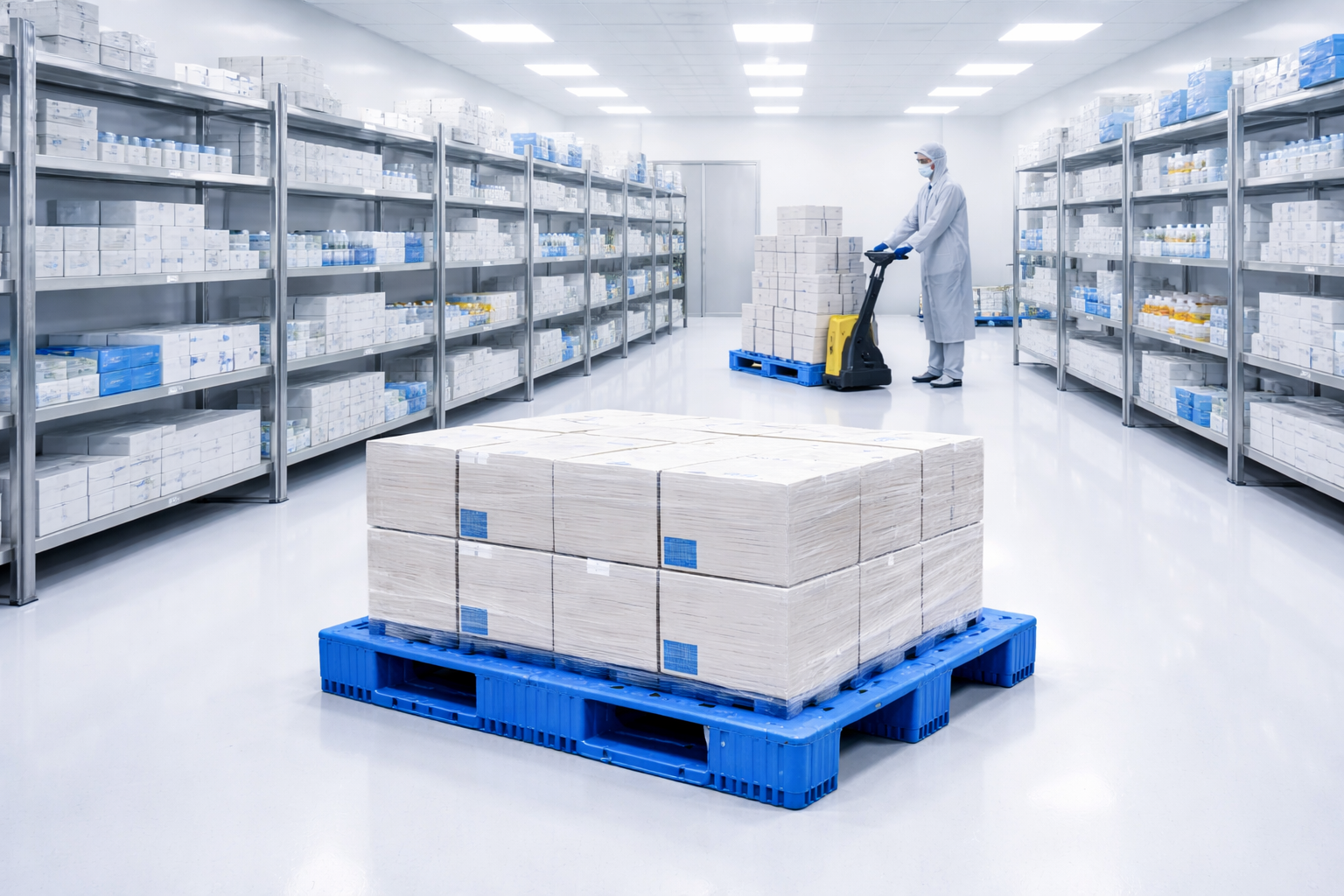
I have worked with customers across different industries, and I have found that pharmaceutical pallet selection is not just about choosing plastic over wood. I need to match the pallet with the complete logistics process.
Why Are Plastic Pallets Used in the Pharmaceutical Industry?
A pallet can enter production areas, warehouses, trucks, and cleaning stations many times. A poor design can create problems in several of these steps.
I use plastic pallets in pharmaceutical logistics because they offer easy cleaning, moisture resistance, stable dimensions, and better control of common contamination risks than many wood pallets.
Hygiene and Handling
I usually start with hygiene because pharmaceutical logistics has less room for dirt, moisture, and loose material. Plastic does not absorb water like wood, and a properly designed plastic pallet can be washed and inspected more easily.
I pay close attention to the deck design. A closed-deck pallet gives me a relatively smooth working surface. It has fewer open spaces where dust, liquid, or product residue can collect. Rounded corners also make cleaning easier.
I do not say that every plastic pallet is automatically hygienic. The design matters. A complicated surface with many deep gaps can still make cleaning difficult.
| Feature | Plastic Pallet | Wood Pallet |
|---|---|---|
| Water absorption | Low | Higher |
| Cleaning | Easier | More difficult |
| Surface consistency | High | Can vary |
| Wood splinters | No | Possible |
| Mold risk from absorbed moisture | Lower | Higher |
| Dimensional stability | More consistent | Can change with moisture |
Plastic Pallets vs. Wood Pallets
I often compare plastic and wood based on the full working process instead of the purchase price.
Wood can have a lower initial cost in some markets. It can also be repaired more easily in some logistics systems. Plastic usually costs more at the beginning, but it can provide more consistent dimensions and repeated-use performance.
For pharmaceutical applications, I also consider international shipping. Wood packaging may need treatment and marking under applicable import rules. Plastic does not have the same wood-treatment requirement.
I still ask customers to check their actual logistics rules. The right choice depends on the country, route, pallet pool, and operating process.
Where Do Pharmaceutical Plastic Pallets Get Used?
I see pharmaceutical pallets used in production support, raw material storage, finished goods warehouses, distribution centers, and temperature-controlled logistics.
I also see them used under cartons, drums, containers, and other secondary packaging. The pallet does not normally replace the primary product packaging. Its job is to provide a stable base for handling and storage.
What Makes a Plastic Pallet Suitable for Pharmaceutical Use?
I do not judge a pharmaceutical pallet by its material name alone. I check the surface, material documentation, cleaning needs, and handling system together.
A suitable pharmaceutical plastic pallet should have a cleanable design, suitable material, reliable load performance, stable dimensions, and documented properties that match the customer's actual requirements.
Hygienic and Easy-to-Clean Surface
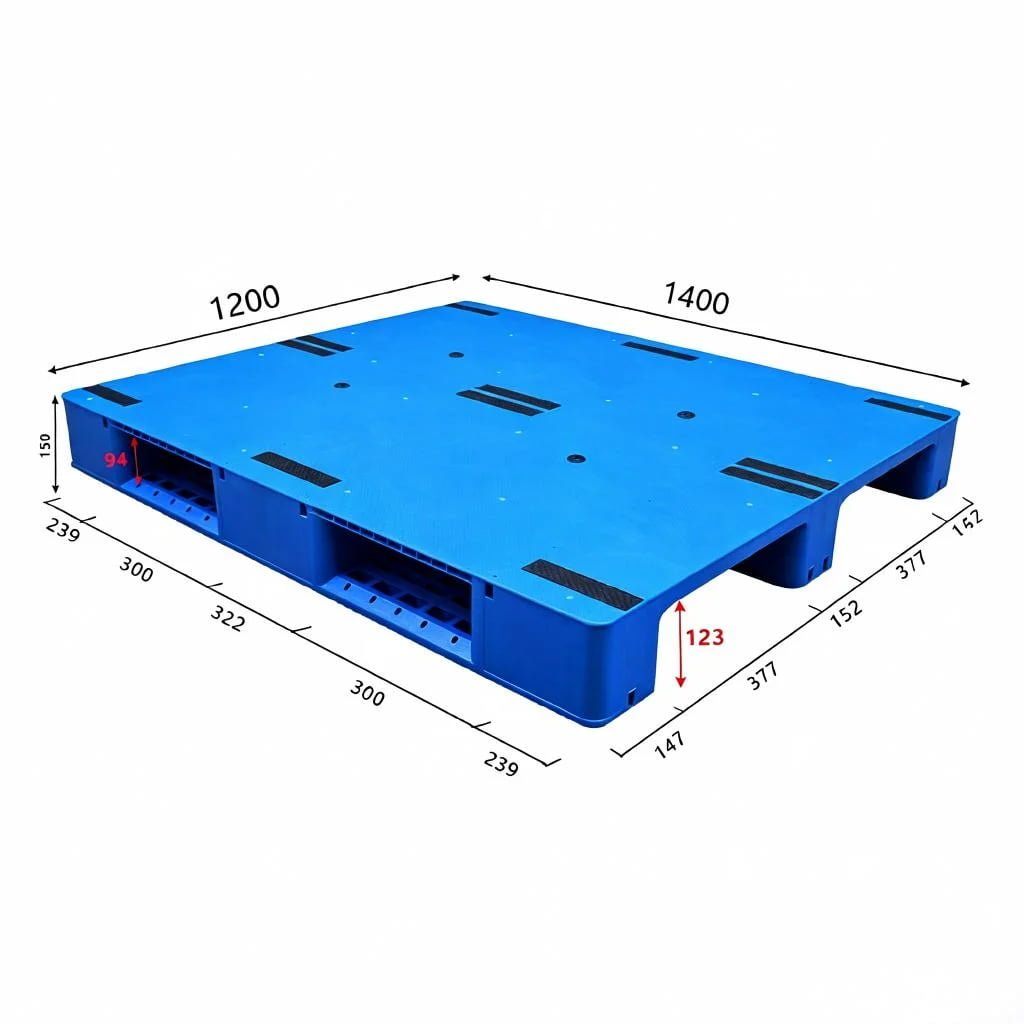
When I recommend pallets for hygiene-sensitive applications, I usually look at the deck first.
A closed deck is often useful when the pallet needs frequent washing or inspection. A smooth surface gives fewer places for dirt and liquid to remain. Rounded corners can also reduce hard-to-clean areas.
I think about it like cleaning a workbench. A flat workbench is easier to wipe than one with many deep grooves.
I do not treat closed deck as a universal answer. Some warehouses need drainage and ventilation. In those cases, a grid deck can make sense.
| Deck Type | My Typical Application View |
|---|---|
| Closed deck | Frequent cleaning and hygiene-sensitive areas |
| Grid deck | Drainage and ventilation needs |
| Reinforced closed deck | Heavy loads and demanding warehouse use |
| Lightweight deck | Export and weight-sensitive transport |
FDA-Compliant Materials for Pharmaceutical Pallets
I pay close attention to the wording around FDA requirements.
A supplier may use FDA-compliant material, but that does not automatically mean the complete pallet has an FDA approval for every pharmaceutical application.
I normally ask for material information and supporting documents. I also check whether the stated compliance applies to the resin, additives, finished product, or a specific application.
For customers with strict material requirements, I usually start with virgin HDPE or virgin PP from a traceable source. These materials can give me a clearer starting point for material control.
I also avoid treating virgin material as an automatic guarantee of suitability. The production process, additives, colorants, and final product requirements still matter.
Resistance to Moisture, Chemicals and Cleaning
I consider cleaning when I select the pallet because a pallet that works well when dry may face a very different environment during washing.
Plastic is generally resistant to water and does not absorb moisture like wood. That makes it easier to use in wet logistics areas.
Still, I do not tell customers that every plastic pallet is compatible with every chemical. Cleaning agents and disinfectants can vary. Temperature and exposure time can also affect material performance.
I recommend checking the actual cleaning chemicals before placing a large order.
Consistent Dimensions for Automated Handling
Automation changes how I evaluate a pallet.
When I work with conveyors, ASRS, AGV, or AMR systems, I pay more attention to dimensions, bottom design, flatness, and deformation.
An operator may be able to correct a pallet position with a forklift. An automated system may not have that flexibility.
I therefore ask for the automation equipment requirements before I select the pallet. I also check load conditions and the expected number of cycles.
What Type of Plastic Pallet Is Best for Pharmaceutical Warehouses?
I do not believe there is one pallet type for every pharmaceutical warehouse. I choose the structure based on cleaning, storage, weight, handling, and transport requirements.
I normally compare closed-deck, rackable, heavy-duty, and lightweight plastic pallets based on where and how the pallet will work.
Closed-Deck Plastic Pallets
I usually consider closed-deck pallets first for hygiene-sensitive areas. The smooth surface can make cleaning and visual inspection easier.
I would consider this design for pharmaceutical production support, clean storage areas, and applications where washing is frequent.
Rackable Plastic Pallets
I use rackable pallets when the warehouse stores goods on pallet racking. Here I focus on racking load instead of only static load.
A pallet may support a large load on the floor but behave differently when that load is carried between rack beams.
Heavy-Duty Plastic Pallets
I choose heavy-duty designs when the customer handles heavy raw materials, dense products, or repeated warehouse cycles.
I do not select a heavy-duty pallet just because it weighs more. I check whether the extra material actually supports the customer's load and handling conditions.
Lightweight Plastic Pallets
I consider lightweight pallets when shipping weight and freight efficiency matter.
They can be useful for export logistics or applications with moderate loads. I still check whether the pallet can handle the required handling cycles.
| Pallet Type | I Usually Consider It For |
|---|---|
| Closed deck | Hygiene and frequent cleaning |
| Rackable | High-bay storage |
| Heavy duty | Heavy loads and repeated cycles |
| Lightweight | Export and weight-sensitive logistics |
How Do I Choose a Pharmaceutical Plastic Pallet?
I start with the actual working conditions. I do not start with the pallet catalog.
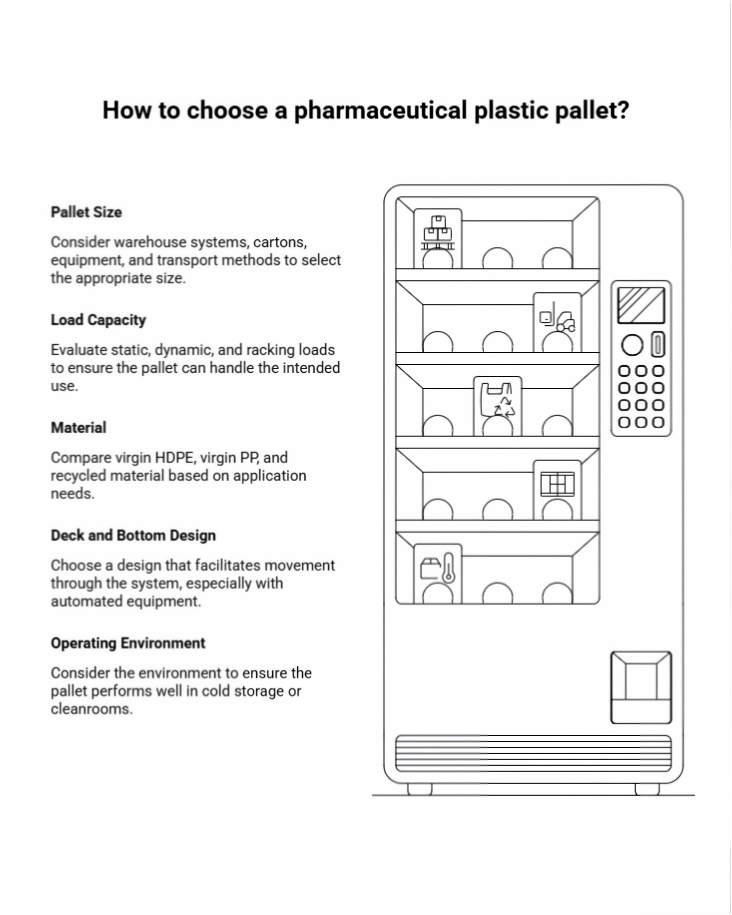
I choose a pharmaceutical plastic pallet by checking size, load capacity, material, deck design, handling method, temperature, cleaning process, and automation requirements.
1. Pallet Size
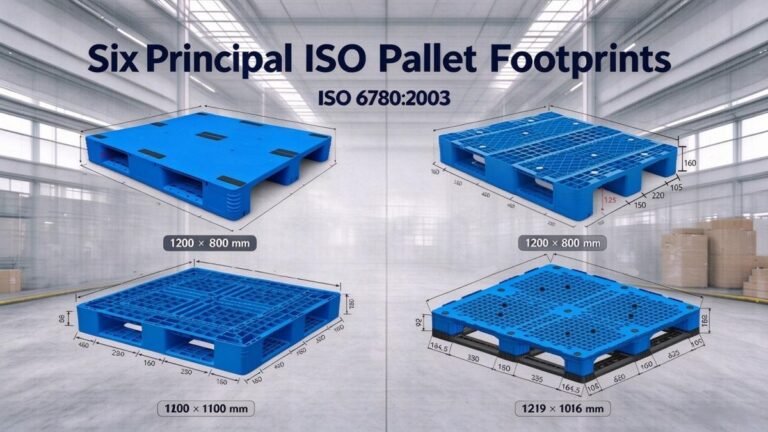
I commonly see 1200 × 800 mm and 1200 × 1000 mm in international logistics. The correct size depends on the warehouse system, cartons, equipment, and transport method.
I first check the footprint of the load. Then I check the conveyor, rack, truck, and container requirements.
2. Load Capacity
This is where I see many purchasing mistakes.
Static load means the pallet carries a load while standing still on a floor. Dynamic load relates to handling during movement. Racking load relates to supported storage on a rack.
I never use the static number alone to choose a pallet.
| Load Type | What I Check |
|---|---|
| Static Load | Load during stationary stacking |
| Dynamic Load | Load during forklift or pallet jack handling |
| Racking Load | Load during supported rack storage |
3. Material
I usually compare virgin HDPE, virgin PP, and recycled material based on the application.
Virgin HDPE can provide a useful balance of impact resistance and temperature performance. PP can also be suitable for many applications where its specific properties fit the working conditions.
Recycled material can work in some logistics applications. I do not reject it automatically. I first check the source, consistency, application, and customer requirements.
4. Deck and Bottom Design
I check whether the pallet needs a closed deck, grid deck, flat bottom, forklift entry, or pallet jack entry.
I also check how the pallet will move through the system. The bottom design becomes especially important when conveyors or automated equipment are involved.
5. Operating Environment
I ask where the pallet will spend most of its working life.
A cleanroom, cold storage area, pharmaceutical warehouse, and loading dock can create different requirements.
For cold storage, I pay attention to low-temperature impact performance. For cleaning areas, I check material compatibility and surface design.
Are Plastic Pallets Better Than Wood Pallets for Pharmaceuticals?
I often prefer plastic for pharmaceutical logistics when repeated cleaning, moisture control, dimensional consistency, and automated handling are important.
I generally find plastic pallets more suitable than wood for many pharmaceutical applications because they are easier to clean, resist moisture, maintain consistent dimensions, and work well with automated systems.
Hygiene and Moisture
I see the biggest practical difference in wet and hygiene-sensitive environments.
Wood can absorb moisture. Plastic does not absorb water in the same way. Plastic also avoids issues such as wood splinters.
This does not mean plastic has no maintenance needs. I still recommend routine inspection and cleaning.
Automation
I find plastic more convenient when a warehouse needs consistent pallet dimensions. Automated systems depend on repeatable movement.
The pallet still needs to meet the system's exact requirements. Plastic alone does not guarantee automation compatibility.
International Shipping
I also consider international transport. Wood pallets may be subject to wood packaging treatment requirements. Plastic pallets avoid the wood-treatment process because they are not wood packaging.
Lifecycle Cost
I compare the purchase price with the expected number of uses.
A cheaper pallet can become expensive if it breaks often, creates handling problems, or requires frequent replacement. A more expensive pallet may make sense if the customer uses it for many cycles.
I therefore compare:
| Cost Factor | What I Consider |
|---|---|
| Purchase cost | Initial investment |
| Freight | Pallet weight and volume |
| Cleaning | Washing frequency and process |
| Replacement | Expected breakage and loss |
| Handling | Equipment compatibility |
| Service life | Expected reuse cycles |
How Do Plastic Pallets Support GMP and Pharmaceutical Logistics?
I see GMP as a management and process framework, not as a label that automatically belongs to a pallet. For reference, the 21 CFR Part 211 sets out current good manufacturing practice requirements for finished pharmaceuticals, which helps clarify how pallet use fits into the broader compliance system.
Plastic pallets can support GMP-related logistics by providing cleanable surfaces, consistent handling, contamination control, and traceable material information, but the pallet itself is not automatically “GMP certified.”
Cleaning and Inspection
I consider cleaning part of the pallet management process.
A pallet should be easy to inspect after cleaning. A smooth deck can help operators identify visible dirt, residue, or damage.
I also recommend defining when a pallet should be removed from service. A cracked pallet can create a bigger problem than a dirty pallet because the damage can affect handling and cleaning.
Contamination Control
I use pallet design as one part of contamination control.
A closed deck can reduce areas where debris collects. A non-absorbent plastic surface can also make moisture management easier.
Still, the pallet is only one part of the system. Packaging, storage areas, cleaning procedures, personnel, and transport conditions all matter.
Traceability
For controlled logistics, I like traceability options such as labels, barcodes, or RFID.
These tools can help customers identify pallet groups, track movement, and manage reusable assets.
I would not add RFID simply because it sounds advanced. I first check whether the customer's warehouse system can use the data.
What Should I Check Before Buying Pharmaceutical Plastic Pallets?
I always tell buyers to check documents and samples before placing a large order. A product photo cannot tell me how a pallet will behave in the customer's warehouse.
Before buying pharmaceutical plastic pallets, I check material documents, test reports, load ratings, dimensions, cleaning requirements, temperature conditions, and sample performance under real working conditions.
Documents I Ask For
I usually ask suppliers to provide the documents that match the customer's requirements.
These can include material certificates, test reports, dimensions, load test information, and applicable compliance documents.
I also check what each document actually covers. A certificate for raw material is not automatically a certificate for the complete finished pallet.
Product Testing
I prefer sample testing when the application is important.
I would place the sample into the actual warehouse process if possible. I would test forklift handling, rack storage, cleaning, conveyor movement, and temperature exposure when these conditions apply.
| Check | My Question |
|---|---|
| Material | Is the material source clear? |
| Size | Does it match the equipment? |
| Load | Does it meet the real load condition? |
| Racking | Can it handle the rack requirement? |
| Cleaning | Does the material fit the cleaning process? |
| Temperature | Can it handle the working temperature? |
| Automation | Does it run correctly through the system? |
| Documents | Can the supplier support the stated requirements? |
Why I Recommend Samples
I have seen specifications look good on paper but fail when the product enters a real process.
A sample gives me a chance to find these problems before a large purchase.
I would rather spend time testing a few pallets than discover a design problem after receiving a full container.
Pharmaceutical Plastic Pallet Manufacturer and Customized Solutions?
I often find that pharmaceutical customers need more than a standard catalog pallet because their warehouses and products have different requirements.
I recommend customized pharmaceutical plastic pallet solutions when standard size, load, deck, reinforcement, identification, or automation requirements do not fully match the customer's working conditions.
Custom Size and Design
I can consider custom dimensions when the customer's cartons, equipment, or warehouse layout require them.
I also consider custom colors and logos when customers need product identification or brand control.
I do not recommend custom tooling without a clear reason. Mold development adds cost, so I first check whether an existing pallet can solve the problem.
Steel Reinforcement
I consider steel reinforcement when the customer needs additional load support, especially for demanding rack applications.
I still check the actual load condition before adding steel. More reinforcement is not automatically more economical.
RFID and Barcode Options
I consider RFID or barcode identification when customers operate large reusable pallet pools.
These systems can help track pallet movement and improve asset management. The right option depends on the customer's existing software and scanning system.
Application-Based Recommendations
My normal approach is simple. I ask about the load, location, handling equipment, cleaning process, temperature, and expected use cycle.
Then I match the pallet design to those conditions.
I find this approach more useful than simply sending a customer a catalog and asking them to choose.
FAQ: What Do Buyers Usually Ask About Pharmaceutical Plastic Pallets?
I receive many questions before customers place their first pharmaceutical pallet order. Most questions are about FDA requirements, materials, cleaning, temperature, and pallet size.
I answer these questions by separating material compliance, finished-product requirements, actual operating conditions, and warehouse equipment instead of using one general rule for every pharmaceutical pallet.
Are Plastic Pallets FDA Approved?
I do not use “FDA approved” as a blanket statement for every plastic pallet. I first check whether the material or finished product has documentation that matches the customer's specific FDA-related requirement.
I recommend asking the supplier exactly what the documentation covers.
Are Plastic Pallets Suitable for Pharmaceutical Warehouses?
I believe plastic pallets can be suitable for many pharmaceutical warehouses. I still check the pallet design, material, load rating, cleaning process, and warehouse equipment before making a final selection.
What Plastic Is Best for Pharmaceutical Pallets?
I commonly consider virgin HDPE or virgin PP when material control and traceability are important. I choose between them based on temperature, impact, load, cleaning, and application requirements.
Can Pharmaceutical Plastic Pallets Be Washed and Sanitized?
I generally consider plastic easier to wash than wood. However, I always check the cleaning chemicals, water temperature, pressure, and exposure time before approving a cleaning process.
Can Plastic Pallets Be Used in Cold Storage?
I use plastic pallets in cold storage when the selected material and design are suitable for the required temperature.
I pay special attention to low-temperature impact performance because some plastics can become more brittle when temperatures fall.
What Is the Best Pallet Size for Pharmaceutical Logistics?
I commonly see 1200 × 800 mm and 1200 × 1000 mm sizes. I do not call one size universally better. I choose based on load dimensions, warehouse equipment, racking, automation, and transport requirements.
Conclusion
Pharmaceutical buyers should never select plastic pallets based on photos only. Always start from real‑world working conditions, then verify specifications and samples before large orders. Key factors include pallet size, load weight, storage mode, handling equipment and cleaning process, followed by material, structure, load rating and temperature needs. Sample testing is critical for pharmaceutical use to avoid paper‑good‑looking pallets failing in actual warehouse operations. The correct pharmaceutical plastic pallet matches load, environment, cleaning workflow, handling systems and compliance requirements. Ask for a Pharmaceutical Pallet Recommendation
My Role
I guide pharmaceutical customers through pallet procurement. I collect onsite operational requirements to shortlist suitable options, stress real‑condition sample validation, and evaluate overall fit instead of only upfront cost, helping customers avoid costly mismatched purchases.
About Euro Plastic Pallet
Euro Plastic Pallet is a plastic pallet manufacturer with over 20 years of production experience, headquartered in China. We provide high‑quality, customized plastic pallet solutions for brand owners, wholesalers, and distributors. With 60+ injection/rotational molding machines, each staffed with quality control personnel having 5+ years of experience, we ensure consistent product quality.
Services
- Products: Complete plastic pallet solutions
- Customization: Custom colors, logos, and molds
- International Certifications: ISO 9001, CE, REACH, ROHS, SGS, FDA, GRS
Quality Assurance
- Raw Material Testing: Complies with RoHS, REACH standards, meeting international strength and performance requirements
- Precision Manufacturing: Automated injection molding, precision assembly, accuracy ±0.1mm
- Comprehensive Inspection: 100% factory testing, ISO 9001 sampling protocols ensuring high standards
- Certifications: ISO 9001, CE, REACH, ROHS, SGS, FDA standards compliance
Production Capacity
- High‑Quality Manufacturing: 60+ injection/rotational molding machines following ISO 9001
- Premium Customization: Customized solutions for global brands
- Flexible Solutions: Customer‑specific customization enhancing market competitiveness
Global Impact
Serving global customers with reliable plastic pallets and customized logistics packaging solutions, supporting business growth and customer trust.