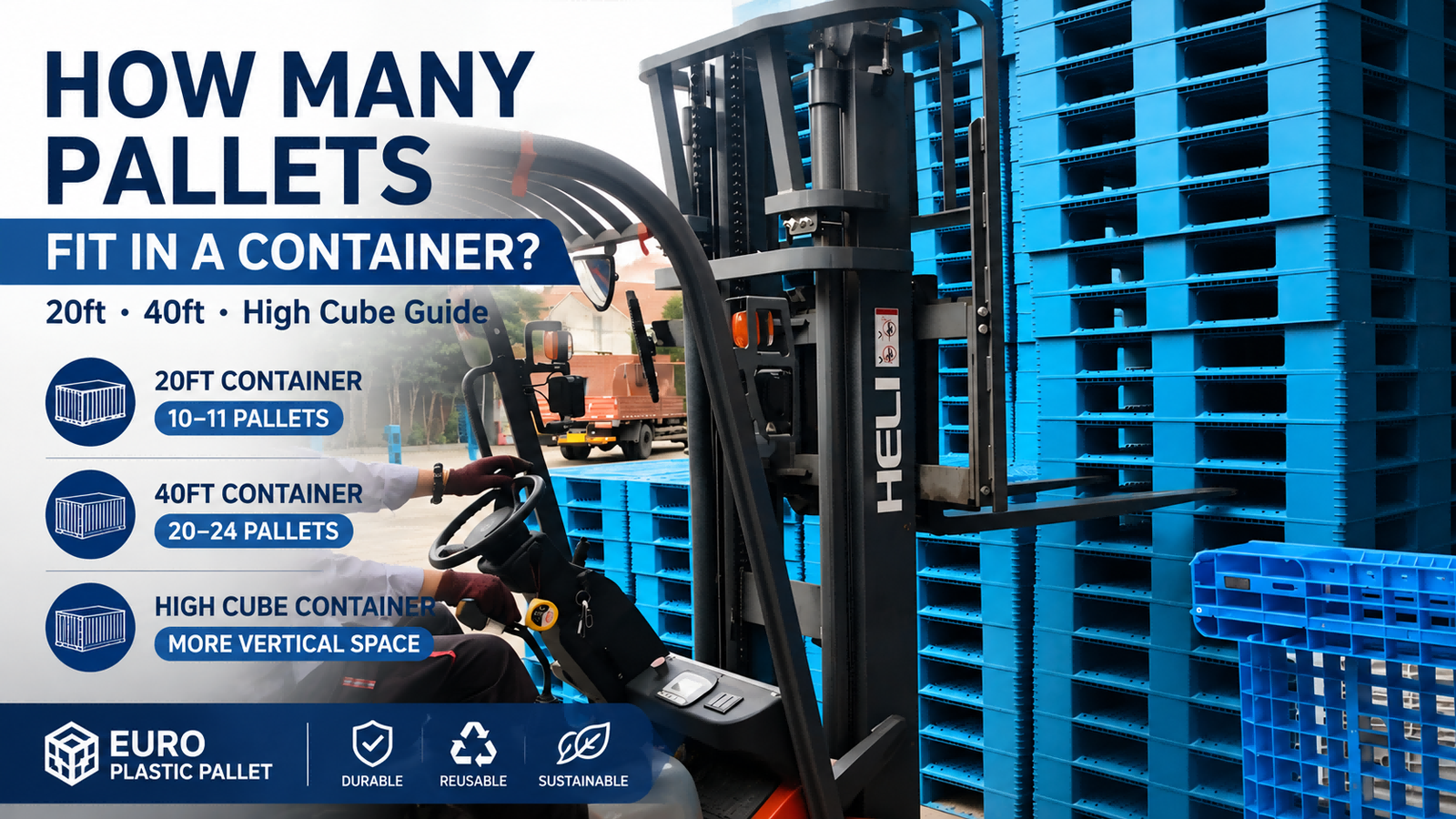
How many pallets fit in a shipping container? The answer depends mainly on the pallet size, container type, loading pattern, pallet orientation, and cargo configuration. As a general planning guide, a 20ft container can hold about 10–11 standard pallets, while a 40ft container can hold around 20–25 pallets in a single floor layer, depending on the pallet footprint. For example, approximately 11 1200 × 800 mm Euro pallets, 10 1200 × 1000 mm pallets, or 10 48 × 40 in GMA pallets can fit in a 20ft container when loaded efficiently. Exact capacity should always be confirmed against the actual container's internal dimensions and the cargo arrangement.
Quick Answer: How Many Pallets Fit in a Container?
For the most common pallet sizes, these are useful planning figures for single-tier floor loading:
| Pallet Size | 20ft Container | 40ft Container | 40ft High Cube |
|---|---|---|---|
| 1200 × 800 mm Euro | 11 | 23–25 | 23–25 |
| 1200 × 1000 mm Industrial / ISO | 10 | 20–21 | 20–21 |
| 1100 × 1100 mm | 10 | 20 | 20 |
| 48 × 40 in GMA | 10 | 20–21 | 20–21 |
These are typical planning figures, not guaranteed loading quantities. Actual results can vary with the container manufacturer, internal dimensions, door clearance, pallet tolerances, cargo overhang, loading restrictions, and whether the pallets are loaded empty or with goods.
For a purchasing decision, the more important question is not simply how many pallets fit, but which pallet size gives you the best combination of cargo fit, container utilization, warehouse compatibility, and destination-market requirements.
3 Ways to Load Pallets in a Container
Before calculating pallet capacity, it is important to understand how to load pallets in a shipping container. The same pallet can produce different loading results depending on its orientation and the arrangement used inside the container.
The three common approaches are straight loading, turned loading, and mixed-orientation loading.
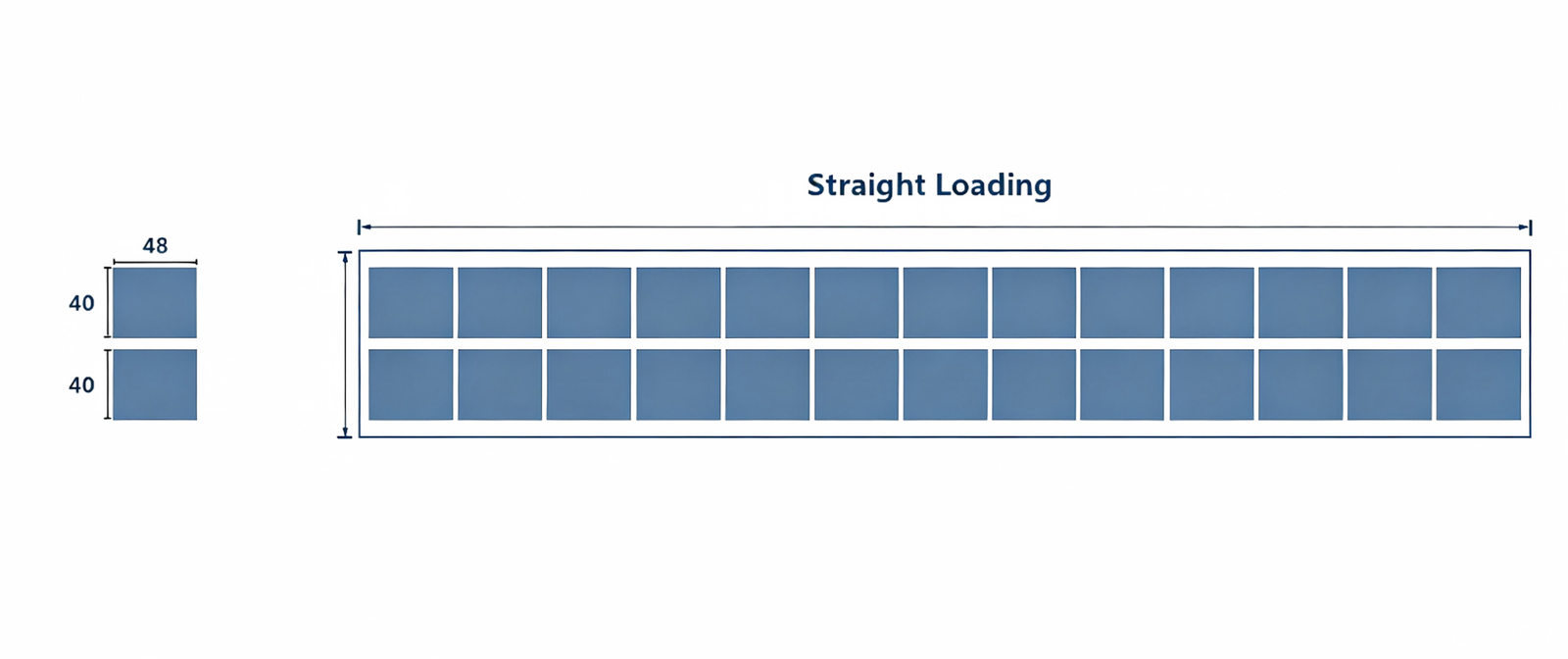
1. Straight Loading
Straight loading places all pallets in the same orientation, creating consistent rows along the length of the container.
It is the easiest arrangement to plan and is useful when:
- All pallets have the same dimensions
- Cargo must remain in a consistent orientation
- Fast loading and unloading are priorities
- Simple warehouse handling is more important than maximum floor utilization
The disadvantage is that straight loading can leave unused floor space when the pallet footprint does not match the container dimensions efficiently.
2. Turned Loading
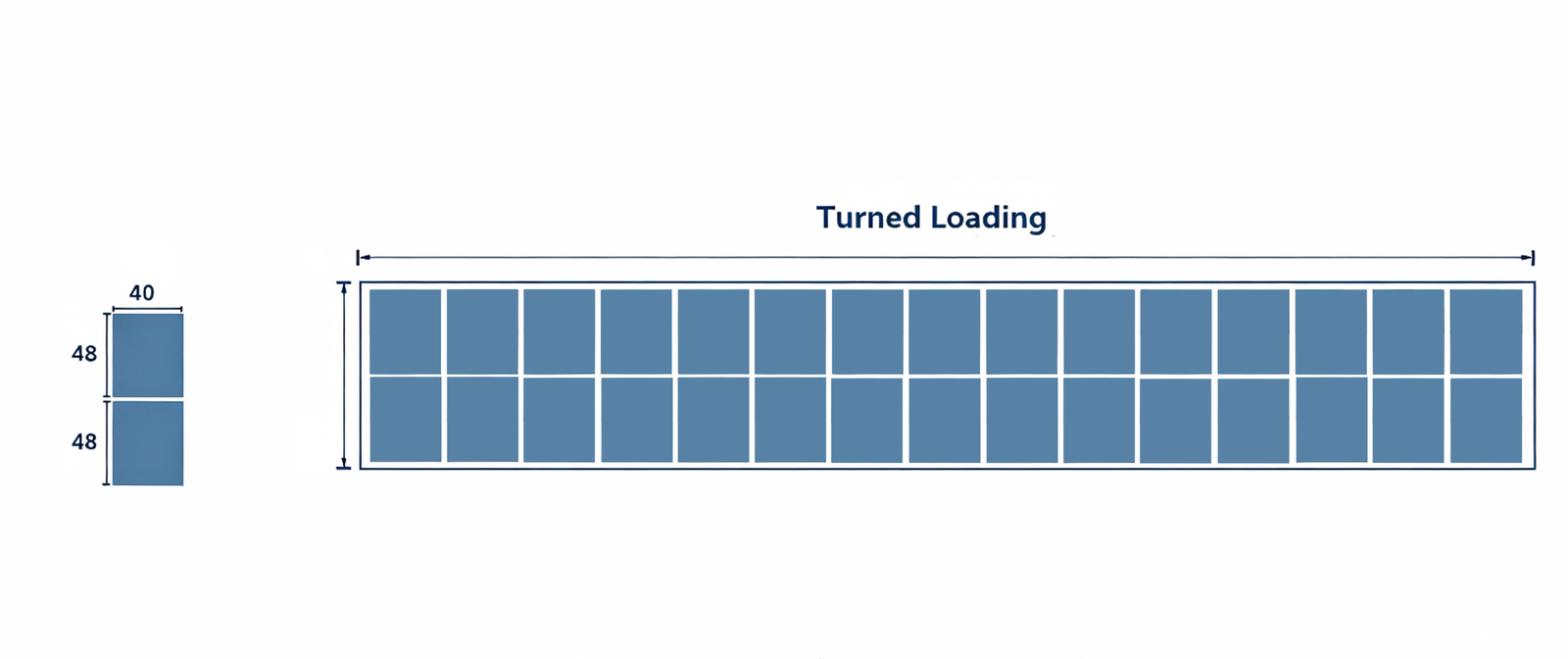
Turned loading rotates the pallet 90 degrees so that its length and width are reversed relative to the container.
This can improve container utilization for some pallet sizes, but not for all. A rectangular pallet may fit more efficiently in one direction than another because the container width is relatively narrow.
For this reason, simply turning every pallet does not necessarily increase the total count.
3. Mixed-Orientation Loading
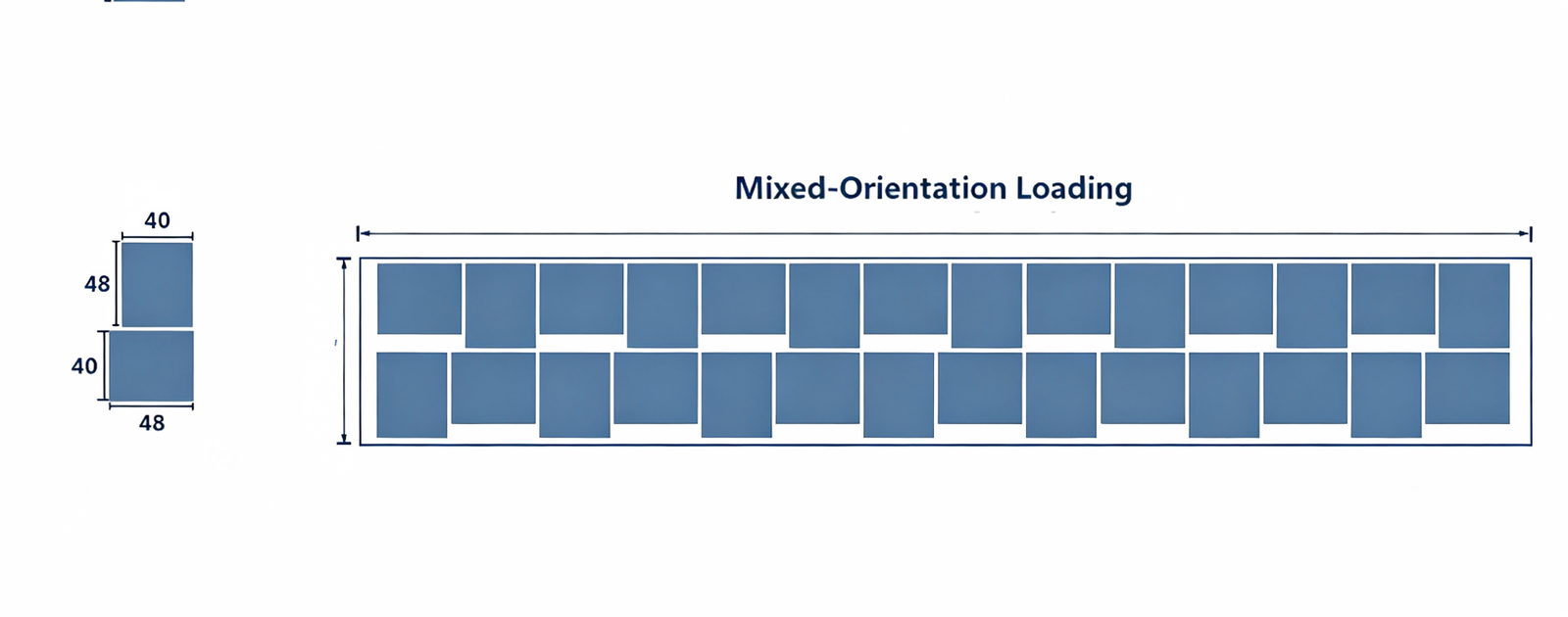
Mixed-orientation loading combines pallets placed in different directions to make better use of the available floor space.
This approach can be particularly effective for rectangular pallet sizes such as 1200 × 800 mm. For example, a 1200 × 800 mm pallet cannot place two 1200 mm sides across a typical container because the internal width is only around 2.35 m. A mixed arrangement can instead combine different orientations and make better use of the remaining floor area.
When the primary objective is maximizing pallets per container, mixed-orientation loading is often worth evaluating before simply using a straight pattern.
However, loading efficiency should never come at the expense of cargo stability, forklift access, door clearance, or safe weight distribution.
How Many Pallets Fit in a 20ft Container?
A standard 20ft dry container has an internal length of approximately 5.9 m and an internal width of approximately 2.35 m, although exact dimensions vary by container manufacturer.
The pallet footprint therefore has a major influence on how many pallets can be loaded.
1200 × 800 mm Euro Pallets
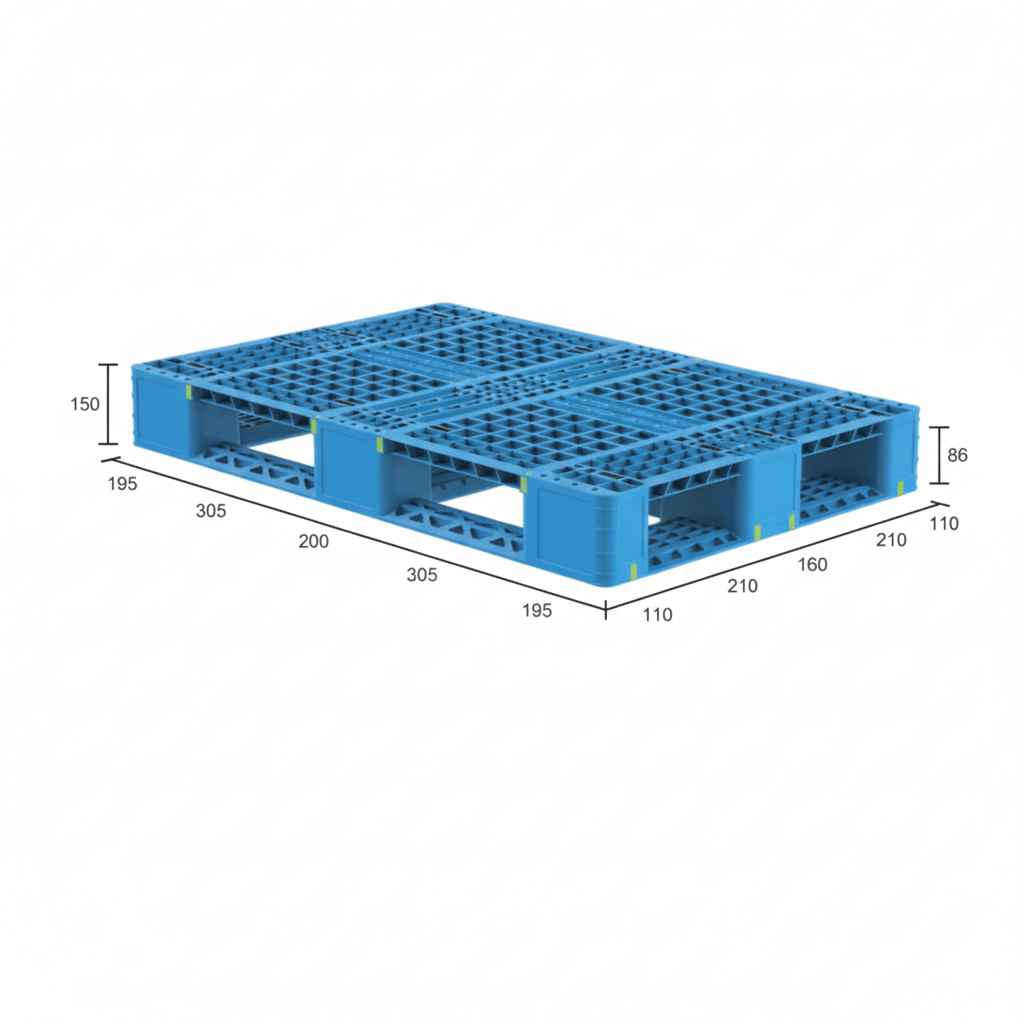
A 1200 × 800 mm Euro pallet is one of the most common pallet footprints in European logistics.
A 20ft container can typically accommodate around 11 pallets in a well-optimized single-layer arrangement.
This is higher than the number obtained from a simple single-orientation layout because the 1200 × 800 mm footprint can be arranged in different orientations to use the container floor more efficiently.
For export shipments, this makes the 1200 × 800 mm pallet an attractive option when the destination market already uses the Euro pallet format.
1200 × 1000 mm Industrial Pallets
A 1200 × 1000 mm pallet occupies more floor space than a 1200 × 800 mm pallet.
A 20ft container can typically accommodate around 10 pallets in a single floor layer. This is a commonly quoted planning figure for standard 20ft container loading.
Although the pallet count is slightly lower than for 1200 × 800 mm pallets, the larger footprint may be a better match for wider cartons, drums, bags, chemical products, or industrial loads.
Therefore, a lower pallet count does not necessarily mean lower logistics efficiency.
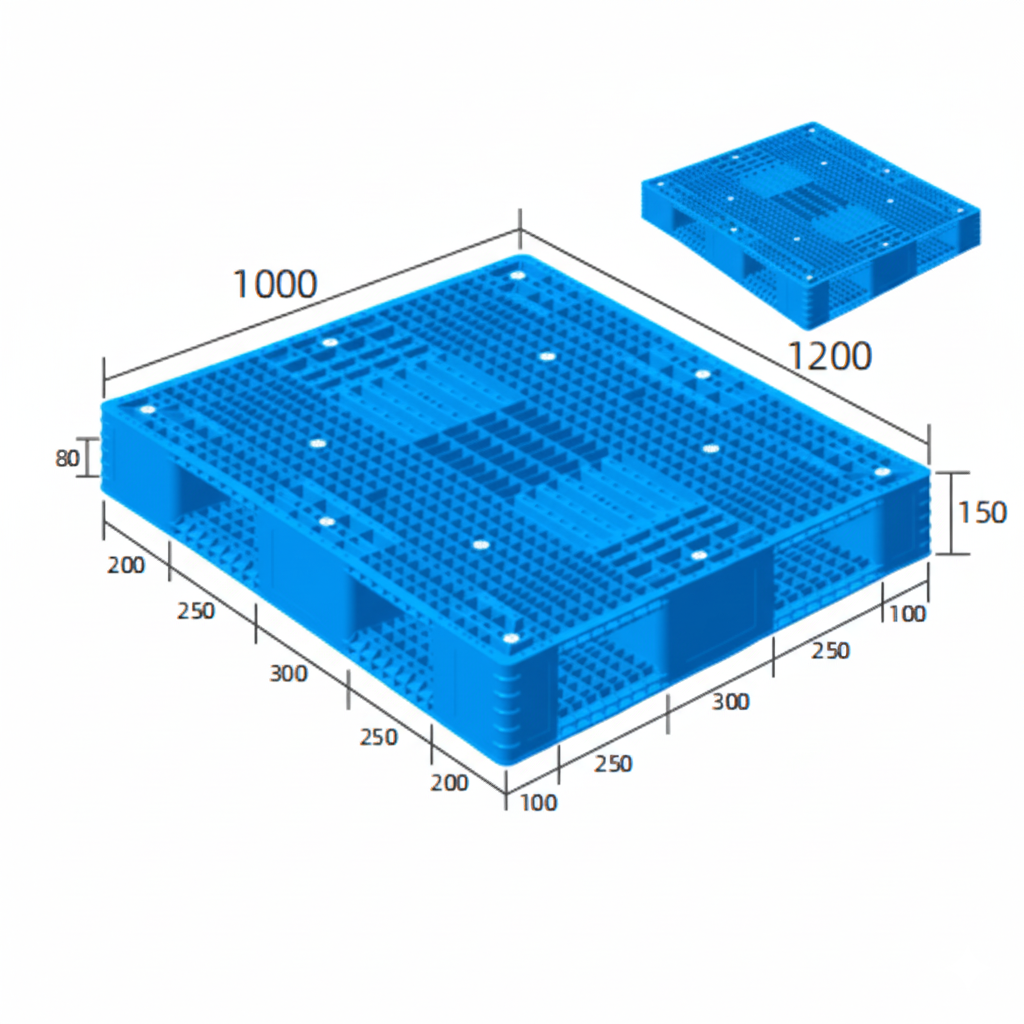
1100 × 1100 mm Pallets
An 1100 × 1100 mm pallet has a square footprint, so rotating the pallet does not significantly change its dimensions.
A typical 20ft container can accommodate around 10 pallets in a single tier.
This size is particularly relevant when supplying markets that already use 1100 × 1100 mm pallets. In this case, compatibility with the customer's warehouse and handling system may be more important than gaining one additional pallet position.
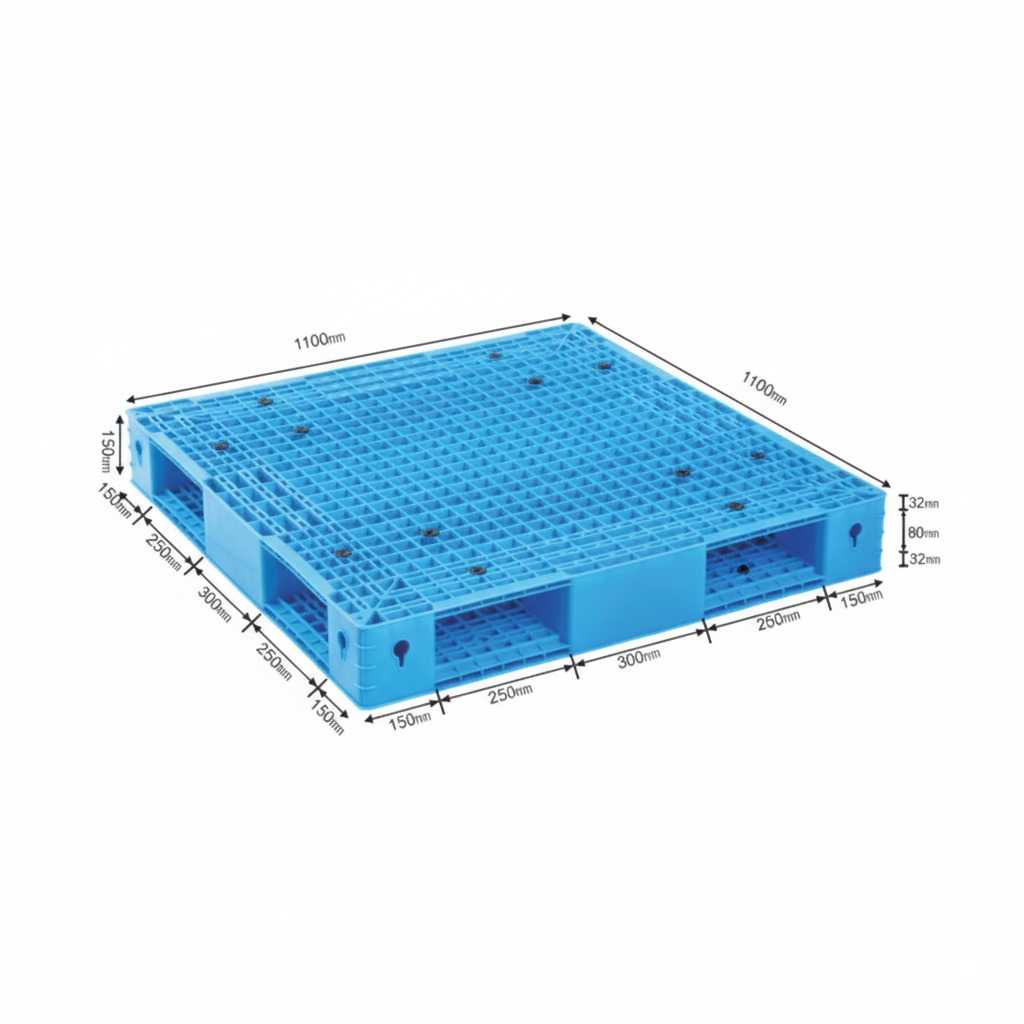
48 × 40 in GMA Pallets
The 48 × 40 in GMA pallet, approximately 1219 × 1016 mm, is the dominant pallet footprint in many North American supply chains.
A 20ft container can typically accommodate around 10 GMA pallets in one floor layer.
For North American shipments, using a GMA-compatible plastic pallet can simplify warehouse handling and distribution even if another pallet footprint could provide a slightly different theoretical loading result.
How Many Pallets Fit in a 40ft Container?
A 40ft container provides roughly twice the floor length of a 20ft container, so its single-layer pallet capacity is approximately twice that of a 20ft container, although the exact ratio depends on the pallet dimensions and loading pattern.
1200 × 800 mm Euro Pallets
A 40ft container can typically accommodate approximately 23–25 1200 × 800 mm pallets in a single floor layer when loaded efficiently.
Some loading plans quote 23–24 pallets, while optimized arrangements can reach approximately 25 depending on the actual usable internal dimensions and loading pattern.
For this reason, 23–25 pallets is a safer planning range than presenting one universal number.
1200 × 1000 mm Pallets
For 1200 × 1000 mm pallets, a 40ft container generally holds around 20–21 pallets in one layer.
This format is widely used for industrial and export applications because its footprint provides a good balance between cargo support and container utilization.
1100 × 1100 mm Pallets
A 40ft container can typically hold around 20 1100 × 1100 mm pallets in a single tier.
Because the footprint is square, rotating the pallet does not provide a major advantage. The main consideration is whether the 1100 × 1100 mm footprint matches the cargo and destination warehouse system.
48 × 40 in GMA Pallets
A 40ft container can typically accommodate around 20–21 48 × 40 in GMA pallets in one floor layer.
For North American export operations, this is a useful baseline for estimating freight requirements before creating a detailed load plan.
How Many Pallets Fit in a 40ft High Cube Container?
A 40ft High Cube container has essentially the same floor footprint as a standard 40ft container, but it provides additional internal height. Therefore, the number of pallets that fit on the floor is generally similar to a standard 40ft container.
| Pallet Size | 40ft Standard | 40ft High Cube | Main Advantage of High Cube |
|---|---|---|---|
| 1200 × 800 mm | 23–25 | 23–25 | More vertical clearance |
| 1200 × 1000 mm | 20–21 | 20–21 | More vertical clearance |
| 1100 × 1100 mm | ~20 | ~20 | More vertical clearance |
| 48 × 40 in GMA | 20–21 | 20–21 | More vertical clearance |
The additional height can become valuable when the cargo is stackable. For example, if loaded pallets are low enough and both the cargo and pallet are designed for safe stacking, a High Cube container may allow two tiers.
However, you should not automatically double the pallet count just because the container is a High Cube.
Before double-stacking, check:
- Total palletized cargo height
- Pallet stacking strength
- Cargo compression strength
- Load stability
- Container door clearance
- Total cargo weight
- Maximum allowable payload
The High Cube's main advantage is therefore additional vertical capacity, not automatically additional floor positions.
Euro vs. GMA vs. Industrial Pallets: Which Size Should You Choose?
The best pallet size depends heavily on where the goods are going and how the goods are handled after arrival.
For European Markets: 1200 × 800 mm
If your goods are primarily shipped to Europe, 1200 × 800 mm is usually the first size to evaluate.
The Euro footprint is widely used in European logistics and distribution systems. It can also provide efficient container utilization when loaded using an optimized arrangement.
A 1200 × 800 mm plastic pallet can be a good choice for:
- General export shipping
- European distribution
- Food and beverage
- Retail products
- Cartons and packaged goods
- Warehousing and distribution centers
For Industrial and Export Applications: 1200 × 1000 mm
The 1200 × 1000 mm footprint is a practical choice when the cargo is wider or when the destination warehouse already uses this format.
It is commonly considered for:
- Chemical products
- Fertilizer
- Flour and agricultural products
- Industrial goods
- Bulk bags
- Drums
- Export shipments
For these applications, cargo footprint and load stability can be more important than gaining one additional pallet position.
For North America: 48 × 40 in GMA
For North American distribution, the 48 × 40 in GMA footprint should usually be considered first.
It fits common warehouse layouts, forklifts, pallet jacks, racking systems, and distribution networks in the region.
If the goods will be delivered into an existing North American supply chain, using a pallet that matches the customer's existing equipment can reduce handling complications.
For Asia and Other Markets: 1100 × 1100 mm
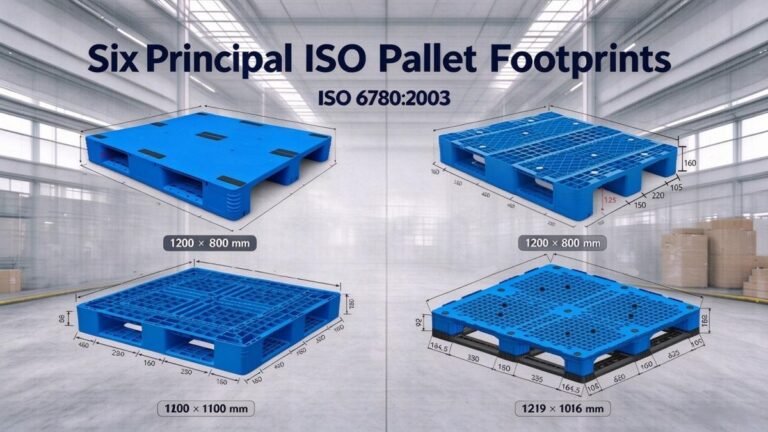
The 1100 × 1100 mm footprint is particularly relevant to Asian supply chains and can be appropriate when the destination customer already uses this pallet format. ISO 6780 recognizes several international pallet footprints, including 1200 × 1000 mm, 1200 × 800 mm, 1219 × 1016 mm, 1100 × 1100 mm, and 1067 × 1067 mm.
The key point is that there is no single "best" pallet size for every export market.
Pallet Size vs. Container Utilization
A common mistake is to choose a pallet simply because it allows the highest number of pallets in a container.
Container utilization should instead be evaluated at three levels:
Cargo → Pallet → Container
For example, a 1200 × 800 mm pallet may allow more pallet positions than a 1200 × 1000 mm pallet. But if your cartons or bags fit the 1200 × 1000 mm footprint much better, the larger pallet may provide better overall cube utilization and cargo stability.
The same principle applies when comparing GMA and metric pallet sizes.
When selecting an export pallet, consider:
- Cargo dimensions
- Pallet footprint
- Container internal dimensions
- Destination market
- Warehouse equipment
- Forklift and pallet jack entry
- Load capacity
- Stacking requirements
- Empty pallet transportation cost
- Whether the pallet is reusable, nestable, or one-way
This is particularly important for plastic pallets because the right structural design can improve both handling performance and transportation efficiency.
How to Calculate Pallets per Container
A simple floor-area calculation can provide an initial estimate:
Container floor area ÷ pallet footprint = theoretical pallet capacity
However, this calculation is only a starting point.
For example, if a container has approximately 5.9 m of usable internal length and 2.35 m of internal width, simply dividing the total floor area by the 1200 × 800 mm pallet footprint does not automatically produce the real loading quantity.
The actual loading plan must consider:
- Pallet orientation
- Available length and width
- Unused gaps
- Door clearance
- Pallet tolerances
- Cargo overhang
- Loading and unloading access
This is why layout-based calculations are more reliable than floor-area calculations alone.
For commercial shipments, the safest approach is to test the actual pallet dimensions against the container's usable internal dimensions before confirming the final quantity.
Should You Choose a Nestable Plastic Pallet for Empty Export Shipping?
If you are exporting empty plastic pallets, the calculation changes significantly.
A standard loaded pallet occupies its full footprint on the container floor. A nestable plastic pallet, however, can be nested inside another pallet to reduce the shipping volume.
This means the relevant question is no longer simply:
How many pallets fit on the container floor?
Instead, you should ask:
How many empty pallets can be nested into one shipping stack, and how many stacks fit inside the container?
For one-way export applications, nestable plastic pallets can therefore help reduce the transportation volume of empty pallets before they reach the destination.
This is one reason pallet design matters as much as pallet footprint when calculating the total logistics cost.
Container Loading Quick Reference
If you need a quick answer for quotation or freight planning, use the following figures as a starting point:
| Common Pallet | Size | 20ft | 40ft / 40ft HC | Typical Market |
|---|---|---|---|---|
| Euro Pallet | 1200 × 800 mm | 11 | 23–25 | Europe |
| Industrial Pallet | 1200 × 1000 mm | 10 | 20–21 | International / Industrial |
| Asian Pallet | 1100 × 1100 mm | ~10 | ~20 | Asia |
| GMA Pallet | 48 × 40 in | 10 | 20–21 | North America |
Use these numbers for preliminary planning only. Final loading quantities should be confirmed using the actual container dimensions, pallet specifications, cargo dimensions, and loading plan.
FAQ
How many pallets fit in a 20ft container?
A 20ft container typically holds about 11 1200 × 800 mm Euro pallets, 10 1200 × 1000 mm pallets, 10 1100 × 1100 mm pallets, or 10 48 × 40 in GMA pallets in a single floor layer, depending on the loading arrangement.
How many pallets fit in a 40ft container?
A 40ft container can typically accommodate around 23–25 1200 × 800 mm pallets, 20–21 1200 × 1000 mm pallets, approximately 20 1100 × 1100 mm pallets, or 20–21 48 × 40 in GMA pallets in a single tier.
How many pallets fit in a 40ft High Cube container?
The floor capacity of a 40ft High Cube is generally similar to a standard 40ft container. The main difference is the additional internal height, which can provide more vertical loading space when the cargo and pallets are suitable for stacking.
Can I fit more pallets by rotating them?
Sometimes. Rotating a rectangular pallet can improve or reduce the number of pallets depending on the relationship between the pallet dimensions and the container's internal dimensions. For some pallet sizes, mixed-orientation loading can provide better floor utilization than keeping every pallet in the same direction.
What is the most efficient pallet size for container shipping?
There is no universal best size. 1200 × 800 mm can provide efficient loading for many European shipments, while 1200 × 1000 mm and 48 × 40 in can be better choices when cargo dimensions or destination-market standards favor those footprints.
Is a 1200 × 800 mm pallet better than a 1200 × 1000 mm pallet?
Not necessarily. A 1200 × 800 mm pallet can provide a higher pallet count in some container configurations, but a 1200 × 1000 mm pallet may support larger cargo more efficiently. The best choice depends on cargo dimensions, destination market, warehouse handling, and total logistics cost.
How many plastic pallets fit in a container?
Plastic pallets have essentially the same floor capacity as other pallets with the same dimensions. For example, a 1200 × 800 mm plastic pallet occupies the same floor footprint as a 1200 × 800 mm wooden pallet. The advantage of plastic pallets may come from other characteristics such as durability, hygiene, reusable design, or nestability.
How many empty plastic pallets fit in a container?
This depends on the pallet design. Nestable plastic pallets can be stacked inside one another, allowing substantially more empty pallets to be transported in the same container than loaded pallets arranged individually on the floor. The exact quantity depends on the pallet's nesting ratio and stack height.
Does a High Cube container fit more pallets?
Not necessarily on the floor. A 40ft High Cube has approximately the same floor dimensions as a standard 40ft container, so the single-tier pallet count is usually similar. Its additional height can provide more capacity when the palletized cargo can be safely stacked.
Need Help Choosing the Right Plastic Pallet Size?
Choosing the right pallet starts with more than the pallet dimensions. Your cargo size, destination market, container type, handling equipment, and loading pattern all affect the final choice.
If you are comparing 1200 × 800 mm, 1200 × 1000 mm, 1100 × 1100 mm, or 48 × 40 in plastic pallets, our team can help you evaluate the best footprint for your shipment.
Send us your cargo dimensions, destination market, and container type. We can help you select a plastic pallet size that balances container utilization, handling requirements, and overall shipping efficiency.
My Role
With over 20 years in the plastic pallet industry, I do more than supply pallets to customers. I provide end-to-end support from pallet selection to delivery, including sea freight assistance to help clients plan container shipping for their pallets, helps customers simplify logistics and avoid unnecessary troubles.
About Euro Plastic Pallet
Euro Plastic Pallet is a plastic pallet manufacturer with over 20 years of production experience, headquartered in China. We provide high-quality, customized plastic pallet solutions for brand owners, wholesalers, and distributors.
With 60+ injection/rotational molding machines, each staffed with quality control[^12] personnel having 5+ years of experience, we ensure consistent product quality.
Services
- Products: Complete plastic pallet solutions
- Customization: Custom colors, logos, and molds
- International Certifications: ISO 9001, CE, REACH, ROHS, SGS, FDA, GRS
Quality Assurance
- Raw Material Testing: Complies with RoHS, REACH standards, meeting international strength and performance requirements
- Precision Manufacturing: Automated injection molding, precision assembly, accuracy ±0.1mm
- Comprehensive Inspection: 100% factory testing, ISO 9001 sampling protocols ensuring high standards
- Certifications: ISO 9001, CE, REACH, ROHS, SGS, FDA standards compliance
Production Capacity
- High-Quality Manufacturing: 60+ injection/rotational molding machines following ISO 9001
- Premium Customization: Customized solutions for global brands
- Flexible Solutions: Customer-specific customization[^17] enhancing market competitiveness
Global Impact
Serving global customers with reliable plastic pallets[^1] and customized logistics packaging solutions[^18], supporting business growth and customer trust.