I often see buyers ask for one fixed beer pallet capacity. That number can be misleading when the beer format, case size, pallet footprint, or stacking pattern changes.
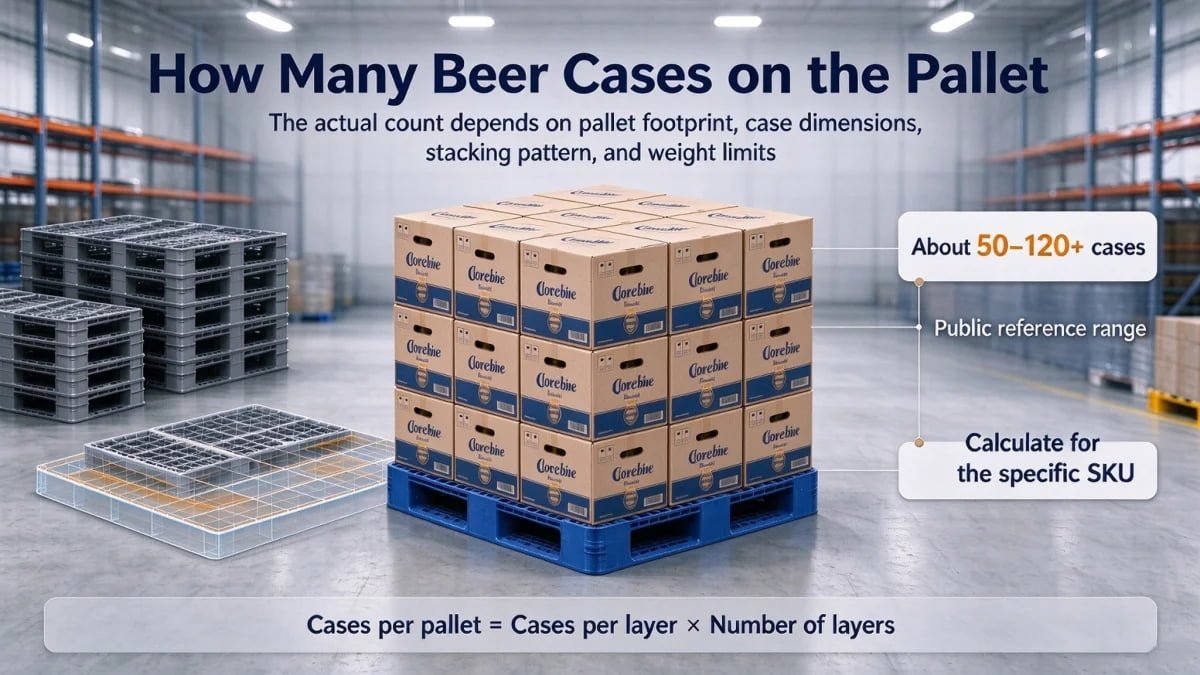
There is no single standard number. A beer pallet may hold roughly 50–120+ cases in different public configurations, but the actual capacity depends on pallet footprint, beer pack format, case dimensions, stacking pattern, and weight limits.
I have worked with plastic pallets for many years, and I usually start with the beer load instead of the pallet. I ask what beer format is being handled, how many cans or bottles are in each case, how large the case is, and how high the finished pallet can be. I also check the total weight and handling equipment. This gives me a more useful answer than simply saying that one pallet holds 80, 90, or 100 cases.
What Is a Beer Pallet?
I use the term beer pallet to describe a pallet used or optimized for brewery and beverage distribution work. I do not treat it as one universal pallet size or one fixed design.
A beer pallet can handle cardboard beer cases, reusable plastic beer crates, cans, bottles, or kegs. A beverage pallet and brewery pallet can serve similar applications, while a plastic beer pallet focuses on the material and handling characteristics of the pallet itself.
When I choose a pallet for beer cases, I mainly look at the case footprint, load weight, stacking height, and handling system. When I choose one for kegs, I pay more attention to keg diameter and load retention.
I also look at the environment. Breweries and beverage warehouses can involve water, condensation, spills, cleaning, cold storage, and repeated handling. These conditions can make pallet material and deck design important.
So, when I hear “beer pallet,” I do not immediately think of a particular dimension. I think about the complete beer handling application.
How Many Cases of Beer Can a Pallet Hold?
I would not give one fixed case count without knowing the beer package. I use the pallet footprint and actual case dimensions to calculate the first estimate, then I check the weight and handling requirements.
A beer pallet may hold roughly 50–120+ cases in different public configurations, but this is a broad observed range, not an industry standard. The actual count must be calculated from the specific beer SKU and pallet pattern.
| Factor | Example effect |
|---|---|
| Pallet footprint | Changes available layer area |
| Case dimensions | Changes cases per layer |
| Pack format | Changes case size and weight |
| Stacking pattern | Changes layer efficiency |
| Number of layers | Changes final case count |
| Case weight | Can limit total quantity |
| Pallet capacity | Limits safe loaded weight |
| Transport height | Can limit stacking |
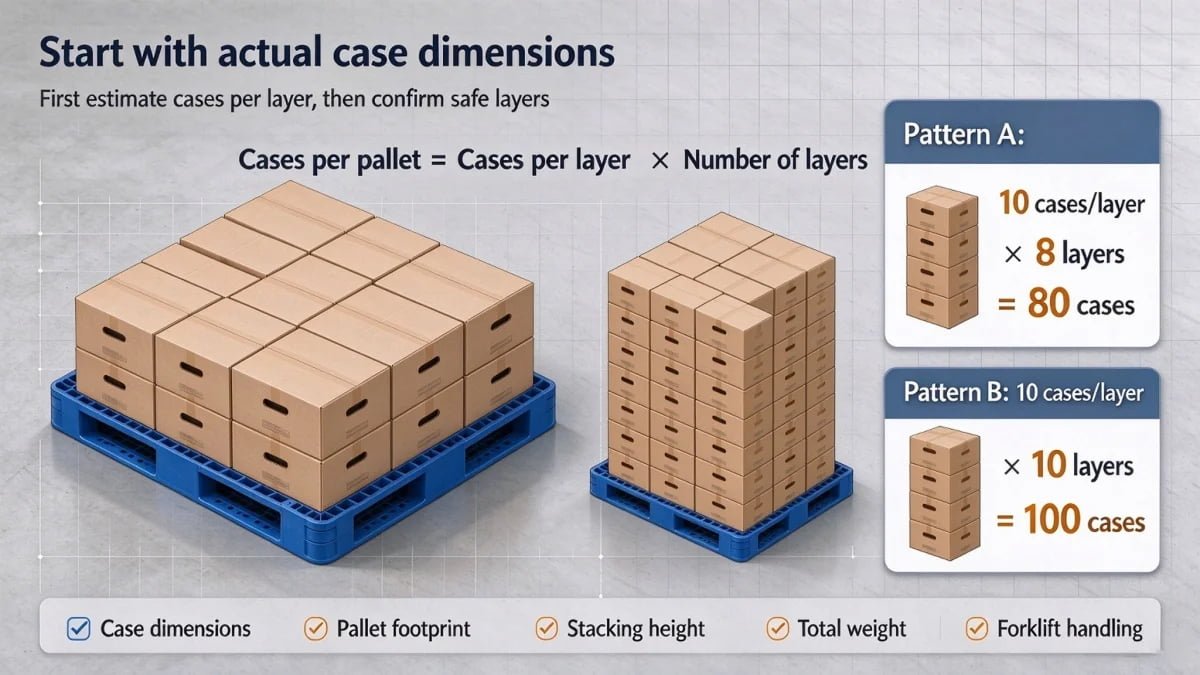
I use one simple formula as the starting point:
Cases per pallet = Cases per layer × Number of layers
For example, if I can place 10 cases on each layer and safely stack 8 layers, the calculation gives 80 cases. If I can use 10 layers with the same pattern, the calculation gives 100 cases.
I still do not call either number the final answer. I need to check the finished pallet height, total load weight, stability, forklift handling, and transport conditions.
One public brewery configuration, for example, lists 100 cases of 12 oz standard cans on a pallet. Other package formats at the same brewery use different case counts. I use examples like this to show the main point: the beer package changes the pallet count.
How Many 12 oz or 330 ml Beer Cases Fit on a Pallet?
I often see 12 oz cans used in North American beer distribution and 330 ml cans or bottles used in international markets. I do not calculate pallet capacity from the liquid volume alone.
12 oz and 330 ml beer can have very different pallet capacities because the can or bottle, pack count, case dimensions, and stacking pattern all affect the final pallet configuration.
For 12 oz cans, I first check whether the product uses a 12-pack, 24-pack, 30-pack, or another format. A 24-pack case can have a different footprint from a 30-pack case. I also check the case height because it affects the number of layers.
I use the same approach for 330 ml beer. A 330 ml can and a 330 ml bottle do not necessarily use the same case dimensions. A 24 × 330 ml carton can also have a different footprint from a reusable plastic crate holding the same number of bottles.
Public configurations can show 90 or 120 cases per pallet for some 330 ml beer products, while other configurations use different counts. I do not use those numbers as a universal answer.
The important measurement is the outside case footprint. If I know that footprint, I can test how many cases fit on each pallet layer. I can then check how many layers are practical.
How Many 500 ml Beer Cases Fit on a Pallet?
I normally expect a 500 ml beer format to hold fewer cases than a comparable 330 ml format when the pack structure and pallet footprint are similar. The reason is not simply the liquid volume. The larger package often changes the case dimensions, case weight, and stacking height.
Some public 500 ml beer configurations show roughly 72–90 cases per pallet, but the actual capacity depends on the package, case footprint, pallet size, and stacking pattern.
I first check whether the 500 ml beer uses cans or bottles. I then check how many units are in each case. A 12-pack can have a very different footprint from a 24-pack.
I also check case weight. More beer per case can increase the total pallet weight quickly. A pallet may still have enough physical space for another layer, but the finished load may already be too heavy for the application.
For me, this is why I avoid answering “How many 500 ml cases fit?” with one number. I need the actual case drawing or dimensions before I can confirm the layer pattern.
What Determines Beer Cases per Pallet?
I normally check eight things before I confirm a beer pallet configuration. I start with the physical dimensions, then move to weight and handling.
Beer case capacity depends on pallet size, case dimensions, packaging format, cases per layer, number of layers, case weight, pallet load capacity, and maximum transport height.
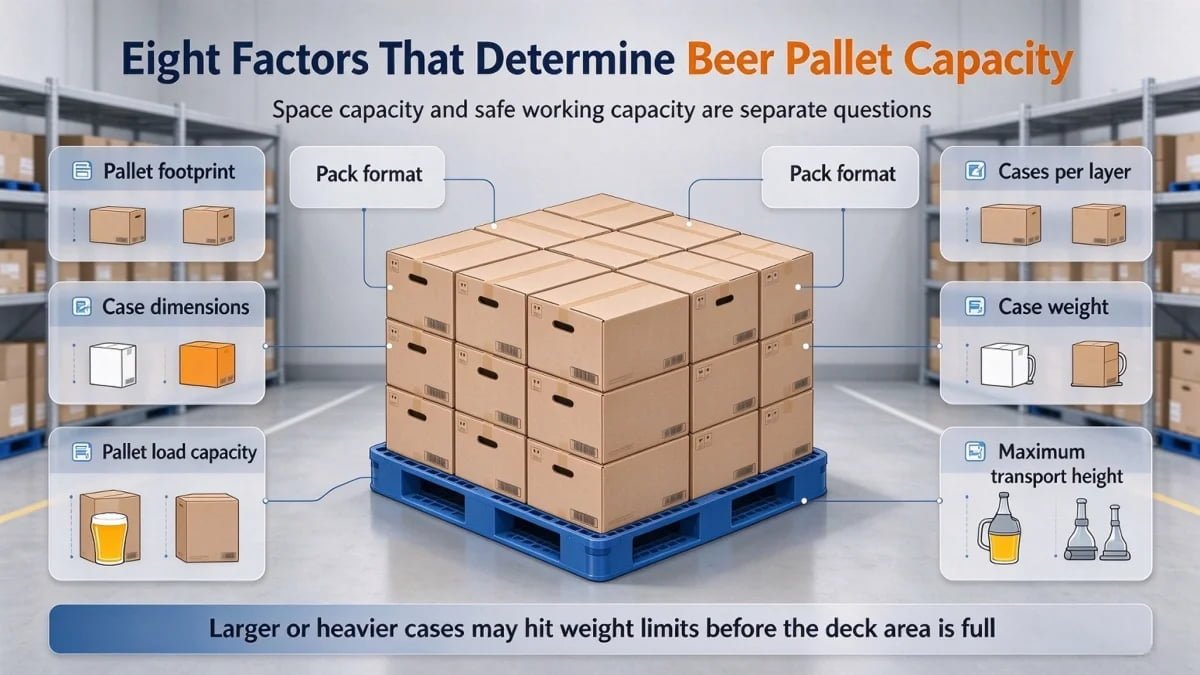
Pallet Size
I check the pallet length and width first. Common footprints can include 48 × 40 inches, 1200 × 800 mm, 1200 × 1000 mm, and beverage-focused sizes such as 1100 × 1200 mm or 1100 × 1240 mm.
2. Case Dimensions
I measure the actual outside length, width, and height of the beer case. I do not calculate from bottle or can volume alone.
3. Beer Packaging
I check cans, bottles, cartons, trays, shrink-wrapped packs, and reusable crates separately. Each format can create a different load pattern.
4. Cases per Layer
I test how many cases fit on one layer. I may rotate the case or change the pattern to improve space use and stability.
5. Number of Layers
I then check the maximum practical number of layers. Warehouse clearance, truck height, pallet stability, and handling equipment can all limit the number.
6. Case Weight
I calculate the weight of all cases on the pallet. Weight can become the limit before the available deck area is fully used.
7. Pallet Load Capacity
I check the required static, dynamic, and racking conditions instead of using only one load rating.
8. Maximum Transport Height
I check the finished pallet height against the warehouse, truck, container, and handling system.
I treat “space capacity” and “safe working capacity” as two different questions. A pallet may physically hold more cases, but that does not mean I should load those extra cases.
Do Beer Cases and Beer Kegs Need the Same Pallet?
I do not use the same pallet logic for beer cases and beer kegs. The two loads behave differently during handling and transport.
Beer cases use a rectangular stacking pattern, while beer kegs are cylindrical. Keg loads therefore need more attention to diameter, retention, anti-roll design, stacking, and center of gravity.
I think of a case pallet as a flat loading surface. I think of a keg pallet more like a group of fixed parking spaces.
A cardboard case can usually sit directly beside another rectangular case. A keg has a round body, so gaps can appear between kegs. The keg can also move or roll if the pallet does not control it.
This does not mean every keg needs a completely different pallet. It means I need to check the actual keg format and handling process before I decide whether a standard pallet is suitable.
What Is a Beer Keg Pallet?
I use the term beer keg pallet for a pallet designed or optimized to keep cylindrical beer kegs stable during storage, handling, and transport.
A beer keg pallet uses its footprint and retention features to control cylindrical kegs. The design can account for keg diameter, 20 L, 30 L, 50 L, and US keg formats, as well as stacking and handling requirements.
I first check keg diameter because diameter controls how many kegs fit on a layer. I then check keg height and weight. I also check whether the pallet uses rings, dividers, skids, or another retention method.
I have seen commercial keg pallet designs that support multiple keg formats rather than one single size. That approach can be useful for distributors that handle different keg SKUs.
US formats can include 1/2 BBL, 1/4 BBL, and 1/6 BBL kegs. European systems can also use 20 L, 30 L, and 50 L formats. I do not assume that similar volume means similar outside dimensions.
For keg pallets, I care about stability as much as capacity. A pallet that holds more kegs but allows them to move during transportation is not a good final configuration.
Why Use a Plastic Pallet for Beer?
I do not say that plastic is always better than wood. I look at the operating environment and handling system first.
Plastic pallets can suit beer distribution because they can provide easy-to-clean surfaces, consistent dimensions, moisture resistance, reusable handling, automation compatibility, and anti-slip options.
I pay attention to pallets' cleanability and how to clean when the pallet works around water, condensation, and beer spills. I also look at repeated handling because reusable distribution can put the pallet through many handling cycles.
I care about dimensional consistency when the pallet runs through conveyors, palletizers, or automated warehouse systems. I also check the deck surface because load movement can become a problem during forklift handling and transportation.
Cold environments are another point I check. If a pallet enters a cold room or refrigerated area, I need to confirm that the selected plastic material and pallet design suit the operating temperature.
I also ask whether the pallet is part of a one-way export flow or a reusable distribution loop. The right design can be different for each application.
How Do I Choose a Plastic Beer Pallet?
I start with the beer load and then choose the pallet. I do not start with a pallet model and try to make the beer fit it.
I choose a plastic beer pallet by confirming the beer format, case dimensions, target quantity, total load, handling equipment, automation, rack storage, temperature, washdown conditions, and distribution model.
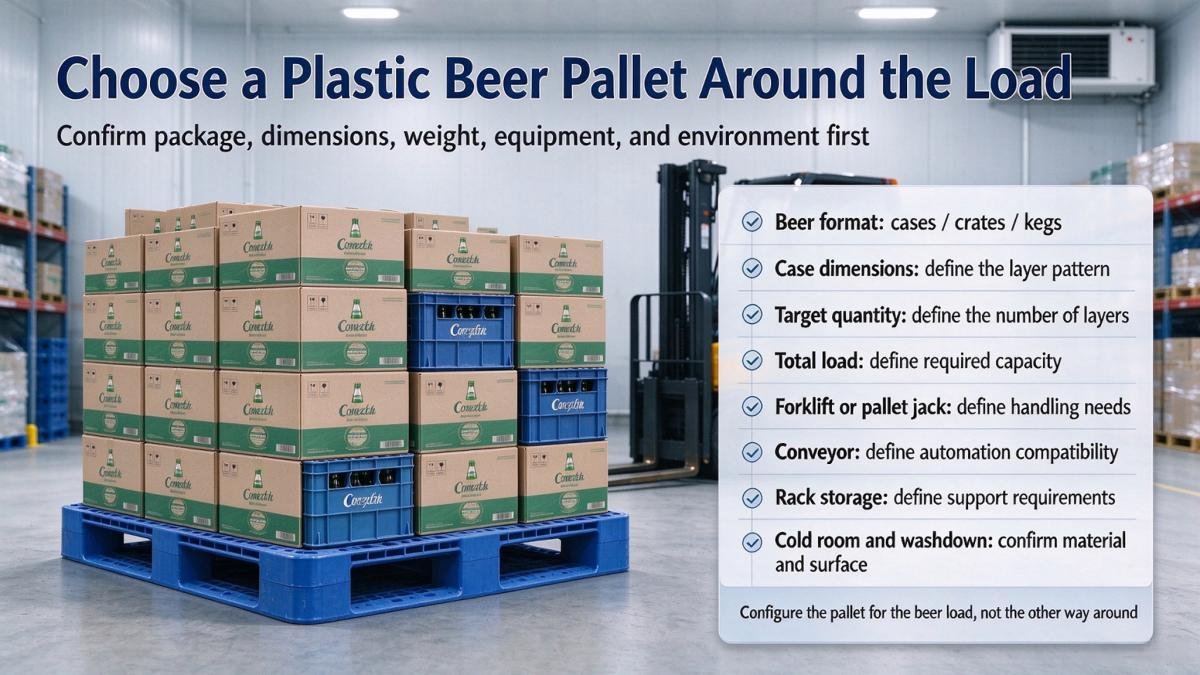
I use this checklist when I discuss a new application:
| Question | Why I ask it |
|---|---|
| What beer format? | Defines the load type |
| What case dimensions? | Defines the layer pattern |
| Cases per layer? | Defines basic capacity |
| Number of layers? | Defines final quantity and height |
| Total load? | Defines required capacity |
| Forklift or pallet jack? | Defines handling needs |
| Conveyor? | Defines automation compatibility |
| Rack storage? | Defines support requirements |
| Cold room? | Defines temperature requirements |
| Washdown? | Defines surface and cleaning needs |
| One-way or reusable? | Defines the distribution model |
I also ask whether the customer handles cases, crates, kegs, or mixed loads. A standard plastic pallet may be enough for one application, while another may need a more specialized deck or retention design.
Final Thoughts: Choose the Pallet Around the Beer Load
I have found that the best beer pallet decisions start with the beer, not the pallet. I first confirm the package, case or keg dimensions, target load, and handling conditions.
There is no single universal beer cases-per-pallet number. Public configurations can show roughly 50–120+ cases, but those figures describe different products and pallet patterns. I use them as reference points, not as promises.
For 12 oz cans, one public brewery configuration lists 100 cases, with 24 cans per case. Other 12 oz formats use different counts. For 330 ml and 500 ml beer, I also expect different results because the case footprint, weight, and stacking pattern can change.
If you need a plastic beer pallet for cases, crates, or kegs, I recommend starting with the actual load. Euro Plastic Pallet can evaluate the pallet configuration around your beer format, target load, handling equipment, and working environment.
If you know your beer case or keg dimensions, target cases per pallet, pallet size, and loaded weight, you can use those details to define the right plastic pallet configuration for your application.
Frequently Asked Questions
How many cases of beer can a pallet hold?
There is no universal answer. Public brewery and beverage configurations can show roughly 50–120+ cases, but the actual number depends on the beer format, case dimensions, pallet footprint, stacking pattern, and load limits.
How many 12 oz beers are on a pallet?
One public Full Sail configuration lists 100 cases of 12 oz standard cans, with 24 cans per case, or 2,400 cans. Other 12 oz package formats use different pallet counts.
How many 330 ml beer cases fit on a pallet?
Public trade configurations can show around 90 or 120 cases per pallet for some 330 ml formats. I would confirm the actual bottle or can dimensions and pallet pattern before using either number.
How many 500 ml beer cases fit on a pallet?
Some public configurations show roughly 72–90 cases per pallet. I would still calculate the actual capacity from the case footprint, weight, pallet size, and stacking height.
What is a beer pallet?
A beer pallet is a pallet used or optimized for brewery and beverage distribution applications. It can handle beer cases, bottles, cans, reusable crates, or kegs depending on its design.
What is a keg pallet?
A keg pallet is designed or optimized for cylindrical beer kegs. It can use retaining features, rings, dividers, or other structures to reduce keg movement during handling and transportation.
Are plastic pallets suitable for beer?
Yes. Plastic pallets can be used for beer cases, bottles, cans, crates, and kegs when the selected pallet matches the load, handling equipment, temperature, automation, and distribution requirements. Beverage-focused pallet suppliers such as ORBIS, DW Reusables, and Rehrig Pacific also offer products designed around beer and beverage applications.
My Role
Having spent years advising beverage manufacturers and distributors, I know that choosing the right pallet comes down to two critical factors: perfect packaging fit and maximized load density. I built this practical assessment guide based on hands-on industry experience to help you find right beer pallet.
About Euro Plastic Pallet
Euro Plastic Pallet is a plastic pallet manufacturer with over 20 years of production experience, headquartered in China. We provide high-quality, customized plastic pallet solutions for brand owners, wholesalers, and distributors.
With 60+ injection/rotational molding machines, each staffed with quality control[^12] personnel having 5+ years of experience, we ensure consistent product quality.
Services
- Products: Complete plastic pallet solutions
- Customization: Custom colors, logos, and molds
- International Certifications: ISO 9001, CE, REACH, ROHS, SGS, FDA, GRS
Quality Assurance
- Raw Material Testing: Complies with RoHS, REACH standards, meeting international strength and performance requirements
- Precision Manufacturing: Automated injection molding, precision assembly, accuracy ±0.1mm
- Comprehensive Inspection: 100% factory testing, ISO 9001 sampling protocols ensuring high standards
- Certifications: ISO 9001, CE, REACH, ROHS, SGS, FDA standards compliance
Production Capacity
- High-Quality Manufacturing: 60+ injection/rotational molding machines following ISO 9001
- Premium Customization: Customized solutions for global brands
- Flexible Solutions: Customer-specific customization[^17] enhancing market competitiveness
Global Impact
Serving global customers with reliable plastic pallets[^1] and customized logistics packaging solutions[^18], supporting business growth and customer trust.