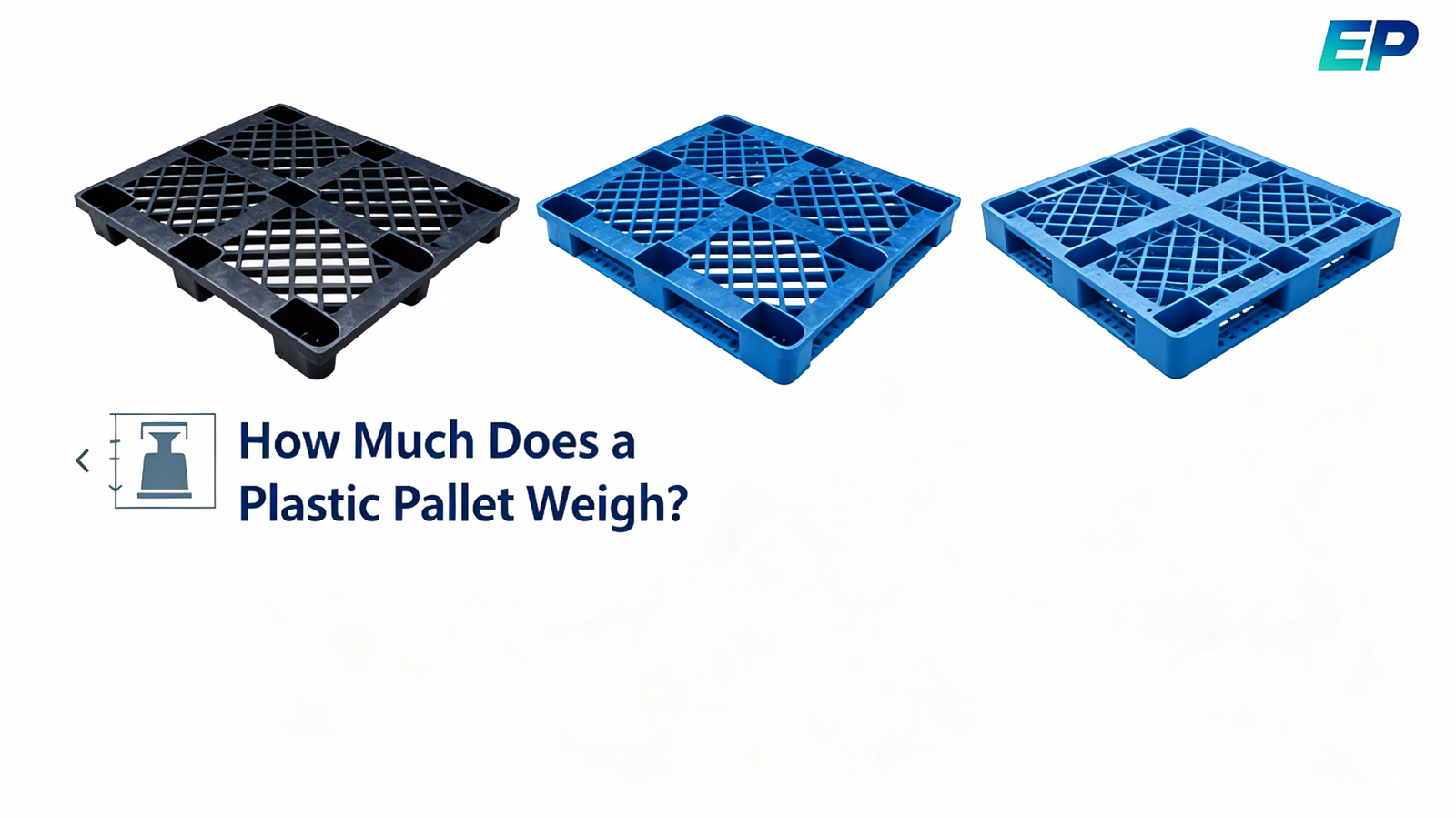
A pallet that is too heavy can increase freight weight and reduce usable payload. Yet choosing the lightest pallet can create load and durability problems.
A plastic pallet can weigh around 10 kg for lightweight designs, about 10–20 kg for standard pallets, and over 20 kg for heavy-duty models. Weight depends on size, material, structure, and reinforcement. As a specialized plastic pallet manufacturer, we see how these design choices directly impact your total logistics costs.
The important point is that pallet weight is not a fixed industry standard. To choose the right pallet, you need to look at weight together with structure, load requirements, material, and reinforcement.
How Much Does an Empty Plastic Pallet Weigh?
The weight of an empty plastic pallet varies widely because manufacturers use different materials, structures, wall thicknesses, and reinforcement options.
A lightweight plastic pallet may weigh around 10 kg, while standard virgin-material pallets are often about 10–30 kg. Heavy-duty designs can exceed 30 kg. These are approximate ranges, not fixed industry standards.
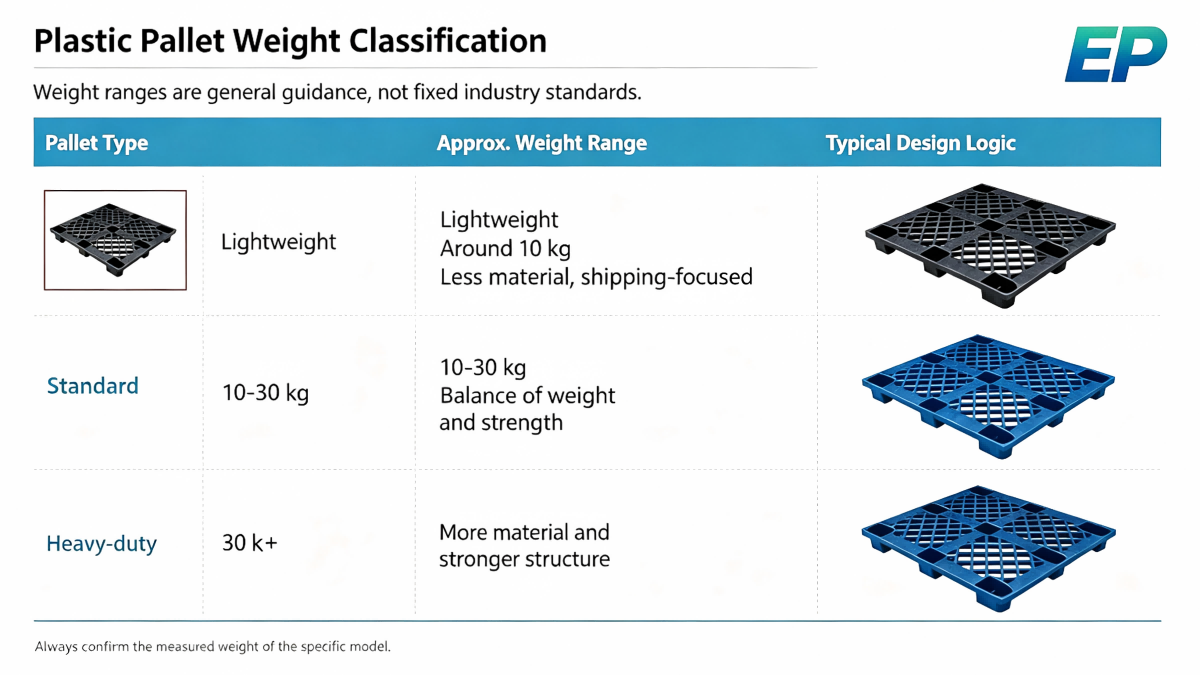
When I discuss pallet weight with buyers, I normally start by separating pallets into three broad groups:
| Pallet Type | Approx. Weight Range | Typical Design Logic |
|---|---|---|
| Lightweight | Around 10 kg | Less material, shipping-focused |
| Standard | About 10–30 kg | Balance of weight and strength |
| Heavy-duty | 30 kg+ | More material and stronger structure |
These figures should be treated as general guidance rather than a specification for every pallet on the market.
Lightweight pallets and one-way plastic pallets made with recycled material can be around 10 kg. Some grid-deck designs can be below 10 kg because the open structure uses less material. This can be useful when pallet tare weight is an important part of shipping calculations.
Standard pallets made from virgin material are commonly around 10–30 kg. They provide a balance between pallet weight, structural performance, and repeated handling.
Heavy-duty pallets can weigh more than 30 kg. They generally use more material or stronger structural features. Some also include steel reinforcement bars.
It is also important to separate empty pallet weight from loaded pallet weight. Empty pallet weight is the tare weight of the pallet itself. Loaded pallet weight includes the pallet, products, packaging, and any other cargo placed on it.
For procurement, I recommend asking the supplier for the actual measured weight of the specific pallet model. Do not assume that two pallets with the same dimensions will have the same weight.
What Determines the Weight of a Plastic Pallet?
Two plastic pallets with the same outside dimensions can have very different weights. The difference usually comes from their material, geometry, wall thickness, load requirements, and reinforcement.
Plastic pallet weight is mainly determined by size, material, deck design, structural design, load requirements, and steel reinforcement.
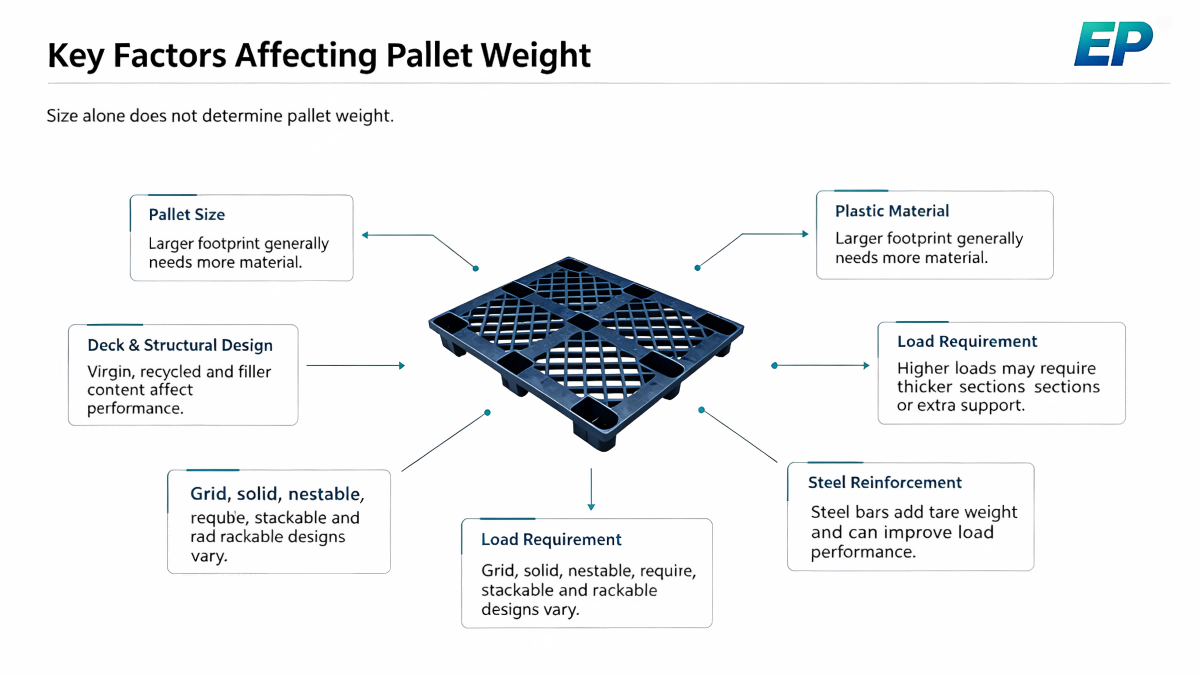
Pallet Size
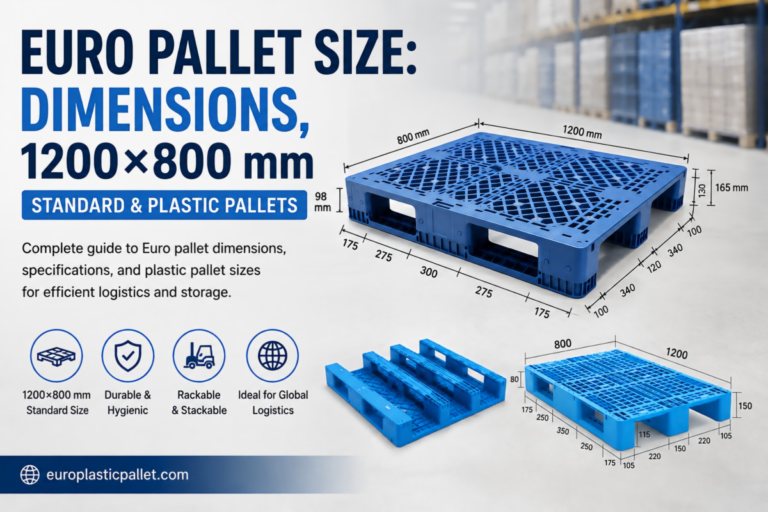
A larger pallet footprint generally requires more material, so size can affect weight. Common examples include 1200×800 mm, 1200×1000 mm, and 48×40 inch pallets.
However, dimensions alone cannot tell you how much a pallet weighs. A pallet’s height, wall thickness, runner structure, and internal geometry also affect material consumption. For detailed dimensions, check our guide on standard pallet sizes and why they matter.
For example, two 1200×800 pallets can have different weights if one is designed as a lightweight shipping pallet—such as our 1200 x 800 lightweight plastic pallet—and the other is designed for heavier repeated use.
Plastic Material
Material selection also affects pallet weight and structural performance.
Virgin material and recycled material can have different physical characteristics. The composition of recycled resin can also vary, including the presence of fillers. For this reason, material should not be reduced to a simple rule such as “one material is always heavier.”
When comparing suppliers, I would confirm the material grade together with the pallet’s actual weight and performance requirements.
Deck and Structural Design
The pallet’s design can make a significant difference.
Grid or open-deck pallets generally use less material than designs with a large solid deck. This is one reason some lightweight pallets can be made at around or below 10 kg.
Other structural choices also matter:
- Nestable pallets are designed to fit inside one another when empty, which can reduce empty-pallet storage requirements.
- Stackable pallets use structural features that allow loaded pallets to be stacked.
- Rackable pallets require sufficient structural support for racking applications.
- Heavy-duty designs generally use more material or stronger structural elements.
The same footprint can therefore be produced in several weight ranges. Explore options directly from a plastic pallet manufacturer to find the structural fit for your supply chain.
Load Requirement
Load requirements are another major factor. A pallet designed for one-way shipping does not necessarily need the same structure as a pallet intended for repeated warehouse circulation or racking.
Static load, dynamic load, and racking requirements should be considered separately. For a deeper dive into these ratings, read our analysis on plastic pallet load capacity. Increasing the required performance can lead to additional material, thicker sections, or reinforcement.
Steel Reinforcement Bars
Steel reinforcement is one factor buyers sometimes overlook.
Steel bars placed inside the pallet deck or runners directly add to the pallet’s tare weight. The number of steel bars also affects the final weight.
At the same time, reinforcement can improve the pallet’s ability to handle higher static or dynamic loads and demanding racking applications.
This means a heavier pallet is not necessarily inefficient. Part of that extra weight may come from a deliberate reinforcement system designed around the required application.
Does a Heavier Plastic Pallet Mean a Stronger Pallet?
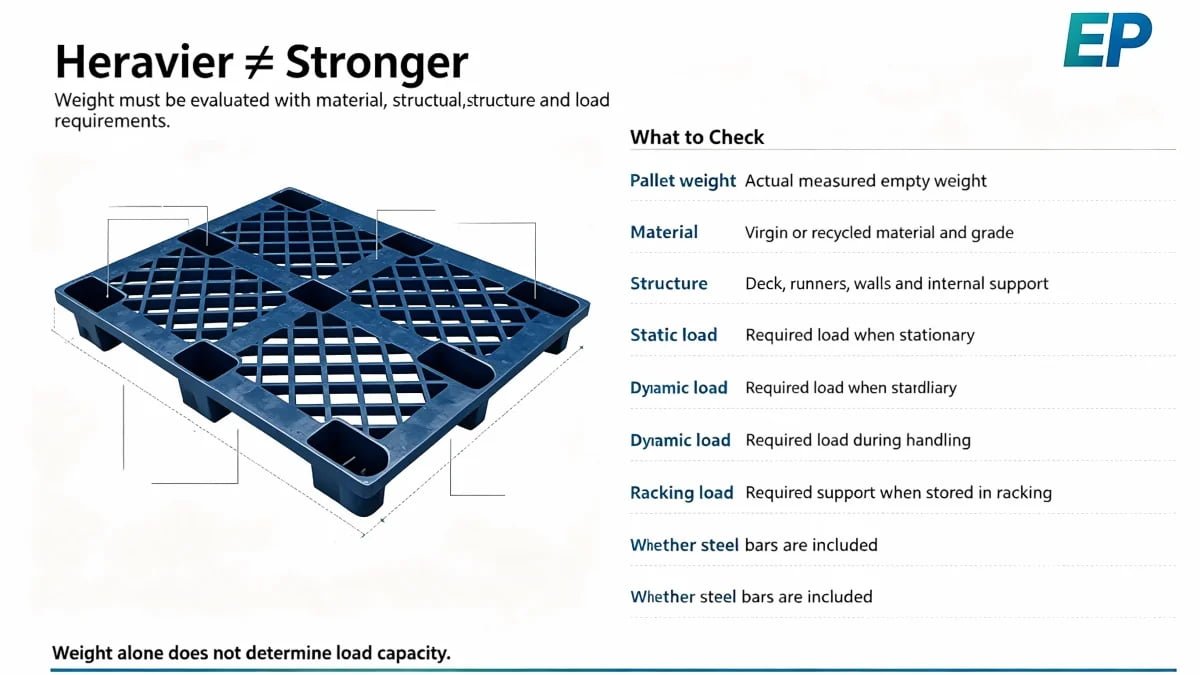
A heavier plastic pallet often contains more material or reinforcement, but weight alone cannot prove that a pallet is stronger or better.
A heavier pallet may have higher load performance, but pallet weight should always be evaluated together with material, structural design, and the required static, dynamic, and racking loads.
This is an important distinction when comparing suppliers.
A pallet may be heavier because it has thicker walls, a stronger runner structure, or steel reinforcement. Those features can be useful when the application requires higher performance.
However, extra weight does not automatically mean better quality. As a buyer, I would avoid selecting a pallet simply because its specification sheet shows a higher kilogram figure.
| Comparison Factor | What to Check |
|---|---|
| Pallet weight | Actual measured empty weight |
| Material | Virgin or recycled material and material grade |
| Structure | Deck, runners, walls, and internal support |
| Static load | Required load when stationary |
| Dynamic load | Required load during handling |
| Racking load | Required support when stored in racking |
| Reinforcement | Whether steel bars are included |
One common mistake is to confuse pallet tare weight with load capacity. A 20 kg pallet does not automatically have twice the load capacity of a 10 kg pallet.
For example, a lightweight pallet may be suitable for cost-efficient shipping, while a heavier rackable pallet may be more appropriate for warehouse storage. The correct choice depends on the application.
From a procurement perspective, I normally compare the pallet’s weight and load ratings together. This gives a much clearer picture than weight alone.
Plastic Pallet Weight vs Wood Pallet Weight
Pallet weight is not fixed for either plastic or wood pallets. The actual weight depends on pallet design and construction, while wood can also gain weight from moisture.
Both plastic and wood pallet weights can vary, so an “average pallet weight” should not be treated as a universal number.
A wood pallet’s weight can change with its moisture content. A pallet that has absorbed moisture may weigh more than the same pallet when dry.
Plastic pallets do not absorb water in the same way. Their weight is therefore more closely tied to the material quantity and physical design of the pallet itself.
For buyers comparing the two materials, the more useful approach is to compare actual pallet specifications rather than rely on a generic average.
| Factor | Plastic Pallet | Wood Pallet |
|---|---|---|
| Weight consistency | Mainly determined by design and material | Can be affected by moisture |
| Design variation | Lightweight to heavy-duty designs | Varies by construction |
| Empty pallet weight | Depends on model | Depends on construction and moisture |
| Weight comparison | Use the specific model’s measured weight | Use the actual pallet condition |
This is especially relevant when calculating shipment weight. The pallet itself becomes part of the shipment’s total weight regardless of the pallet material.
The key lesson is simple: there is no single weight that represents every plastic pallet or every wood pallet.
Does Pallet Weight Matter for Shipping and Warehouse Operations?
Pallet weight matters whenever the pallet becomes part of the total load being transported, stored, or handled.
The lightest pallet is not always the best pallet. A lower tare weight is useful only when the pallet still meets the required performance for the application.
From a B2B logistics perspective, I would consider pallet weight in several areas:
- Total shipment weight: Empty pallet weight must be added to the product and packaging weight.
- Freight calculations: A heavier pallet increases total transportation weight.
- Manual handling: Lower pallet weight can make empty-pallet handling easier.
- Forklift and pallet jack operations: The pallet must still provide the required structural performance during handling.
- Empty pallet storage: Pallet design can affect how efficiently empty pallets are stored.
- Container utilization: The pallet’s own weight contributes to the total container load. If you are planning shipping efficiency, see our guide on how many pallets fit in a container.
This is why lightweight pallets are often attractive for one-way export shipments. If the pallet is only being used to move cargo internationally, reducing unnecessary tare weight can improve shipping efficiency.
However, there is a trade-off. A pallet designed only around minimum weight may not be suitable for repeated circulation or racking.
For closed-loop warehouse operations, buyers may accept a higher pallet weight if the pallet is designed for repeated handling and longer-term use. For racking applications, structural support may be more important than simply reducing tare weight.
Air freight makes the issue even more obvious because the pallet’s own weight becomes part of the chargeable shipment weight. In that situation, buyers often look for the lightest pallet that still meets the required application.
The right target is therefore not “minimum weight.” It is minimum practical weight for the required performance.
How Should You Choose a Plastic Pallet by Weight?
Choosing a plastic pallet by weight alone can lead to the wrong specification. Start with the application and load requirement, then use pallet weight as one part of the final comparison.
The best approach is to define load performance, dimensions, structure, reinforcement, and usage cycle first, then compare the actual pallet weight and shipping impact.
I normally recommend using the following procurement checklist:
- Start with required load capacity.
Determine whether the pallet will be used for static stacking, dynamic forklift handling, or racking. - Confirm pallet dimensions.
Specify the exact footprint, such as 1200×800 mm, 1200×1000 mm, or 48×40 inches. Do not compare weight without confirming dimensions. - Check deck and structural design.
Ask whether the pallet has a grid deck, solid deck, nestable structure, stackable structure, or rackable design. - Determine whether racking support is needed.
A pallet intended for racking may require a stronger runner structure or additional reinforcement. - Check steel reinforcement requirements.
Ask whether steel bars are included and how many are used. Reinforcement directly affects the pallet’s final tare weight. - Confirm the material.
Ask whether the pallet uses virgin material, recycled material, or another specified resin composition. - Compare the actual measured weight.
Ask the supplier for the measured weight of the exact model rather than using a generic weight for the same pallet size. - Consider shipping efficiency last.
Once the required performance is confirmed, compare pallet weight and its effect on transportation and empty-pallet logistics.
In my experience, this sequence prevents one of the most common purchasing mistakes: selecting a pallet based on a low kilogram figure before checking whether it can handle the intended application.
If a supplier offers two pallets with similar dimensions but very different weights, I would ask why. The difference may come from material, wall thickness, internal structure, molding design, or steel reinforcement. That explanation is more valuable than simply choosing the lighter option.
Frequently Asked Questions
How much does a standard plastic pallet weigh?
A standard plastic pallet is often around 10–20 kg. This is an approximate range, not a fixed industry standard. Actual weight depends on dimensions, material, deck design, structural design, and reinforcement. Always confirm the measured weight of the specific pallet model.
How much does a 48×40 plastic pallet weigh?
A 48×40 plastic pallet does not have one universal weight. Its weight depends on the material, wall thickness, deck design, structural requirements, and whether steel reinforcement is included. Lightweight shipping designs can be much lighter than heavy-duty versions with the same footprint.
How much does a Euro plastic pallet weigh?
A Euro-sized plastic pallet can fall into different weight ranges depending on its design. Lightweight models may be around 10 kg, standard virgin-material models are often about 10–20 kg, and heavy-duty designs can exceed 20 kg. The exact weight should be confirmed for the specific model.
Does a heavier plastic pallet have a higher load capacity?
Not necessarily. A heavier pallet may contain more material or reinforcement and may support higher loads, but weight alone does not determine load capacity. Static, dynamic, and racking performance also depend on the material and structural design.
Do steel reinforcement bars increase plastic pallet weight?
Yes. Steel reinforcement bars add directly to the pallet’s tare weight. The number of bars also affects the final weight. Reinforcement can be useful when the pallet requires higher load performance, particularly for demanding handling or racking applications.
Final Thoughts
Pallet weight is more than just a number on a spec sheet—it is a critical factor that directly influences your shipping costs, handling efficiency, and operational durability. Choosing the right plastic pallet means striking the ideal balance between low tare weight and structural strength for your specific logistics setup.
Need expert guidance to select the optimal pallet specification? Contact our engineering team today to discuss your load requirements, or explore our custom plastic pallet solutions to get a lightweight, heavy-duty design tailored precisely to your application.
My Role
About Euro Plastic Pallet
PEuro Plastic Pallet is a plastic pallet manufacturer with over 20 years of production experience. We are headquartered in China. Moreover, we provide high-quality, customized plastic pallet solutions. We serve brands, wholesalers, and distributors.
Additionally, with over 60 injection molding/rotational molding machines, we ensure quality. Each machine has quality control personnel with over 5 years of experience. Therefore, we ensure stable quality.
Services
- Products: One-stop plastic pallet solutions
- Customization: Custom colors, custom logos, custom molds
- International Certifications: ISO 9001, CE, REACH, ROHS, SGS, FDA, GRS
Quality Assurance
- Raw Material Testing: Compliant with RoHS and REACH standards, strength and performance meet international requirements
- Precision Manufacturing: Automated injection molding, precision assembly, accuracy ±0.1mm
- Complete and Sampling Inspection: 100% factory inspection, ISO 9001 sampling, ensuring high standards
- Certifications: Passed ISO 9001, CE, REACH, ROHS, SGS, FDA standards
Production Capacity
- High-Quality Manufacturing: Over 60 injection molding/rotational molding machines, following ISO 9001
- High-End Customization: Providing customized solutions for global brands
- Flexible Solutions: Customized according to customer needs