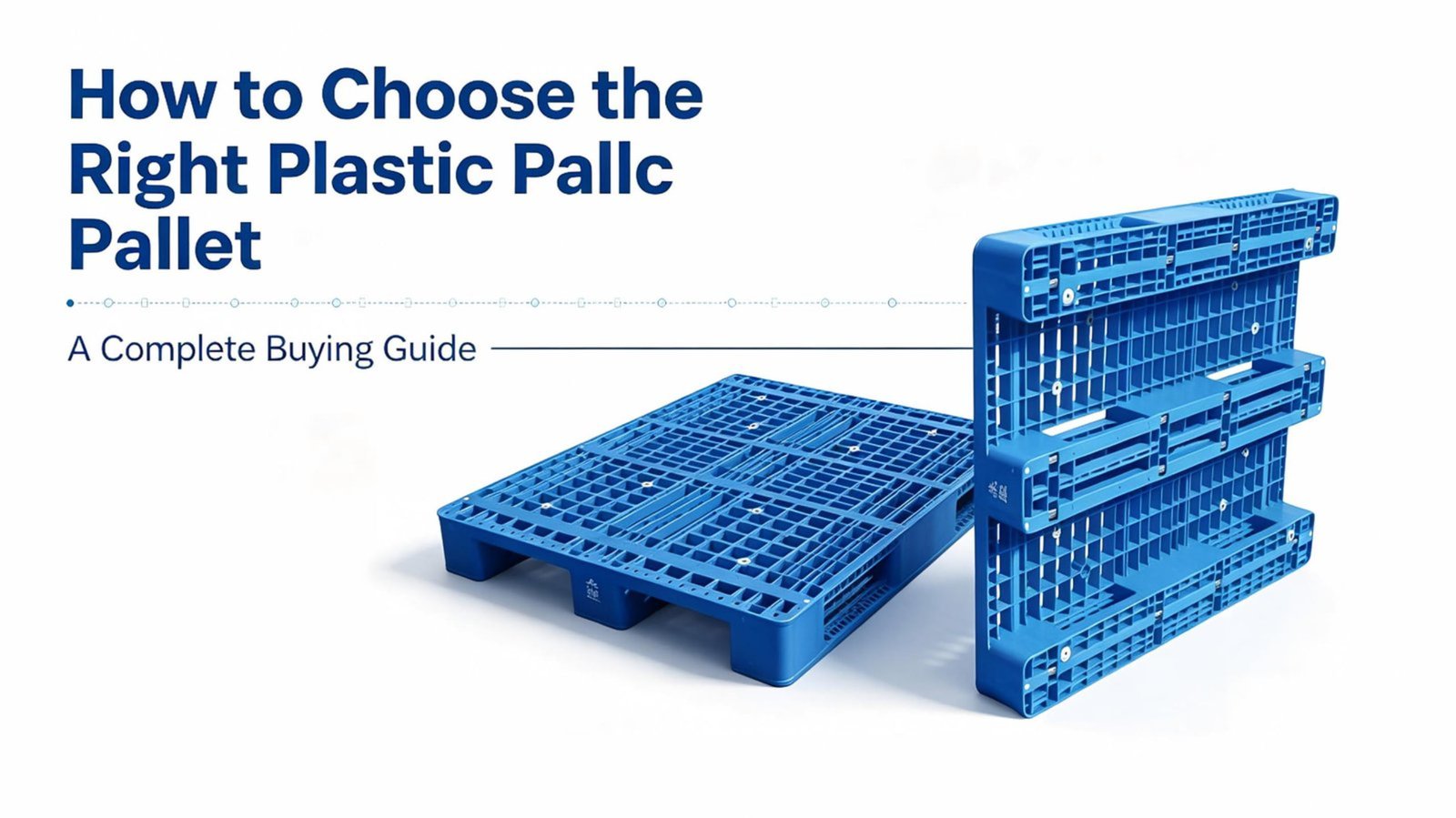
How to Choose the Right Plastic Pallet: A Complete Buying Guide
I have seen many buyers choose a pallet by price first, then find out later that it does not fit their rack, load, or handling system.
I recommend choosing a plastic pallet by application, load, size, design, material, equipment, and environment before comparing price.
If I were buying plastic pallets for the first time, I would not start with the question, “How much does one pallet cost?” I would start with a few basic questions about the load, warehouse, equipment, and working conditions. These answers can quickly narrow down the right pallet.
What Should You Check Before Buying Plastic Pallets?
A plastic pallet should match the way I plan to use it, not just the size I need.
Before I buy a plastic pallet, I check its load capacity, dimensions, design, material, equipment compatibility, and operating environment.
When I talk with customers, I usually ask about the actual application before I recommend a product. I want to know how much weight the pallet will carry and how that weight will be distributed. I also ask whether the pallet will stay on the floor or go into a rack.
I then check the pallet size against the cartons or bags that will sit on it. A pallet that is too small can leave cargo unsupported. A pallet that is too large can waste warehouse and container space.
I also look at the handling equipment. A pallet used with a forklift has different requirements from one used on an automated conveyor. A pallet used in a cold store also needs different material performance from one used in a normal warehouse.
| What I check | Why it matters |
|---|---|
| Load capacity | Prevents overload during use |
| Size | Affects cargo fit and space use |
| Deck design | Affects support, drainage, and ventilation |
| Material | Affects strength, consistency, and application |
| Entry design | Affects forklift and pallet jack handling |
| Environment | Affects material and service performance |
I have found that these basic checks prevent many problems later. They also make supplier discussions much easier.
How Much Load Capacity Do You Need?
I never judge a pallet by one load number because dynamic, static, and racking loads describe different working conditions.
Dynamic load is for moving cargo, static load is for stationary cargo, and racking load is for pallet storage on a supported rack.
I often explain pallet capacity with a simple example. Imagine putting a heavy box on a table. The table has support under the whole surface. Now imagine putting the same box on a board supported only at both ends. The board faces a different type of stress.
A pallet works in a similar way.
Dynamic load describes the pallet when I move a loaded pallet with a forklift or pallet jack. Static load describes a pallet sitting on a flat floor. Racking load describes a pallet supported at specific points while the center of the pallet may be suspended.
This is why I do not recommend using static capacity as the only buying standard.
| Load type | Typical situation | What I check |
|---|---|---|
| Dynamic load | Forklift or pallet jack handling | Pallet strength during movement |
| Static load | Floor stacking | Long-term weight support |
| Racking load | Warehouse rack | Deflection and support condition |
I also recommend leaving a reasonable safety margin. The rated capacity is not a target that I try to reach every day. Actual cargo weight, load distribution, handling impact, rack condition, and temperature can all affect performance.
If a customer tells me that the pallet will carry 1,000 kg on a rack, I want to know the rack structure and support points before I suggest a pallet.
How to Choose the Right Plastic Pallet Size?
I choose pallet size from the cargo and warehouse first, rather than choosing a common size simply because it is popular.
The right pallet size should fit the cargo, warehouse equipment, storage system, container, and transportation plan.
I have worked with customers who initially asked for a standard size without checking the cartons. After we looked at the loading pattern, another size gave them better support and better space use.
Common sizes include 1200 × 800 mm, 1200 × 1000 mm, 1100 × 1100 mm, and 48 × 40 inches. Each size can work well in the right application.
The 1200 × 800 mm format is common in European logistics. The 1200 × 1000 mm format gives a larger working surface and is widely used for industrial cargo. The 1100 × 1100 mm size can work well with certain Asian logistics and export applications. The 48 × 40 inch format is widely used in North American supply chains.
| Pallet size | Where I would consider it |
|---|---|
| 1200 × 800 mm | European logistics and distribution |
| 1200 × 1000 mm | General industrial and warehouse use |
| 1100 × 1100 mm | Asian logistics and selected export applications |
| 48 × 40 in | North American logistics |
I also check container loading before I approve a size for an export project. A pallet can work perfectly inside a warehouse but still create poor container utilization. If I ship thousands of pallets each year, even a small difference in loading efficiency can affect the total logistics cost.
Which Plastic Pallet Design Should You Choose?
I choose pallet design according to storage and handling conditions because stackable, rackable, and nestable pallets solve different problems.
Stackable pallets suit floor storage, rackable pallets suit supported racking, and nestable pallets help reduce empty-pallet storage and transport space.
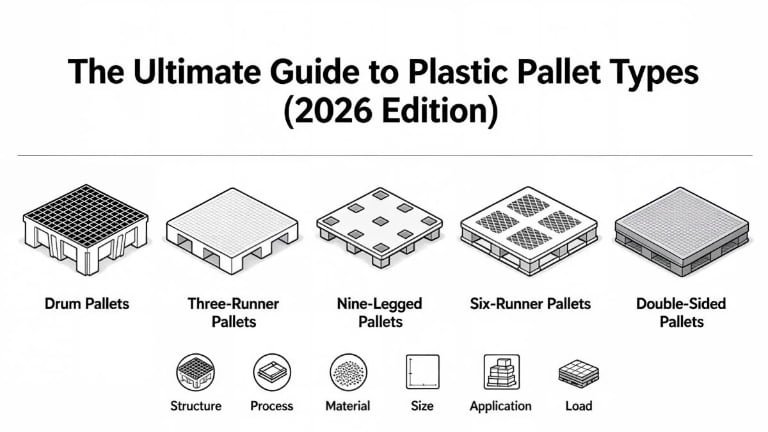
I often see buyers compare pallets by appearance. Two pallets may look similar, but their bottom structures can be very different.
A stackable pallet normally has a structure that allows loaded pallets to be placed one above another. This can help when I store goods directly on the floor.
A rackable pallet needs stronger support around the areas that contact the rack. I pay close attention to the actual racking conditions because different rack systems provide different support.
A nestable pallet is useful when I need to move or store many empty pallets. The pallets can fit inside each other and reduce empty-pallet volume.
A reversible pallet has a deck structure that can be used on both sides in suitable applications. A 4-way-entry pallet gives forklifts and pallet jacks more approach options than a 2-way-entry design.
| Design | Main advantage | My typical consideration |
|---|---|---|
| Stackable | Stable floor stacking | Warehouse floor storage |
| Rackable | Designed for supported racking | Rack type and load |
| Nestable | Saves empty space | Return logistics |
| Reversible | Can use both sides | Load and handling method |
| 2-way entry | Simple structure | Fixed handling direction |
| 4-way entry | Easier access | Multiple handling directions |
I would not call one design universally better. I first look at the way the pallet will actually work.
Solid Deck vs. Open Deck Plastic Pallets?
I choose between solid and open decks based on cargo support, cleaning, drainage, ventilation, and the working environment.
Solid decks provide a more continuous surface, while grid decks can improve drainage and ventilation and may reduce pallet weight.
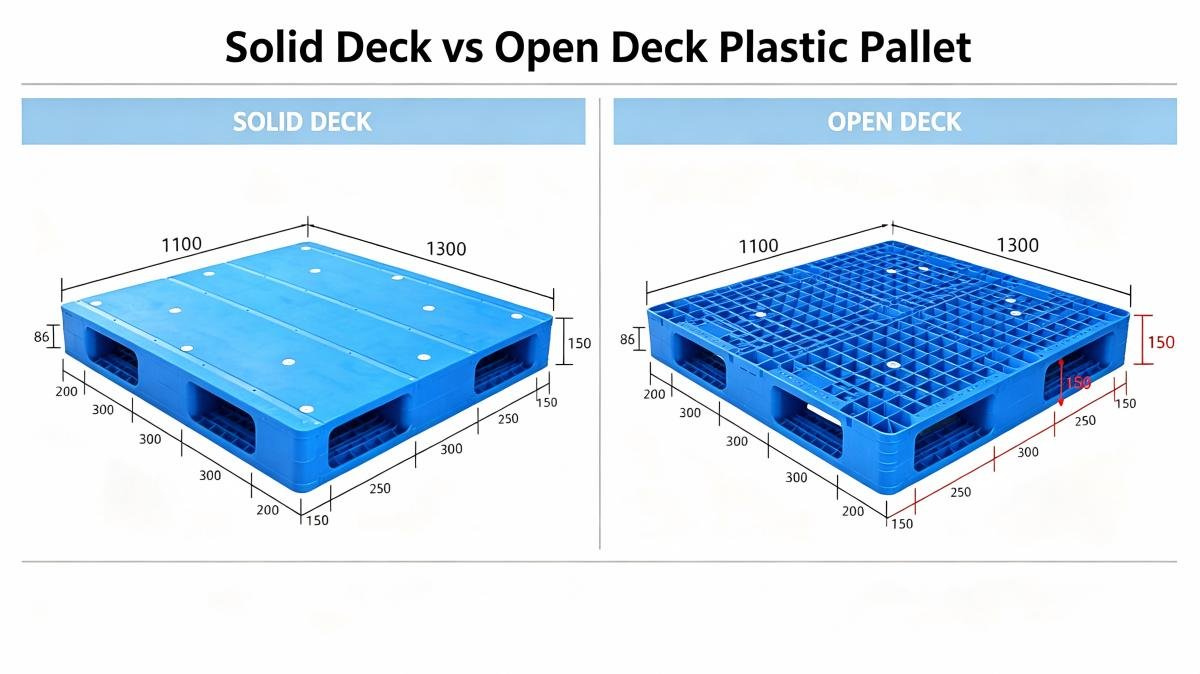
I usually recommend a solid deck when the cargo needs broad and continuous support. Small cartons, bags, and products with unstable bottoms can benefit from a more continuous surface.
A grid deck has openings across the pallet surface. These openings can help water and air pass through the deck. This can be useful in applications where pallets are washed often or where ventilation matters.
The choice also depends on the cargo. If I put small products directly on a large grid deck, I need to make sure the openings do not affect product stability.
| Feature | Solid deck | Grid/open deck |
|---|---|---|
| Continuous support | Stronger | More limited |
| Drainage | Lower | Better |
| Ventilation | Lower | Better |
| Cleaning | Easy surface cleaning | Depends on opening design |
| Small cargo | Often easier | May need extra consideration |
Food, pharmaceutical, chemical, and industrial users may have very different requirements. I always consider the cargo and cleaning process before choosing the deck.
Should You Choose Virgin or Recycled Plastic Pallets?
I do not tell every customer to use virgin plastic because the right material depends on the application, compliance needs, and budget.
Virgin HDPE or PP offers stable material properties, while recycled HDPE or PP can provide a cost-focused option for suitable applications.
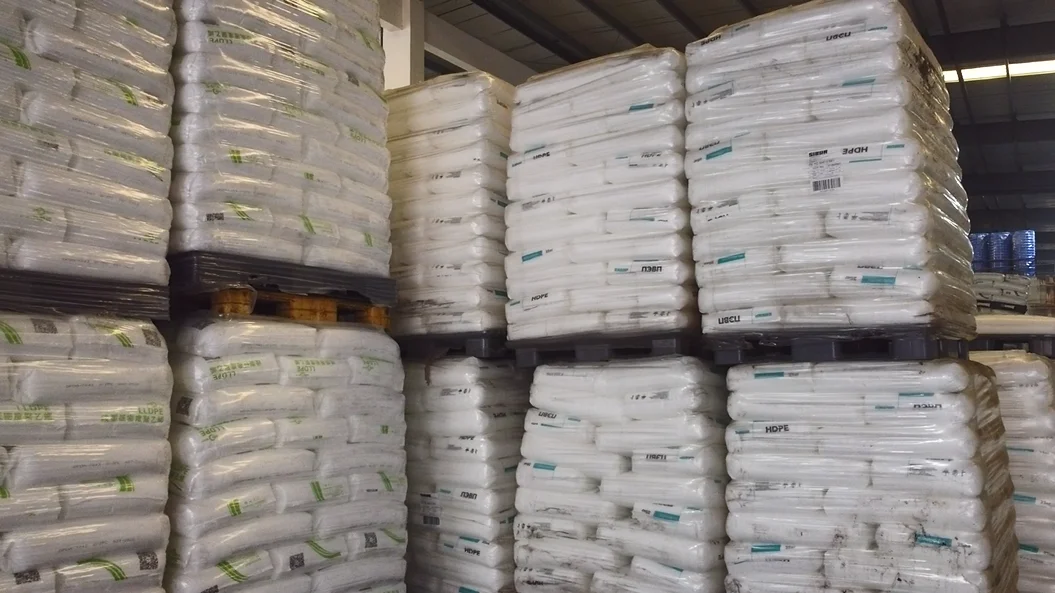
Virgin HDPE and PP are common choices when I need stable material performance and consistent production. These materials can be suitable for demanding applications when the pallet is correctly designed.
Recycled plastic can be useful when the application allows it. It can help reduce material costs and make use of recovered plastic resources.
I do not judge a pallet only by whether it uses new or recycled material. I also look at the pallet weight, structure, manufacturing process, load rating, and actual working environment.
A heavier recycled pallet may perform better in one application than a lighter virgin-material pallet. The opposite can also happen. The design still matters.
| Factor | Virgin material | Recycled material |
|---|---|---|
| Material consistency | Usually higher | Depends on source and control |
| Cost | Usually higher | Can be lower |
| Food-contact use | Often preferred when compliant | Requires careful compliance review |
| Heavy-duty use | Suitable with correct design | Suitable for selected applications |
| Sustainability consideration | Uses new resin | Uses recovered material |
For food, pharmaceutical, or other controlled applications, I ask for the exact material and compliance information instead of accepting a simple “food grade” claim.
Do You Need Food-Grade Plastic Pallets?
I never judge food-grade status by pallet color or appearance because a clean-looking pallet is not automatically suitable for food contact.
For food-contact applications, I check the resin, additives, manufacturing process, cleaning requirements, and applicable food-contact regulations.
I have had customers ask whether a white plastic pallet is automatically food grade. My answer is no. Color does not tell me what material or additives were used.
For food and beverage applications, I first identify whether the pallet will directly contact food or only carry packaged products. I then check the customer's regulatory requirements.
Virgin resin is often considered when hygiene and controlled material composition are important. But I still want to see the relevant compliance information.
The pallet design also matters. A hygienic pallet should be easy to clean and should not create unnecessary areas where dirt or liquid can remain.
| Question I ask | Why I ask it |
|---|---|
| Does the pallet contact food? | Determines the compliance requirement |
| What resin is used? | Helps verify material suitability |
| Is virgin material required? | May be required by the application |
| How is the pallet cleaned? | Affects deck and structure choice |
| What regulation applies? | Confirms the correct compliance basis |
Food and pharmaceutical buyers should give the supplier their exact requirements before ordering. I would rather spend time checking this before production than discover a compliance issue after delivery.
Will the Pallet Work With Your Equipment?
I always ask what equipment will handle the pallet because a pallet is part of a logistics system, not an independent product.
I check forklift, pallet jack, rack, conveyor, AS/RS, AGV, and AMR requirements before approving a pallet design.
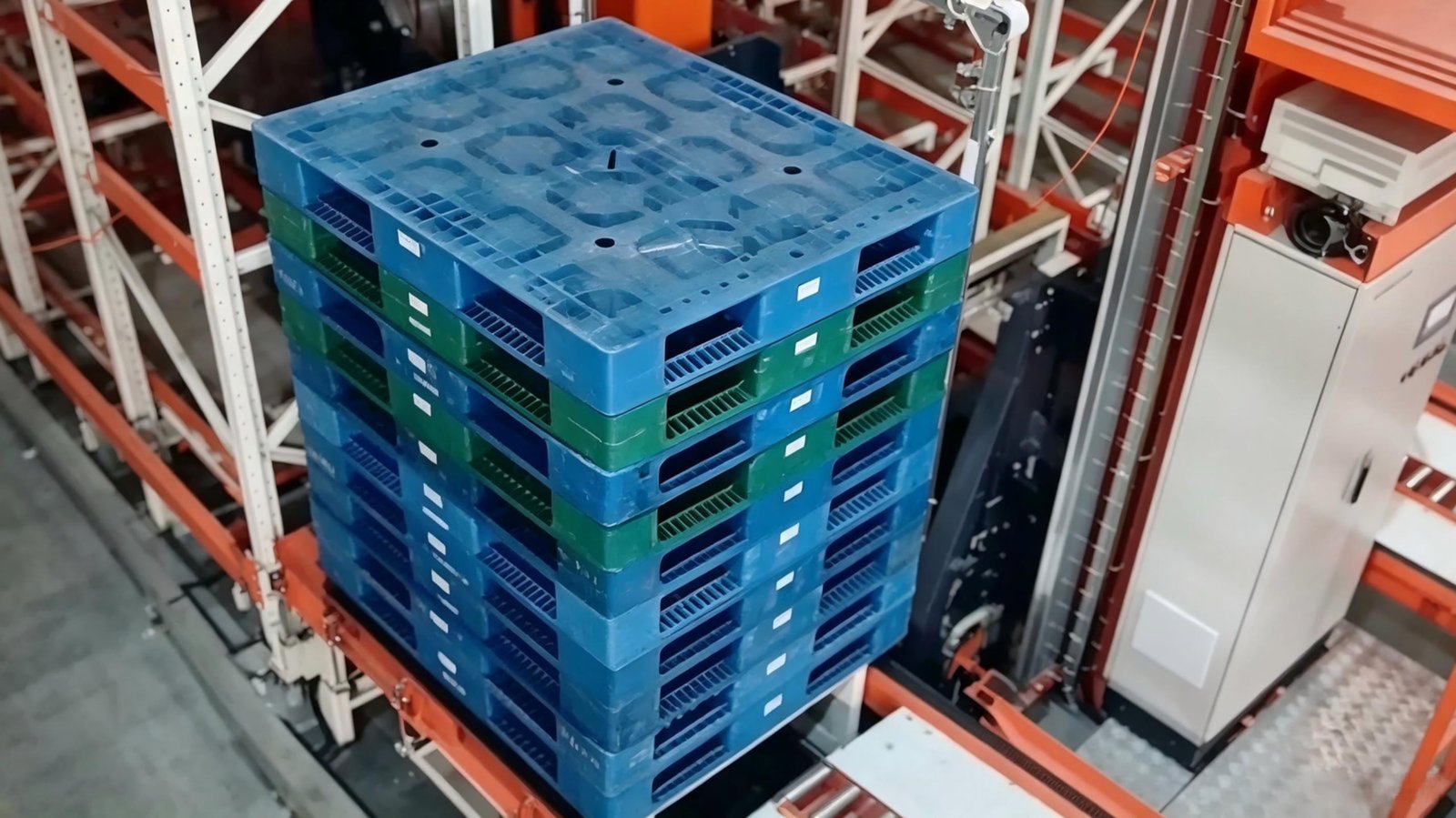
A forklift and a pallet jack do not always interact with a pallet in the same way. The entry openings and bottom structure can affect handling.
Conveyors also need a stable pallet base and suitable dimensions. An automated warehouse can be even more sensitive because the system may rely on consistent pallet dimensions and movement.
I once had a project where the requested pallet size looked correct on paper. The problem appeared when we checked the conveyor. The pallet dimensions and bottom structure needed to match the equipment more closely.
That is why I ask for equipment drawings or specifications when choosing ASRS pallets for automative warehouse, or when the project involves automation.
| Equipment | What I check |
|---|---|
| Forklift | Entry openings and fork access |
| Pallet jack | Lower entry and wheel access |
| Rack | Support points and racking load |
| Conveyor | Bottom structure and dimensions |
| AS/RS | Dimensional consistency and handling |
| AGV/AMR | Pallet positioning and access |
| Pallet shuttle | Rack and shuttle compatibility |
For a normal warehouse, a small mismatch may be manageable. For an automated system, it can stop the whole process. I prefer to check compatibility before production starts.
What Operating Conditions Should You Consider?
I never recommend a pallet without asking where it will be used because temperature, moisture, chemicals, washing, and outdoor exposure can affect performance.
I consider temperature, moisture, cleaning, chemical exposure, sunlight, and cold-storage conditions when selecting pallet material and design.
A normal warehouse is usually easier to handle than a freezer or chemical plant. Low temperatures can affect plastic impact performance. Frequent washing can place different demands on the material and pallet design.
Cold-chain customers should tell me the lowest operating temperature. I want to know whether the pallet will be moved while cold or only stored in a cold area.
For chemical applications, I also ask what chemicals the pallet may contact. Different chemicals can affect different materials in different ways.
Outdoor use brings another issue. Long exposure to sunlight can affect plastic unless the pallet and material are suitable for that environment.
| Environment | What I focus on |
|---|---|
| Normal warehouse | General load and handling |
| Cold storage | Low-temperature performance |
| Freezer | Material and impact performance at low temperature |
| Frequent washing | Cleaning and drainage |
| Chemical area | Material compatibility |
| Outdoor use | Weather and UV exposure |
I do not assume that one pallet can handle every environment equally well. I prefer to match the material and design to the actual conditions.
What Should Be on Your Plastic Pallet Buying Checklist?
I use a simple checklist because a clear specification makes supplier comparison much easier.
Before ordering, I confirm the pallet size, weight, load ratings, material, deck, entry type, environment, handling equipment, quantity, and customization needs.
When a customer sends me only “1200 × 1000 plastic pallet,” I still need more information before I can recommend the right product.
I want to know the cargo weight and whether the cargo will be moved or stored. I want to know if the pallet will be placed on a rack. I also need the operating temperature and handling equipment.
For a large project, I also ask about annual quantity and expected usage cycle. These details can affect whether a heavy-duty reusable pallet or a more cost-focused option makes sense.
| Specification | Information to provide |
|---|---|
| Size | Length × width × height |
| Weight | Target pallet weight |
| Dynamic load | Load during handling |
| Static load | Load during floor storage |
| Racking load | Load during rack storage |
| Material | Virgin or recycled HDPE/PP |
| Deck | Solid or grid |
| Entry | 2-way or 4-way |
| Environment | Temperature, moisture, chemicals |
| Equipment | Forklift, jack, conveyor, automation |
| Quantity | Initial and annual demand |
| Customization | Color, logo, mold, structure |
I find that this checklist saves time for both the buyer and the manufacturer. It also makes quotations easier to compare because I am comparing the same specifications rather than only comparing unit prices.
What Common Mistakes Should You Avoid When Buying Plastic Pallets?
I see buyers make the same few mistakes again and again, and most of them happen before the first pallet is delivered.
The most common mistakes are choosing only by price, checking only static load, ignoring racking conditions, choosing the wrong size, and skipping sample testing.
The first mistake is choosing the cheapest pallet without checking the application. A low purchase price does not help if the pallet cannot work with the warehouse system.
The second mistake is looking only at static capacity. A pallet that holds a high static load may have a different racking or dynamic capacity.
The third mistake is ignoring the equipment. This problem becomes serious when pallets enter conveyors or automated storage systems.
The fourth mistake is ordering a large quantity before testing. I prefer to test a sample when the pallet will be used in a new or demanding application.
| Common mistake | What I recommend |
|---|---|
| Choosing only by price | Compare total operating cost |
| Checking only static load | Check dynamic and racking loads |
| Ignoring rack conditions | Confirm rack support and spacing |
| Choosing size by habit | Check cargo and warehouse layout |
| Ignoring equipment | Test with actual equipment |
| Skipping samples | Test before large production |
A sample test is especially useful when the customer has an existing warehouse system. I would rather find a problem with one sample than find it with a full container.
Why Should You Consider Buying Plastic Pallets Directly From a Manufacturer?
I usually recommend speaking directly with the manufacturer when the project involves large quantities, special specifications, or long-term supply.
A direct manufacturer can discuss material, mold, structure, load capacity, customization, production, and quality control with the buyer in one process.
A plastic pallet is the result of several decisions. Material is one decision. Mold design is another. Product weight, reinforcement, deck structure, and manufacturing process also affect the final product.
When a customer needs a special color, logo, size, mold, or load requirement, I find it easier to solve the problem when the sales and production teams can work together.
I also think buyers should ask manufacturers about quality control. I want to know how raw materials are checked, how products are inspected, and how production consistency is maintained.
Euro Plastic Pallet has more than 20 years of plastic pallet manufacturing experience. We operate more than 60 injection molding and related production machines. We also provide customized colors, logos, and molds for different customer requirements.
| Manufacturer capability | Why I consider it useful |
|---|---|
| Material selection | Helps match the application |
| Mold development | Supports special designs |
| Structural adjustment | Helps meet different load needs |
| Color and logo | Supports brand requirements |
| Quality inspection | Helps maintain consistency |
| OEM customization | Supports distributor and brand projects |
I still recommend sample testing before a large order. Direct manufacturing does not remove the need for proper testing. It simply gives the buyer a more direct way to discuss the technical details.
Conclusion
When selecting plastic pallets, prioritize application, load, size, design, material, equipment and environment over price. Low‑cost‑looking pallets can create higher hidden costs due to poor compatibility. Share your operational details via Tell us for proper specification guidance, and run sample tests for large orders to avoid costly purchasing mistakes.
My Role
I guide customers through pallet selection by gathering their real‑world requirements, highlighting hidden risks of cheap options, recommending matching solutions and suggesting pre‑production sample tests to align our products with their actual working conditions.
About Euro Plastic Pallet
Euro Plastic Pallet is a plastic pallet manufacturer with over 20 years of production experience, headquartered in China. We provide high-quality, customized plastic pallet solutions for brand owners, wholesalers, and distributors.
With 60+ injection/rotational molding machines, each staffed with quality control[^12] personnel having 5+ years of experience, we ensure consistent product quality.
Services
- Products: Complete plastic pallet solutions
- Customization: Custom colors, logos, and molds
- International Certifications: ISO 9001, CE, REACH, ROHS, SGS, FDA, GRS
Quality Assurance
- Raw Material Testing: Complies with RoHS, REACH standards, meeting international strength and performance requirements
- Precision Manufacturing: Automated injection molding, precision assembly, accuracy ±0.1mm
- Comprehensive Inspection: 100% factory testing, ISO 9001 sampling protocols ensuring high standards
- Certifications: ISO 9001, CE, REACH, ROHS, SGS, FDA standards compliance
Production Capacity
- High-Quality Manufacturing: 60+ injection/rotational molding machines following ISO 9001
- Premium Customization: Customized solutions for global brands
- Flexible Solutions: Customer-specific customization[^17] enhancing market competitiveness
Global Impact
Serving global customers with reliable plastic pallets[^1] and customized logistics packaging solutions[^18], supporting business growth and customer trust.