Collapsible vs Rigid Plastic Pallet Boxes: Which One Should You Choose?
Are high shipping costs and cluttered storage rooms eating away your logistics profits every single month? Choosing the wrong bulk container creates massive operational bottlenecks and wastes thousands of dollars.
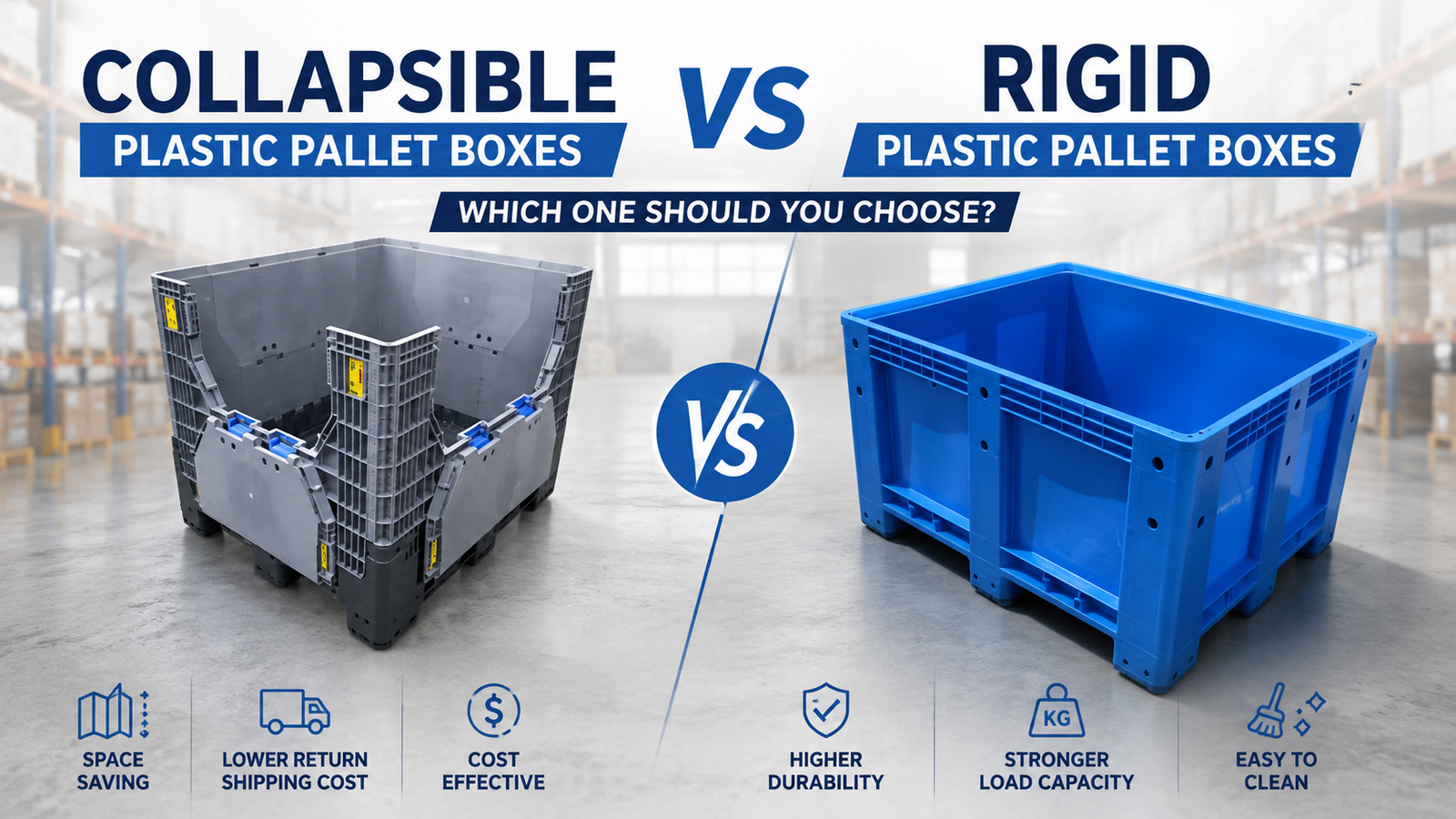
Rigid plastic pallet boxes offer maximum strength, seamless stacking, and long-term durability for heavy internal loads. Collapsible plastic pallet boxes fold flat to save up to 75% of storage space and drastically lower return freight costs.
I see many warehouse managers struggle with this decision when they try to upgrade their bulk handling setup. Let me break down the critical factors so you can select the exact box structure for your supply chain.
How Do Rigid and Collapsible Pallet Boxes Compare at a Glance?
Buying bulk containers without checking key metrics leads to early container failure and wasted capital budget. Many buyers pick a box type randomly and end up paying to ship empty air on return trips.
Rigid boxes excel in heavy-duty strength, fixed stability, and low purchase price. Collapsible boxes shine in space savings, reduced empty freight fees, and flexible warehouse operations.
Core Comparison of Key Features
I always show my clients a quick comparison matrix before we dig into technical drawings. Rigid boxes work like fixed warehouse racks because they stay solid forever. Collapsible boxes work like folding tables because they save space when you do not need them. I know that matching the container structure to your specific loop is the only way to control total operating costs.
| Specification / Feature | Rigid Plastic Pallet Box | Collapsible Plastic Pallet Box |
|---|---|---|
| Wall Structure | Fixed solid or ventilated walls | Foldable hinged walls |
| Foldability | Non-foldable | Folds flat completely |
| Empty Storage Space | Takes up full volume | Saves up to 75% space |
| Return Transport | High cost (ships empty air) | Low cost (maximizes truck load) |
| Load Capacity | High dynamic and static load | Moderate to high load capacity |
| Structural Durability | Maximum (no moving parts) | High (depends on hinge quality) |
| Stacking Stability | Exceptional interlock stacking | High when locked in place |
| Initial Purchase Cost | Lower initial cost | Higher initial cost |
| Best Used For | High-frequency closed loops | Long-distance return loops |
What Is a Rigid Plastic Pallet Box and How Does It Work?
Selecting fragile boxes for harsh factory floors leads to sudden wall cracking and ruined production cycles. Heavy forklift traffic rapidly destroys cheap containers that lack solid wall reinforcement.
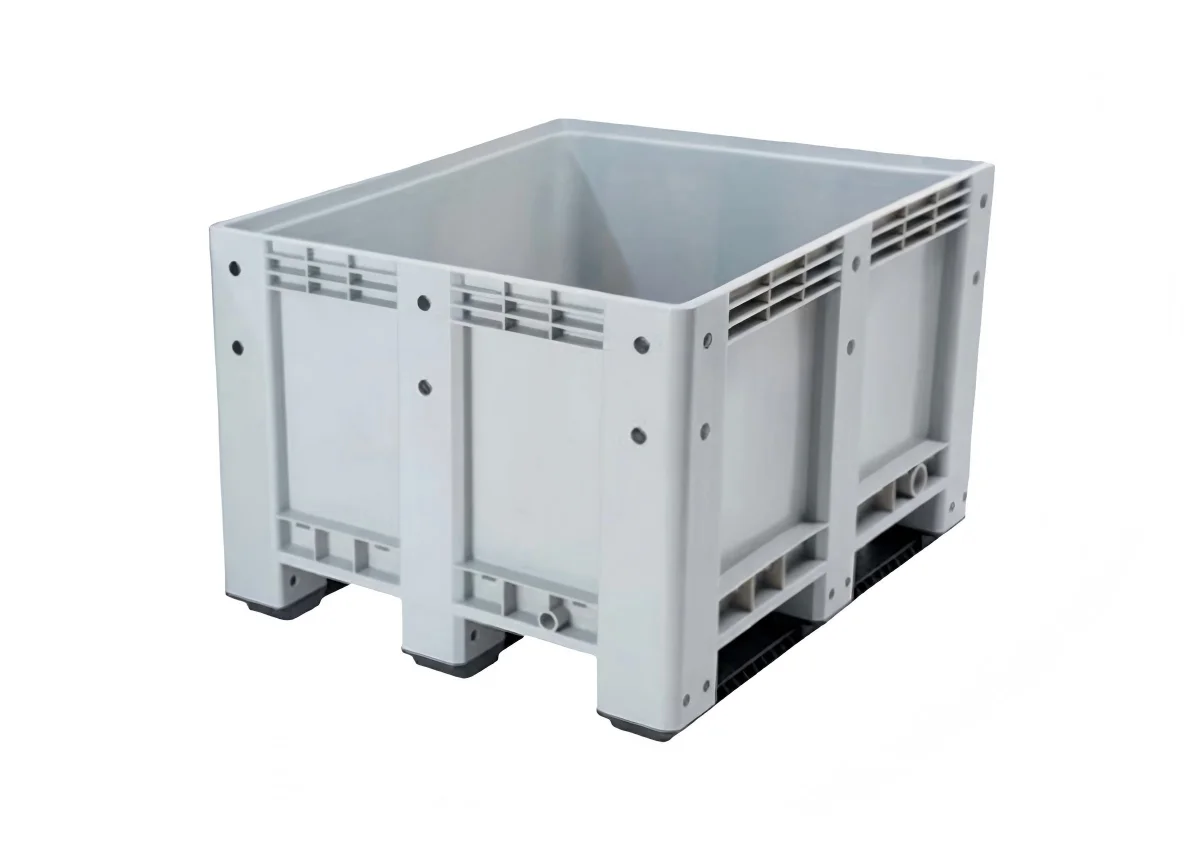
A rigid plastic pallet box features fixed side walls molded directly into the base structure, providing maximum impact resistance, high stack loading, and unmatched long-term durability.
Understanding Rigid Box Design and Functionality
A rigid plastic box relies on a single-piece or heavy-duty welded structure. It has no moving hinges or locking clips. I often tell my clients that rigid boxes are the workhorses of manufacturing plants. Because the walls stay locked in place, forklift drivers can move them quickly without worrying about loose latches.
Main Advantages of Rigid Boxes
- Structural Integrity: The fixed walls handle high dynamic loads during aggressive forklift transit.
- Stacking Strength: You can stack full boxes five or six units high without wall deflection.
- Lower Purchase Price: The simple mold design reduces manufacturing costs compared to complex folding mechanisms.
- Zero Maintenance Hinges: With no moving parts, there are no latches or hinges to inspect or replace.
Key Limitations of Rigid Boxes
- High Return Shipping Costs: Empty boxes occupy the exact same truck space as full boxes.
- Large Storage Footprint: Unused containers consume valuable floor space inside your warehouse.
Typical Applications
Rigid boxes perform best in heavy manufacturing, automotive stamping lines, liquid processing, and short-distance plant transfers. I routinely recommend rigid boxes to flour mills and beverage factories where containers stay filled almost every day of the year.
| Operation Parameter | Rigid Box Capability |
|---|---|
| Static Load | Up to 4,000 kg |
| Dynamic Load | Up to 1,000 kg |
| Wall Type Options | Solid water-tight or perforated grid |
| Forklift Access | 4-way entry base |
What Is a Collapsible Plastic Pallet Box and How Does It Work?
Paying full truckload rates to transport empty containers drains your logistics budget very quickly. Returning empty rigid boxes across hundreds of miles means you are literally paying to transport air.
A collapsible plastic pallet box features hinged side walls that fold flat onto the pallet base, reducing empty box volume by up to 75% for efficient return shipping.
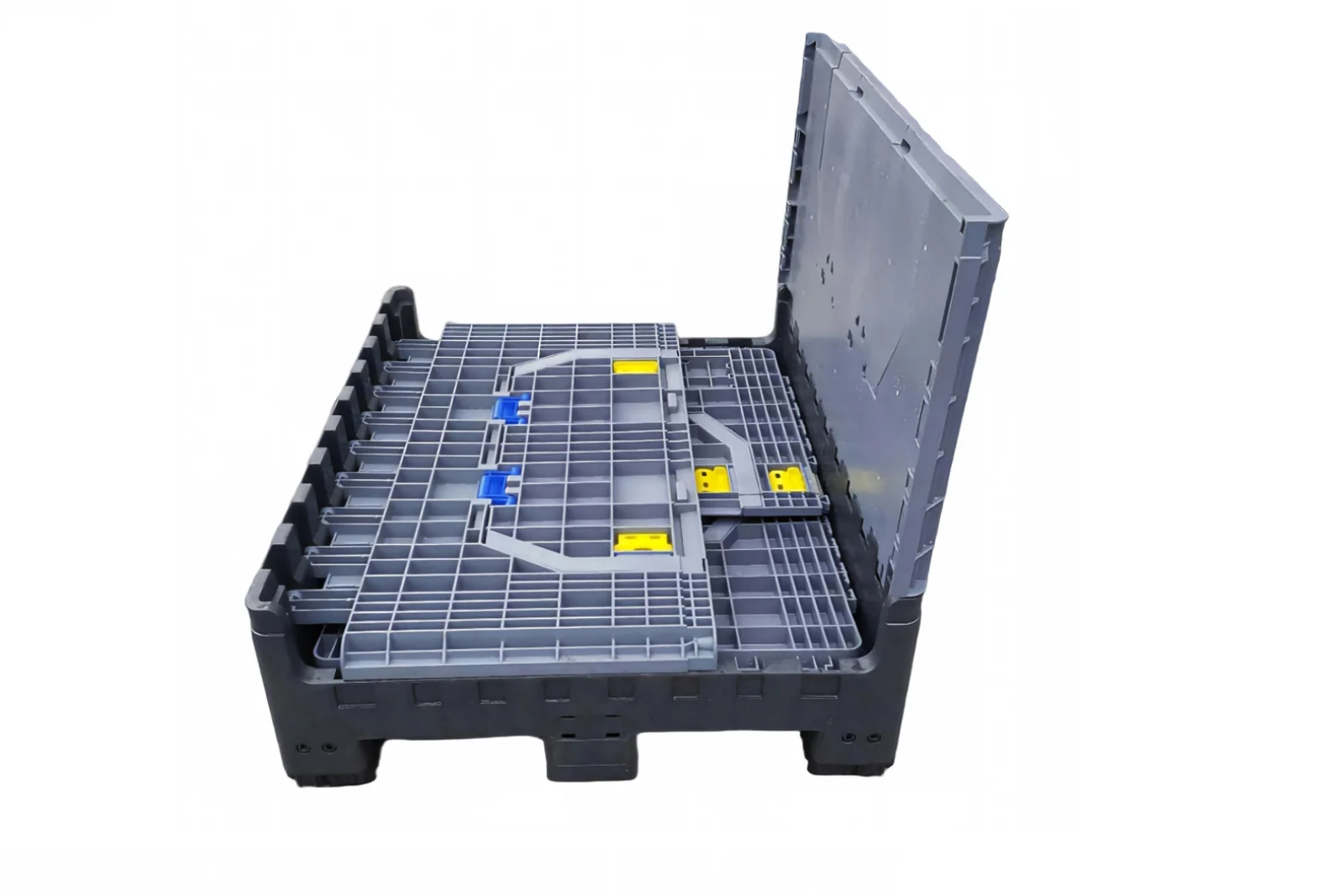
Understanding Collapsible Box Mechanics
A collapsible box uses engineered side panels attached to a heavy-duty base with durable hinges and sliding locks. When workers empty the box, they drop the side latches and fold the walls inward. The entire box collapses down to a fraction of its original height.
Main Advantages of Collapsible Boxes
- Massive Freight Savings: You can fit up to four times more empty collapsed boxes into a single return truck.
- Floor Space Recovery: Workers fold unused boxes and stack them neatly in a corner during off-peak seasons.
- Easy Ergonomic Access: Drop-down side doors make it easy for workers to load and unload heavy parts manually.
- Flexible Closed-Loop Logistics: These boxes cut freight costs in multi-site supply chains.
Key Limitations of Collapsible Boxes
- Higher Purchase Price: Complex multi-part molds and assembly steps increase initial purchase costs.
- Hinge Inspection Needs: Workers must check latches and hinges periodically to prevent latch damage.
Typical Applications
Collapsible boxes are the top choice for retail distribution, agricultural harvesting, pharmaceutical supply chains, and long-distance contract logistics. I helped a large auto-parts distributor switch to collapsible boxes three years ago. They cut their return truck journeys from four trips down to one trip, saving them thousands of dollars each month.
| Operation Parameter | Collapsible Box Capability |
|---|---|
| Volume Reduction Ratio | 3:1 to 4:1 folded ratio |
| Max Static Load | Up to 3,000 kg |
| Max Dynamic Load | Up to 1,000 kg |
| Folding Time | Less than 30 seconds per box |
What Are the 7 Key Differences Between Collapsible and Rigid Boxes?
Misunderstanding container performance metrics leads to premature box failure and dangerous stack collapses. Buyers frequently confuse static load limits with dynamic load limits when evaluating suppliers.
The main differences lie in wall mobility, return freight efficiency, empty storage footprint, initial purchase cost, total ownership cost, hinge maintenance needs, and structural rigidity.
Detailed Operational Breakdown
I always ask my clients to look past the upfront sticker price and analyze total operational cost. A rigid box offers simple fixed strength. A collapsible box adds mechanical versatility. We must analyze how these seven key operational areas impact your daily warehouse tasks.
1. Structure and Design
Rigid boxes use seamless wall-to-base molding. Collapsible boxes use side panels held together by latches, drop-down doors, and structural hinges.
2. Empty Storage Space
Rigid boxes take up 100% of their volumetric footprint at all times. Collapsible boxes fold down flat, saving up to 75% of your warehouse storage space.
3. Empty Return Transportation
Rigid boxes ship empty at a 1:1 ratio with full boxes. Collapsible boxes allow you to pack up to 260 empty folded units into a standard trailer.
4. Load Capacity and Stacking
Rigid boxes provide ultimate rigidity for stacking heavy liquids or dense metal parts. Collapsible boxes carry heavy loads easily, but they require proper latching before stacking.
5. Durability and Maintenance
Rigid boxes have no moving parts to break. Collapsible boxes need durable virgin resin hinges to withstand thousands of folding cycles without cracking.
6. Handling and Warehouse Operations
Rigid boxes require no setup time. Workers simply grab them and go. Collapsible boxes need a few seconds for workers to raise and lock the walls into place.
7. Purchase Cost vs Total Cost
Rigid boxes cost less upfront. Collapsible boxes carry a higher initial price, but they yield massive long-term savings in return freight and warehouse rent.
| Feature Comparison Metric | Rigid Plastic Box | Collapsible Plastic Box |
|---|---|---|
| Return Freight Efficiency | Low (1x volume) | High (3x to 4x volume reduction) |
| Wall Setup Required | None (always ready) | Minimal (unfolding walls) |
| Impact Resistance | Extreme (solid walls) | High (reinforced panels) |
| Access Doors | Optional / Rare | Standard drop-down doors |
| Total Cost of Ownership | Lower for internal loops | Lower for long-distance loops |
Which Plastic Pallet Box Structure Should You Choose for Your Business?
Picking the wrong pallet box structure causes unexpected shipping overhead and operational slowdowns. Selecting based on guesswork often forces companies to replace their entire box inventory prematurely.
Choose rigid boxes for heavy internal loads, permanent full-state operations, and harsh handling environments. Choose collapsible boxes for multi-site freight loops, long-distance returns, and space-constrained warehouses.
Decision Matrix for Purchasing Managers
I always guide my buyers through a simple workflow based on their actual operational loop. Do not buy a collapsible box just because the technology sounds advanced. Likewise, do not buy a rigid box just because it costs less today.
Choose Rigid Plastic Pallet Boxes When:
- Your containers stay inside a single factory or short-distance internal loop.
- Your products stay inside the boxes for long-term storage or aging.
- Forklift operators handle containers aggressively at high speeds.
- You need liquid-tight containment for wet ingredients, meat, or chemicals.
Choose Collapsible Plastic Pallet Boxes When:
- You ship goods long distances and must haul empty boxes back home.
- Your warehouse space is tight, expensive, or highly seasonal.
- Workers need drop-door access to pick individual items manually from the container.
- You run closed-loop supply chains between suppliers, assembly plants, and dealers.
| Your Operational Scenario | Recommended Box Choice | Primary Reason |
|---|---|---|
| In-Plant Parts Transfer | Rigid Box | Maximum durability, no setup time |
| Cross-Country Agriculture Shipments | Collapsible Box | Low return freight costs |
| Cold Storage Warehousing | Rigid Box | Solid stacking strength in freezing temperatures |
| Automotive Component Supply Chain | Collapsible Box | Saves floor space when supplier waits for parts |
How Do I Recommend Selecting the Ideal Pallet Box Step-by-Step?
Ignoring actual load limits and forklift specs leads to crushed box bases and dangerous warehouse accidents. Buyers often overlook critical details like internal container volume and folded dimensions.
Follow my seven-point evaluation process: calculate item weight, verify static and dynamic loads, review stacking height, check forklift clearance, measure empty return ratios, inspect warehouse floor space, and define required cycle counts.
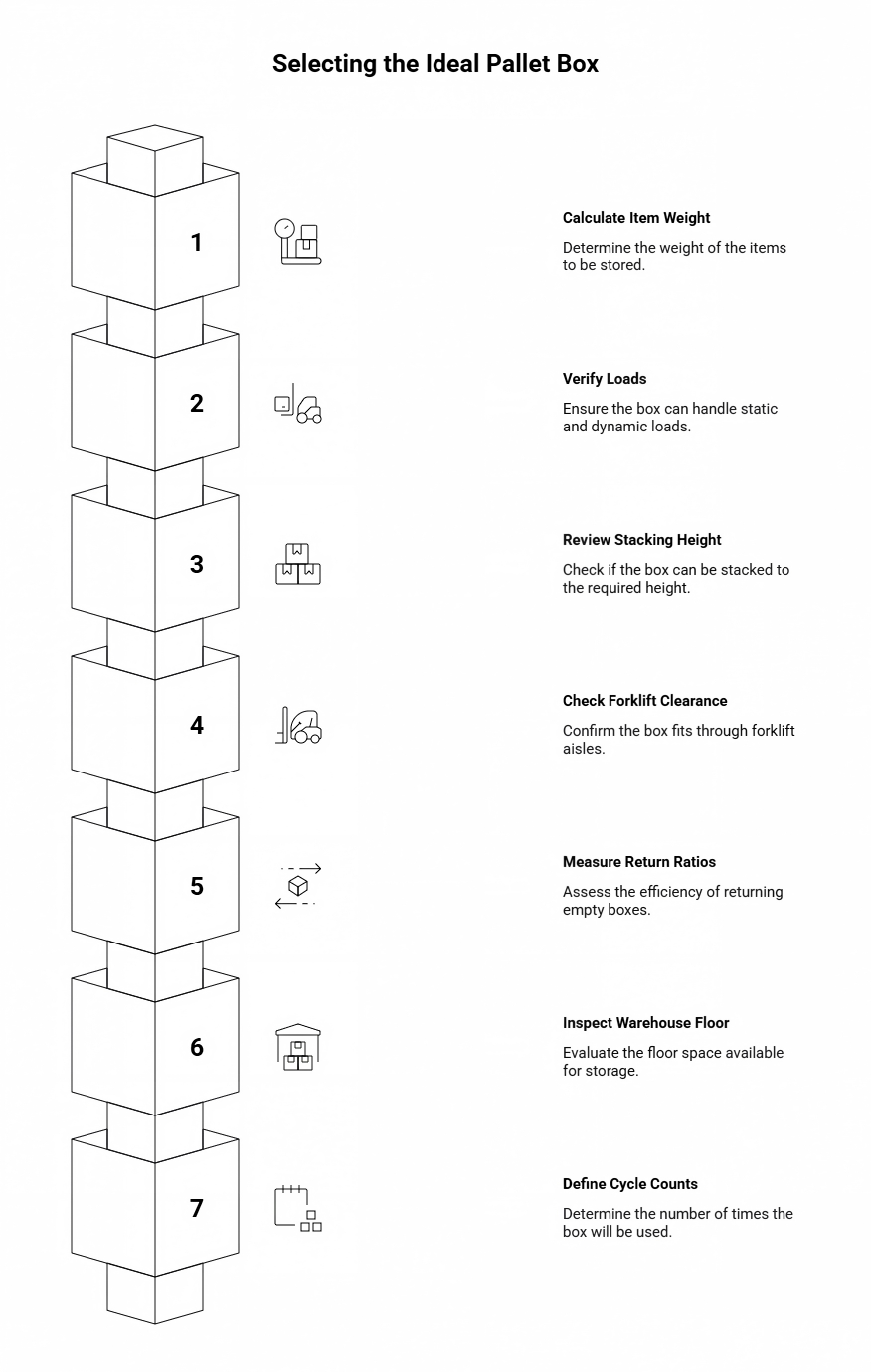
My Personal Selection Methodology
When clients visit our factory, I never start by showing them product catalogs. I ask them specific questions about their daily workflows. Here is the exact selection checklist I use to protect my customers from costly procurement mistakes:
- Calculate Product Weight and Volume: Measure your payload weight. Make sure the internal box dimensions match your product volume without pushing outward on the side walls.
- Verify Static and Dynamic Load Limits: Dynamic load applies when a forklift lifts the box. Static load applies when boxes sit stacked on the floor. Never confuse these two numbers.
- Confirm Stacking Requirements: Determine how high you must stack full boxes. Check if your warehouse floor is level enough to support heavy multi-tier stacks safely.
- Inspect Forklift and Pallet Jack Entry: Ensure the base entry pockets match your current equipment, including automated conveyor belts and hand pallet trucks.
- Analyze the Empty Return Ratio: Calculate how many miles your empty boxes travel home. High mileage demands collapsible containers to eliminate empty air freight costs.
- Evaluate Warehouse Storage Limits: Measure your available staging area. If seasonal volume drops leave hundreds of boxes idle, collapsible models prevent floor clutter.
- Define Expected Cycle Life: Establish how many times a box rotates per year. High-frequency daily loops require heavy-duty reinforced base structures.
| Evaluation Factor | Key Metric to Verify | Why It Matters |
|---|---|---|
| Payload Weight | Max kg per container | Prevents floor sagging and wall bulge |
| Stacking Height | 1+3 or 1+5 high stack | Maximizes vertical warehouse air space |
| Folded Height | Collapsed mm dimension | Determines exact truck return capacity |
| Material Resin | Virgin HDPE vs Recycled | Ensures impact strength in cold rooms |
What Are the Most Common Buying Mistakes You Should Avoid?
Relying solely on upfront unit pricing causes buyers to overlook long-term freight fees and maintenance costs. Purchasing low-grade containers results in cracked bases, failing latches, and early replacements.
Avoid buying on purchase price alone, assuming heavier boxes are better, ignoring folded heights, confusing load conditions, and skipping latch and hinge quality checks on collapsible models.
Avoiding Costly Procurement Pitfalls
Over the past two decades, I have seen buyers make the same five mistakes when sourcing plastic containers. You can avoid thousands of dollars in hidden costs by watching out for these common traps.
1. Choosing Based Only on Purchase Price
A cheap rigid box costs you a fortune if you ship it empty across the country every week. Conversely, buying an expensive collapsible box for stationary warehouse storage wastes your capital budget.
2. Assuming Heavier Always Means Better
Modern structural engineering uses intelligent rib patterns and high-grade virgin HDPE resins. Extra weight often just adds unnecessary tare weight to your shipments.
3. Ignoring Folded Dimensions
Not all collapsible boxes fold down to the same height. A box that collapses down to 290 mm lets you pack far more units into a truck than a box that stops at 400 mm.
4. Comparing Load Capacity Without Checking Conditions
A supplier might claim a "4,000 kg capacity," but that rating only applies to static floor storage. Always ask for the dynamic load capacity and racking load capacity under specific ambient temperatures.
5. Ignoring Hinge and Latching Structures
On collapsible models, the hinge design dictates container lifespan. Ensure the side wall latches move smoothly, lock securely, and permit easy manual operation without special tools.
| Common Buyer Mistake | Immediate Operational Impact | Long-Term Financial Consequence |
|---|---|---|
| Focusing Only on Purchase Price | Picks wrong box style for logistics loop | Inflated freight and storage costs |
| Ignoring Hinge Quality | Broken latches on collapsible walls | High box repair and replacement rate |
| Misreading Load Specs | Overloading boxes on forklifts | Damaged goods and safety hazards |
| Overlooking Pallet Entry | Incompatible with pallet jacks | Slowed warehouse handling speeds |
What Is My Final Recommendation for Collapsible vs Rigid Pallet Boxes?
Failing to match container selection to your overall supply chain network hurts overall operational efficiency. Every logistics manager needs a clear rule of thumb to finalize their container purchases safely.
Choose rigid plastic pallet boxes for tough, high-frequency, stationary, or short-distance factory tasks. Choose collapsible plastic pallet boxes for multi-site supply chains where empty return transport and storage savings drive total profitability.
FAQ
Are collapsible pallet boxes better than rigid pallet boxes?
Neither box is universally better because each structure serves a different supply chain need. Collapsible boxes excel at saving transport space, while rigid boxes offer superior solid wall strength for high-impact industrial environments.
Are collapsible pallet boxes more expensive?
Collapsible boxes have a higher initial purchase price due to their complex molds and multi-part hinge assembly. However, they drastically reduce long-term freight costs for return logistics, making them cheaper over their total lifecycle.
Which pallet box is better for heavy loads?
Rigid plastic pallet boxes are better for extremely dense or heavy loads. Their seamless, fixed-wall construction distributes heavy weight evenly without relying on mechanical side latches or wall hinges.
Which one saves more transportation space?
Collapsible pallet boxes save significantly more space during empty return transit. They fold down flat to reduce empty container volume by up to 75%, allowing you to fit up to four times more empty boxes into a single return truck.
Are rigid pallet boxes more durable?
Rigid boxes are generally more durable in rough handling environments because they have no moving parts, hinges, or latches. They resist heavy forklift impacts and wall scraping better over years of continuous plant use.
Can collapsible pallet boxes be used for stacking?
Yes, collapsible pallet boxes can be safely stacked when fully open and securely latched. High-quality collapsible models allow you to stack full containers four to six units high safely in the warehouse.
Final Thought
Do not seek a universally best pallet box; instead, pick the one that matches your specific logistics loop. Rigid plastic pallet boxes suit in-plant heavy-duty handling with great durability, while collapsible versions are ideal for multi-site long-distance distribution to cut return freight costs. Always request detailed technical spec sheets and verify dimensions, load capacity, folded height and resin grades prior to ordering.
My Role
With over twenty years of experience in this industry, I help customers select the right plastic pallet boxes for their unique logistics scenarios. I guide clients to evaluate their operation conditions and review key technical specifications before purchase.
About Euro Plastic Pallet
Euro Plastic Pallet is a plastic pallet manufacturer with over 20 years of production experience, headquartered in China. We provide high-quality, customized plastic pallet solutions for brand owners, wholesalers, and distributors.
With 60+ injection/rotational molding machines, each staffed with quality control[^12] personnel having 5+ years of experience, we ensure consistent product quality.
Services
- Products: Complete plastic pallet solutions
- Customization: Custom colors, logos, and molds
- International Certifications: ISO 9001, CE, REACH, ROHS, SGS, FDA, GRS
Quality Assurance
- Raw Material Testing: Complies with RoHS, REACH standards, meeting international strength and performance requirements
- Precision Manufacturing: Automated injection molding, precision assembly, accuracy ±0.1mm
- Comprehensive Inspection: 100% factory testing, ISO 9001 sampling protocols ensuring high standards
- Certifications: ISO 9001, CE, REACH, ROHS, SGS, FDA standards compliance
Production Capacity
- High-Quality Manufacturing: 60+ injection/rotational molding machines following ISO 9001
- Premium Customization: Customized solutions for global brands
- Flexible Solutions: Customer-specific customization[^17] enhancing market competitiveness
Global Impact
Serving global customers with reliable plastic pallets[^1] and customized logistics packaging solutions[^18], supporting business growth and customer trust.