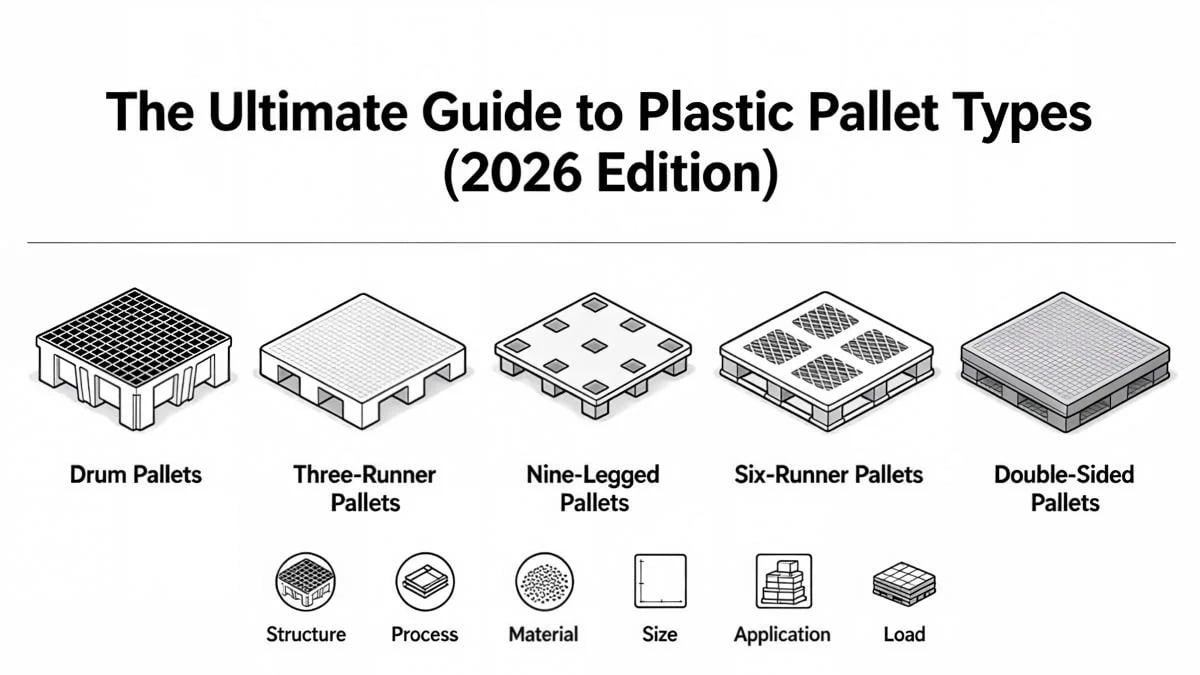
Buying the wrong plastic pallet can create higher costs, damaged goods, warehouse problems, and safety risks before you even notice the mistake.
Plastic pallets differ by structure, size, material, manufacturing process, and intended use. I recommend choosing one based on rack use, automation, load requirements, operating temperature, hygiene needs, and transport conditions.
I have worked with plastic pallet production, sales, and after-sales service for years, and I have seen the same problem many times. Buyers often compare pallets by price or appearance first. That approach can work for simple floor storage, but it can cause problems when the pallet must enter a rack, run through automation, carry heavy goods, or operate in cold environments. In this guide, I will break down the main plastic pallet types, materials, sizes, applications, and selection points so I can show what really changes from one pallet to another.
What Is a Plastic Pallet and Why Do Buyers Use One?
A plastic pallet is a reusable load platform made from plastic materials such as HDPE or PP. I use plastic pallets when I need consistent dimensions, easy cleaning, resistance to moisture, or repeatable handling in storage and transport.
I see 4 main reasons buyers choose plastic pallets: hygiene, durability, recyclability, and tracking options. The right combination depends on the application rather than on the pallet price alone.
Hygiene
Plastic does not absorb water like wood, and many plastic pallet designs can be washed and cleaned. Closed-deck pallets provide a more hygienic surface, while open-grid designs help with drainage and airflow. Critical for food, beverage and pharmaceutical sectors.
Read: What Makes a Plastic Pallet Food-Grade
Durability
Reusable plastic pallets perform well in repeated warehouse and supply-chain cycles. Service life depends on design, material, load, handling and environment. Light export pallets and rack-reinforced pallets are not interchangeable.
Read: Are Plastic Pallets Worth The Investment
Recycling
Plastic pallets can be recycled at end-of-life; HDPE is widely used for pallet production. Note three distinct concepts: pallets made from recycled material, pallets built for long-term reuse, and pallets that are recyclable.
RFID Tracking
RFID tags and barcodes link physical pallets to warehouse / transport data. Helps track asset movement and manage returnable packaging. Tracking is an optional add-on, not a base feature of every pallet.
How Does a Plastic Pallet Compare With a Wooden Pallet?
I do not compare plastic and wood by purchase price alone. I look at the full operating cost because repeated handling, repairs, cleaning, disposal, and export requirements can change the real cost.
Plastic pallets usually have a higher purchase price than basic wooden pallets, but reusable plastic pallets can reduce recurring repair, cleaning, and replacement costs in suitable closed-loop operations.
For a detailed TCO breakdown with real-world cost data, see our full Plastic vs Wooden Pallets TCO Comparison Guide.
Purchase Cost Is Only the First Number
| Cost factor | Plastic pallet | Wooden pallet |
|---|---|---|
| Initial purchase | Often higher | Often lower |
| Moisture resistance | High | More limited |
| Cleaning | Generally easier | More difficult |
| Repair | Usually replaced or recycled | Often repaired |
| Repeated reuse | Suitable for many programs | Depends on condition |
| Export treatment | No ISPM 15 treatment for plastic | Wood may require treatment |
| End-of-life | Can be recycled | Can be reused, repaired, or processed |
| Tracking | RFID/barcode can be integrated | Can also be added |
I use this type of comparison to calculate total cost of ownership. I do not assume that plastic will always be cheaper. The result depends on how many cycles the pallet makes and what happens to it between cycles.
Performance Depends on the Application
Plastic has some practical advantages in wet or hygiene-sensitive environments. Wood can be useful where low initial cost and simple one-way logistics are the main priorities.
I also pay attention to weight and handling. A heavy-duty plastic pallet may weigh more than a lightweight export pallet. A reinforced pallet may cost more but support a different load or rack requirement.
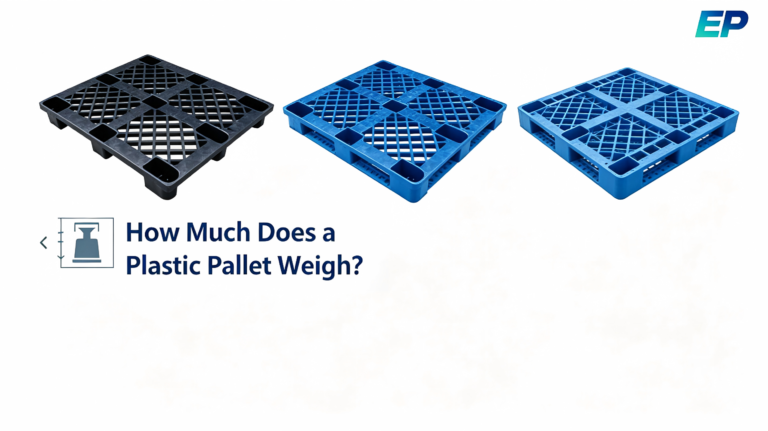
How Much Does a Plastic Pallet Weigh?
When Would I Consider Switching From Wood to Plastic?
I would consider a switch when a buyer has repeated problems with broken boards, moisture, splinters, cleaning, inconsistent dimensions, or export treatment.
I would also consider plastic when the company runs a closed-loop supply chain and can reuse the same pallets many times. In that case, the buyer can evaluate the cost over the full number of cycles rather than over the first purchase.
Plastic vs Wooden Pallets TCO Comparison Guide
What Are the Main Types of Plastic Pallets?
I classify plastic pallets in several ways because one classification alone does not explain how a pallet will work. I normally look at structure first, then size, material, manufacturing process, and application.
The main structural types include nine-leg, three-runner, six-runner, three-runner heavy-duty, and double-face pallets. I select among them based on floor storage, racking, automation, forklift entry, and load requirements.
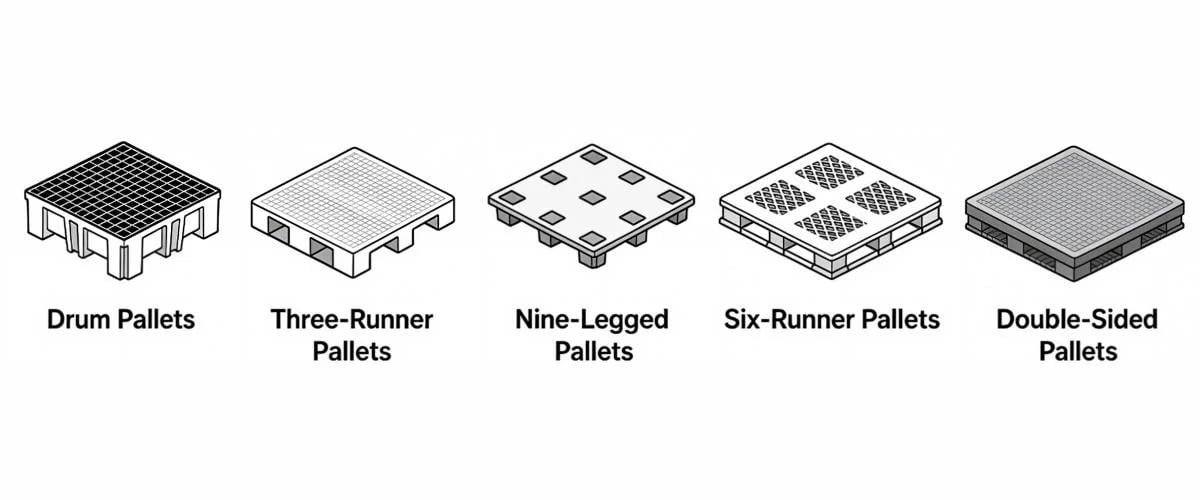
Nine-Leg Plastic Pallets
I use nine-leg pallets mainly for floor storage and general handling. Nine support feet spread under the pallet and allow four-way forklift or pallet-jack access on suitable designs.
Best for: floor storage, lightweight economical solution
- Grid-deck: airflow and drainage
- Flat-deck: bags, cartons, small products
Standard nine-leg not engineered for racking. Do not place across rack beams unless explicitly tested for rack load.
Three-Runner Pallets
I use three-runner pallets when racking, automation, or stronger longitudinal support becomes important. The three runners create a stronger support structure than a basic nine-leg design.
- Some models accept steel reinforcement to boost performance without excessive plastic thickness.
- Best for: rack storage, automated conveyor systems, medium-heavy loads
Six-Runner Pallets
I often see six-runner designs where buyers need more support across the pallet base. The extra runners improve load distribution and provide more support points for handling equipment or storage systems.
More runners do not automatically equal better performance. Real capacity depends on geometry and material.
Best for: improved load spread, medium-heavy duty warehouse cycles
Double-Face Pallets
I use double-face pallets for heavier applications where the pallet needs a stronger and more symmetrical structure. Both sides have similar structural design, suitable for specific stacking and handling operations.
Trade-off: higher weight and higher cost. Not recommended for simple light-load jobs.
Best for: heavy-duty stacking, port and container logistics
Drum Pallets and Special Designs
I also use special pallet designs for specific loads. Drum pallets can be designed around cylindrical containers and chemical or industrial handling needs. Other designs can include anti-slip surfaces, spill-control features, or special load supports.
I treat these as application-specific pallets rather than universal pallets.
Which Plastic Pallet Sizes Should I Consider?
I start pallet size selection with the load footprint and the logistics system. I then check the warehouse rack, forklift, truck, container, and destination market.
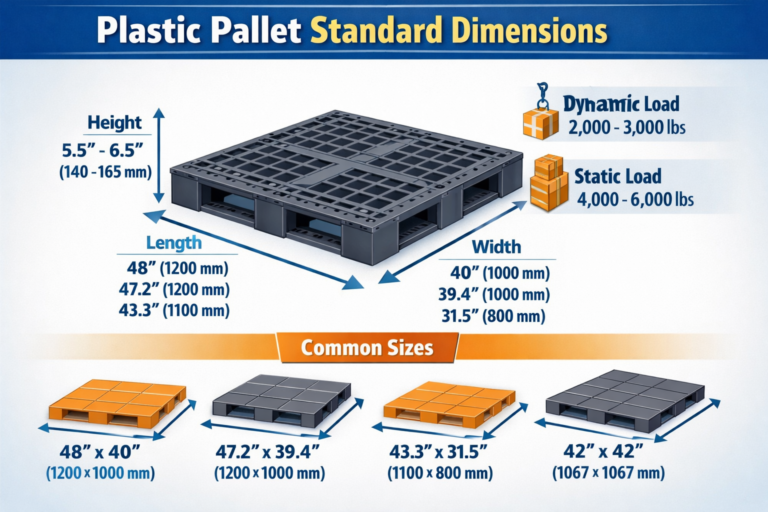
Common pallet footprints include 1200 x 800 mm Euro pallets, 1200 x 1000 mm industrial pallets, 48 x 40 inch North American pallets, 1100 x 1100 mm Asian pallets, and other regional standards.
Reference Resources
Common Pallet Footprints
| Pallet size | Typical market or use |
|---|---|
| 1200 x 800 mm | European logistics |
| 1200 x 1000 mm | Industrial and international applications |
| 48 x 40 in | North American logistics |
| 1067 x 1067 mm | International applications |
| 1100 x 1100 mm | Common in parts of Asia |
| Australian Standard sizes | Australian logistics |
I do not treat these dimensions as interchangeable. A 1200 x 800 mm pallet may work well with a European supply chain but create unused space in a system designed around 48 x 40 inch pallets.
Why Is the 1200 x 800 mm Euro Pallet Important?
I pay special attention to the 1200 x 800 mm format because it is widely associated with European logistics. It can fit established European handling and storage systems when the warehouse and transport equipment are designed around this footprint.
Euro Pallet 1200×800mm Dimensions & Plastic Options
I also check whether the buyer needs a Euro-style pallet for export, domestic distribution, racking, automation, or closed-loop pooling. The same footprint can have very different structural designs.
How Do I Check Container Efficiency?
| Question | What I check |
|---|---|
| Pallet footprint | Length x width |
| Container type | 20 ft, 40 ft, or 40 HC |
| Loading direction | Lengthwise or crosswise |
| Number of pallets | Based on actual loading pattern |
| Pallet weight | Added to cargo weight |
| Cargo overhang | Whether it is allowed |
| Fork access | Whether handling remains practical |
Container Loading Guide: How Many Pallets Fit in a Container
I never use a pallet count from a product page as the only planning number. I check the actual pallet dimensions, cargo dimensions, loading pattern, and container configuration before confirming a shipment plan.
Which Plastic Materials Are Used in Pallet Manufacturing?
I normally focus on HDPE and PP because they are common thermoplastics for pallet production. I choose the material based on temperature, impact, stiffness, chemical exposure, hygiene needs, and cost.
HDPE and PP are both common pallet materials, but I do not treat them as identical. HDPE is often useful when impact resistance and lower-temperature performance matter, while PP can offer useful stiffness and heat performance.
Thermosets vs Thermoplastics
I mainly work with thermoplastics for reusable pallet production because they can be processed by methods such as injection molding and can be recycled after their useful life.
Thermoset plastics behave differently because their material structure does not allow the same type of remelting and reshaping. For most mainstream plastic pallet applications, thermoplastic materials are the more relevant group.
Note: PVC and ABS are generally unsuitable for food-grade and cold-chain applications due to low-temp brittleness, food-safety concerns and recycling limitations.
HDPE vs PP
| Property | HDPE | PP |
|---|---|---|
| Impact resistance | Strong | Good |
| Low-temperature performance | Generally favorable | More limited |
| Rigidity | Good | High |
| Moisture resistance | High | High |
| Common pallet use | General and heavy-duty applications | Rigid and temperature-related applications |
| Recycling | Possible | Possible |
I often prefer HDPE when the pallet may face impact, moisture, or cold conditions. I may consider PP when stiffness and temperature requirements make it a better fit. In common cases, the 2 material can be mixed to achieve better cpacity.
What About Recycled Material?
I do not automatically treat recycled material as poor quality. The key issue is whether the material matches the application and the required performance.
For simple one-way export or general warehouse applications, a recycled-content pallet may be suitable. For demanding food, pharmaceutical, cold-chain, or automated applications, I check the material specification and required compliance more carefully.
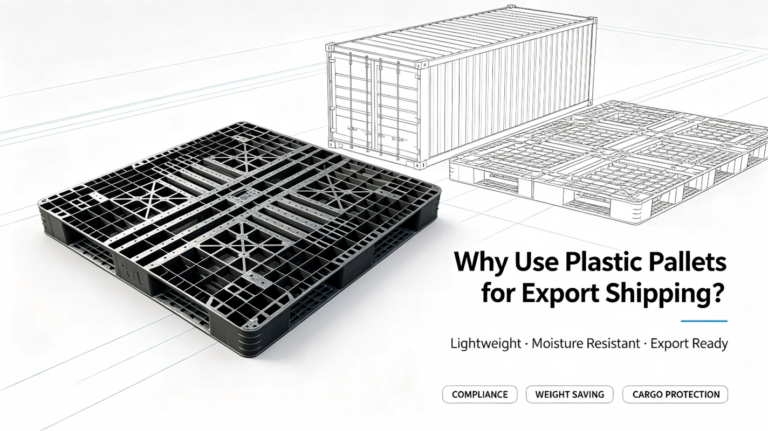
Export-focused Plastic Pallet Considerations
Which Plastic Pallet Types Fit Different Industries?
I choose the pallet after I understand the product, warehouse process, handling equipment, and compliance requirements. Industry names alone are not enough.
Food, pharmaceutical, automotive, electronics, CPG, cold-chain, and heavy-industry applications can use different pallet designs because their hygiene, temperature, load, handling, and automation requirements are different.
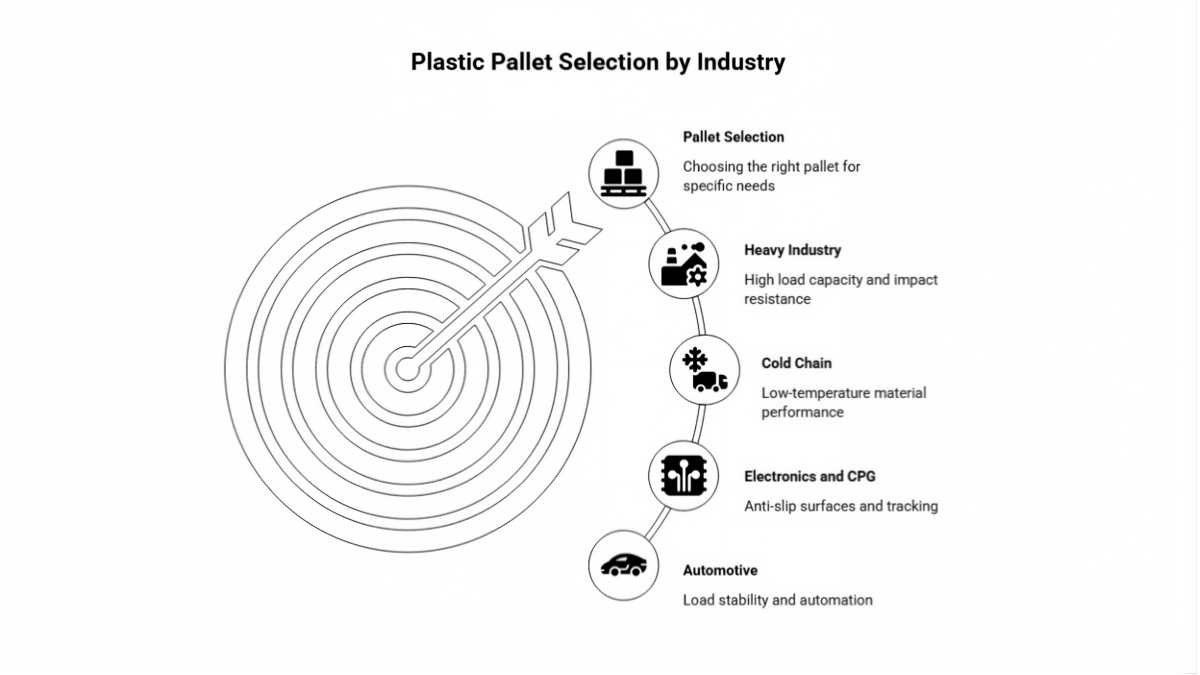
Food and Beverage
Easy cleaning, suitable materials, stable handling, correct deck design. Closed-deck for hygiene; ventilated for drainage / airflow. Check case footprint and total load.
How Many Cases of Beer Can a Pallet Hold
Pharmaceutical
High priority: hygiene, cleanability, material selection, traceability and documentation. Match pallet to cleaning and handling workflows.
Pharmaceutical Pallet Selection Guide
Automotive
Load stability, repeat handling, automation, dimensional consistency. Often requires custom structural features for components.
Electronics and CPG
Anti-slip surfaces, clean decks, tracking interfaces. Lightweight goods do not always mean light-spec pallets if automation is used.
Cold Chain
Focus on low-temperature material impact behaviour. HDPE is frequently preferred for cold repeated handling cycles.
Heavy Industry
Static / dynamic / rack load rating, impact resistance, handling frequency. Reinforced or double-face designs are often appropriate.
How Can I Customize a Plastic Pallet?
I treat customization as a design process rather than simply changing the pallet color. A useful custom pallet starts with the buyer’s load, handling system, and operating conditions.
I can customize pallet dimensions, colors, logos, molds, materials, structures, and load performance when the standard pallet does not match the buyer’s application.
What Can I Customize?
| Custom item | Typical purpose |
|---|---|
| Size | Match products, racks, trucks, or containers |
| Color | Product identification or brand coding |
| Logo | Asset identification and branding |
| Mold | Create a dedicated pallet geometry |
| Material | Match temperature and performance needs |
| Structure | Change runners, deck, supports, or features |
| Load capacity | Match static, dynamic, or rack requirements |
I first collect the basic application data: pallet size, cargo weight, loading pattern, handling equipment, storage method, temperature, and expected use cycle. I then check whether an existing model can meet the requirement. If it cannot, I move toward structural or mold customization.
How Does the Customization Process Work?
- Confirm real-world application conditions
- Define pallet dimensions and load requirements
- Select material and base structure
- Review design and mold requirements
- Arrange production and quality checks
Common pitfall: requesting custom design before defining operating conditions. Structure should follow application requirements.
What Manufacturing Capabilities Should I Check?
I believe buyers should understand who actually makes the pallet, not only what the product page says. Manufacturing equipment, quality control, customization capability, and documentation can all affect a long-term supply program.
Euro Plastic Pallet has more than 20 years of manufacturing experience and more than 60 injection molding and rotational molding machines for standard and customized plastic pallet solutions.
Manufacturing Experience
I use manufacturing experience as one part of supplier evaluation. It does not replace product testing, technical documentation, or quality checks, but it can show whether a supplier has experience with repeated production.
For customized pallets, I also look at whether the manufacturer can move from design requirements to mold production and repeat manufacturing.
Equipment and Production
Euro Plastic Pallet has more than 60 injection molding and rotational molding machines. This gives the manufacturer production options for different plastic logistics products and pallet structures.
Always confirm actual production capacity for your specific pallet model before large orders. General factory capacity ≠ capacity for one specific SKU.
Quality Control and Compliance
I consider quality control important because a pallet can look correct while still having a problem with dimensions, material, welds, reinforcement, or structural performance.
Relevant certifications and compliance documents may include ISO 9001, CE, REACH, RoHS, SGS, FDA, and GRS, depending on the product and application. I recommend that buyers confirm which document applies to the exact pallet and material they plan to purchase.
How Can I Compare Plastic Pallet Features?
I use a comparison matrix when several pallet types appear suitable. It helps me avoid choosing a pallet based on one attractive feature while ignoring the rest of the application.
I compare pallet types against rack use, automation, load level, forklift access, hygiene, temperature, deck design, weight, and intended reuse.
Industry Needs vs Pallet Features
| Application | Rackable | Hygiene | Cold resistance | Heavy load | Automation | Tracking |
|---|---|---|---|---|---|---|
| Food | Depends | High | Depends | Depends | Depends | Optional |
| Pharmaceutical | Depends | High | Depends | Depends | Often important | Useful |
| Automotive | Often | Medium | Depends | High | Often important | Useful |
| Electronics | Depends | High | Depends | Medium | Often important | Useful |
| CPG | Depends | Medium | Depends | Medium | Depends | Useful |
| Cold chain | Depends | High | High | Depends | Depends | Useful |
| Heavy industry | Often | Medium | Depends | High | Depends | Useful |
Pallet Type vs Function
| Pallet type | Floor storage | Racking | Four-way entry | Heavy load | Automation |
|---|---|---|---|---|---|
| Nine-leg | Yes | Generally no | Yes | Light to medium | Depends |
| Three-runner | Yes | Suitable designs | Depends | Medium to heavy | Good |
| Six-runner | Yes | Suitable designs | Depends | Medium to heavy | Good |
| Double-face | Yes | Suitable designs | Depends | Heavy | Depends |
| Custom pallet | Depends | Depends | Depends | Depends | Can be designed |
This matrix is a starting point, not replacement for load testing and technical specs. Real capacity is driven by model, material, reinforcement, load distribution and support spacing.
Load Capacity: Static, Dynamic & Racking Explained
How Should I Maintain a Plastic Pallet and Estimate Its Lifespan?
I treat maintenance as part of pallet management. A plastic pallet can last a long time, but rough handling, excessive loads, heat, cold, and poor storage can shorten its useful life.
I extend pallet service life by using the correct load, avoiding severe impact, cleaning the pallet properly, storing it correctly, and removing damaged pallets from service.
Cleaning and Disinfection
I clean pallets according to the requirements of the application. Food and pharmaceutical operations may need a controlled cleaning process, while general warehouse pallets may only need routine washing.
Step-by-step Plastic Pallet Cleaning Guide
I also inspect the deck, runners, feet, and reinforcement areas after cleaning. Dirt can hide cracks or damage, so inspection matters as much as cleaning.
Storage
I store pallets on a stable surface and avoid unnecessary exposure to conditions that are outside the material’s intended operating range.
I also avoid throwing or dropping pallets from height. Plastic is durable, but repeated impact can still damage a pallet over time.
Service Life
I do not give one universal lifespan number. The actual service life depends on material, structure, load, handling frequency, temperature, UV exposure, and maintenance.
A pallet used in a controlled warehouse can have a very different service life from one used outdoors with heavy loads and frequent forklift impacts.
Repair & Maintain Pallets Best Practices
Recycling
When a pallet reaches the end of its useful service life, I check whether it can be collected and recycled. Reusing a pallet for as long as it remains safe can also reduce material waste.
Important distinction: recyclability does NOT mean safe-to-use. Damaged pallets must be retired regardless of recyclable material.
What Should I Know Before Buying a Plastic Pallet?
I find that most pallet selection problems come from missing application information rather than from a lack of pallet choices.
Before I buy a plastic pallet, I confirm the pallet size, cargo weight, load type, storage method, handling equipment, operating temperature, hygiene requirements, and expected reuse cycle.
What Is the Load?
I first calculate the actual cargo weight and how that weight is distributed. A concentrated load can behave very differently from a uniformly distributed load.
I also separate static load, dynamic load, and rack load. These three numbers describe different operating conditions and should not be treated as interchangeable.
Will the Pallet Go on a Rack?
I ask this question early because it can eliminate unsuitable designs immediately.
A standard nine-leg pallet is mainly intended for floor storage and general handling. If I need racking, I select a pallet that is designed and specified for rack storage.
Will Automation Handle It?
If the pallet enters an automated warehouse, conveyor, or robotic handling system, I pay attention to dimensions, flatness, rigidity, entry points, and consistency.
A pallet can carry the required weight and still fail to work properly in an automated system if its geometry does not match the equipment.
What Is the Operating Environment?
I check temperature, moisture, chemicals, outdoor exposure, cleaning conditions, and impact frequency.
For cold environments, I pay special attention to material selection. For food and pharmaceutical applications, I focus more on hygiene, material traceability, cleaning, and required documentation.
FAQ: What Questions Do Buyers Ask About Plastic Pallets?
I often see buyers ask the same basic questions before placing an order. These questions usually come back to cost, lifespan, recycling, load capacity, customization, and selection.
Plastic pallets can cost more initially than basic wooden pallets, but the right reusable pallet can support repeated handling and lower some operating costs. Capacity and lifespan depend on the exact pallet design and application.
Are Plastic Pallets More Expensive Than Wooden Pallets?
I usually expect the initial purchase price of a plastic pallet to be higher than a basic wooden pallet. I then compare the expected reuse cycles, maintenance, cleaning, export requirements, and replacement rate to understand the total cost.
Read more: Plastic vs Wood TCO
What Is the Lifespan of a Plastic Pallet?
I do not use one fixed number for every pallet. Service life depends on material, structure, load, temperature, handling frequency, storage, and maintenance.
Read more: Extend Pallet Service Life
Are Plastic Pallets Recyclable?
Many plastic pallets can be recycled when the material is suitable and a recycling system is available. I check the material specification and local recycling route rather than assuming every pallet follows the same process.
What Load Capacity Can a Plastic Pallet Support?
I separate static, dynamic, and rack loads. The exact capacity depends on the pallet model, material, reinforcement, load distribution, and support conditions.
Read more: Load Capacity Explained
Can Plastic Pallets Be Customized?
Yes. I can customize dimensions, colors, logos, molds, materials, structural features, and load requirements when the project requires a dedicated design.
What Certifications Do Plastic Pallets Have?
The relevant documents depend on the product and application. Potential certifications or compliance documents can include ISO 9001, CE, REACH, RoHS, SGS, FDA, and GRS. I recommend confirming the exact document for the specific pallet being purchased.
How Do I Choose the Right Plastic Pallet?
I start with three questions: Will the pallet go on a rack? Will it enter an automated system? How heavy is the load? I then check size, material, temperature, hygiene, handling equipment, and reuse requirements.
Read more: Complete Buying Guide
Conclusion
I choose plastic pallets by matching structure, material, size, load, environment, and handling system, because the right pallet is the one that fits the actual job. If you need help selecting the right pallet for your application, contact us for a free consultation today.
My Role
Drawing on years‑long hands‑on experience across plastic pallet production, sales and after‑sales support, I help buyers selecting right plastic pallet types instead of choose only by cost.I prioritize matching pallet structures, materials and specifications to real‑world operational workflows — including racking conditions, automation systems, load profiles, operating temperature and hygiene rules. Lead to stable, long‑term supplier partnerships.
About Euro Plastic Pallet
Euro Plastic Pallet is a plastic pallet manufacturer with over 20 years of production experience, headquartered in China. We provide high-quality, customized plastic pallet solutions for brand owners, wholesalers, and distributors.
With 60+ injection/rotational molding machines, each staffed with quality control[^12] personnel having 5+ years of experience, we ensure consistent product quality.
Services
- Products: Complete plastic pallet solutions
- Customization: Custom colors, logos, and molds
- International Certifications: ISO 9001, CE, REACH, ROHS, SGS, FDA, GRS
Quality Assurance
- Raw Material Testing: Complies with RoHS, REACH standards, meeting international strength and performance requirements
- Precision Manufacturing: Automated injection molding, precision assembly, accuracy ±0.1mm
- Comprehensive Inspection: 100% factory testing, ISO 9001 sampling protocols ensuring high standards
- Certifications: ISO 9001, CE, REACH, ROHS, SGS, FDA standards compliance
Production Capacity
- High-Quality Manufacturing: 60+ injection/rotational molding machines following ISO 9001
- Premium Customization: Customized solutions for global brands
- Flexible Solutions: Customer-specific customization[^17] enhancing market competitiveness
Global Impact
Serving global customers with reliable plastic pallets[^1] and customized logistics packaging solutions[^18], supporting business growth and customer trust.